Iphigenia
Hallowe'en PartyIphigenia is the pencilled inscription that turns Michael Garfield’s drawing into evidence of how he understood his plan to sacrifice his daughter. When Judith reads the word aloud, Poirot connects it to Agamemnon and the sacrifice of a daughter for a desired end. The allusion makes Michael’s vision of a new Garden of Eden inseparable from the intended killing that would serve it.
The word on the drawing
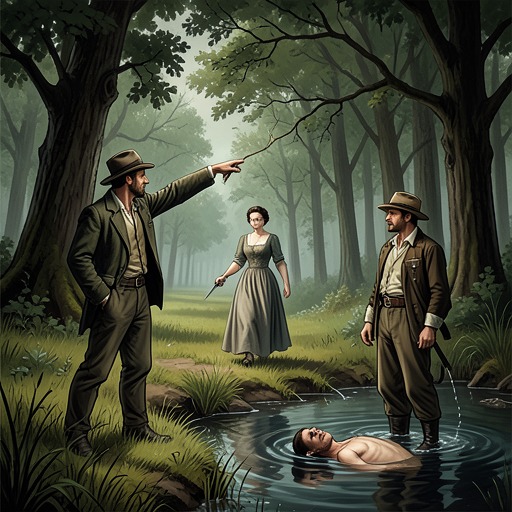
The drawing is signed Michael Garfield and depicts a girl by the stream in Quarry Wood. Poirot explains that Michael made it because he feared forgetting her; the drawing was a way to hold the image in memory. But the pencilled name in the upper left corner changes what the picture means. At Poirot’s prompting, Judith spells it out slowly: Iphigenia. The name is not merely an identification of the girl in the image. It supplies a story through which the drawing, its maker, and the intended violence can be read together.
The placement matters. The name is written across the drawing’s upper left corner, set apart from the signature that identifies its maker. One inscription says who drew the image; the other directs its interpretation. The girl is preserved on paper as an individual Michael was afraid of forgetting, yet the mythic name also makes her legible as a prospective victim. The drawing therefore holds two impulses in tension: remembrance of the girl and the conversion of her into a figure within Michael’s imagined design.
Poirot’s mythic comparison
Poirot spells out the reference by recalling Agamemnon’s sacrifice of his daughter so that a wind would carry his ships to Troy. He then applies that structure to Michael: Michael, he says, would have sacrificed his daughter to obtain a new Garden of Eden. The comparison is specific to the passage’s account of both motives. In each case, the daughter’s life is made subordinate to a larger undertaking desired by her father; a personal victim becomes the price of an ambition presented as serving a greater purpose.
The difference in the desired outcomes sharpens the parallel. Agamemnon’s sacrifice is linked to the voyage to Troy, while Michael’s imagined reward is a renewed paradise. The contrast does not soften Michael’s act. Instead, it exposes the extremity of his vision: the Garden of Eden is not simply an ideal setting, because its creation is imagined as requiring the destruction of someone close to him. Iphigenia names the disturbing logic by which the aspiration to create something ideal can turn a daughter into its cost.
Art, memory, and intended violence
The allusion also changes the significance of Michael’s drawing. His stated reason for making it was fear of forgetting the girl, and Poirot acknowledges that the drawing preserves this fear of loss. Yet remembering her would not, he says, have stopped Michael from killing her. That distinction prevents the picture from serving as proof of tenderness or as an assurance of restraint. The image may preserve the girl’s appearance while its inscription places her inside a fatal pattern.
The drawing thus brings memory and violence into close proximity without resolving their contradiction. Michael’s wish not to forget the girl coexists with his willingness to sacrifice her; the act of depicting her does not undo that willingness. By reading the title against the image, Poirot interprets the drawing as more than a record of someone seen beside the stream. It becomes evidence of the scheme’s human price and of the imaginative justification attached to it. The classical name gives a recognizable form to that conflict, while the particular image keeps the threatened daughter present as a person Michael had looked at and drawn.
The question left open
Judith responds to Poirot’s comparison by saying that Michael knew what he was doing, then wonders whether he would ever have felt regret. Her question introduces a distinction between awareness and remorse: the allusion suggests deliberate sacrifice, but it does not settle what Michael might have felt afterward. Poirot does not answer. Instead, the narrative turns to the image of Michael dead beside the megalithic stone marked with a double axe, still holding the golden goblet he seized and drained when retribution came, saving his victim and delivering him to justice.
That ending places the allusion beside the consequences of Michael’s intended sacrifice. His project does not culminate in the Garden of Eden he imagined; retribution interrupts it and saves the intended victim. Iphigenia therefore functions as a compact interpretive key, not a claim that the modern events literally repeat the ancient story. It identifies the logic of Michael’s plan, while the unanswered question about regret leaves his inner life unresolved. The word makes the threatened sacrifice intelligible; the ending makes clear that it is thwarted.