Michael Garfield's pathological obsession with beauty
Hallowe'en PartyMichael Garfield's pathological obsession with beauty is presented as a creative vision that has become an excuse for ruthlessness. He can imagine gardens on a scale far beyond the ordinary, but the same imaginative power that gives those gardens form also reduces people to instruments: Rowena Drake is a source of money, and Miranda Butler is someone he is prepared to sacrifice to save himself.
The cultivation of an obsession
Hercule Poirot describes the danger confronting the investigation as more than greed alone. It combines ruthlessness, rapid reactions, and greed pushed beyond what he considers a human limit, with a possible touch of madness that was not present originally but had been cultivated. His image of a seed taking root and growing until it takes charge offers a model for understanding Michael: the obsession is not represented simply as a fixed, inexplicable condition, but as a drive that develops until it governs the person who serves it.
That description also conveys the investigators' sense of peril. Protective measures have been taken, yet Poirot admits to being frightened. He believes the opposition's speed and lack of restraint make ordinary caution insufficient. In retrospect, this warning gives the garden-making ambition a darker context: the danger lies not only in what Michael wants to create, but in the expanding authority that desire has acquired over his judgment.
Beauty as purpose and instrument
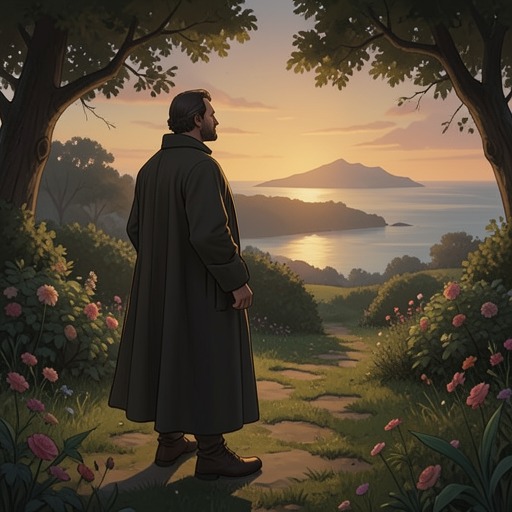
When Ariadne Oliver finds it hard to believe that someone could commit murder merely to make a garden on a Greek island, Poirot reconstructs the attraction of the imagined project. Michael could picture bare rock reshaped to hold possibilities, covered with cargoes of fertile earth, then planted with seeds, shrubs, and trees. The vision moves from a specific landscape to a whole island of beauty. Its scale matters: creation is no longer a task within the world, but a project for which the world and its inhabitants can be made subordinate.
Poirot suggests that Michael may have encountered a newspaper account of a shipping millionaire who created an island garden for the woman he loved. From that example, Michael conceived of making an island garden for himself. This is presented as Poirot's reconstruction, not as a confirmed account of Michael's reading. Its importance is the shift in the imagined purpose of the garden: the model of a gift to another person becomes a work made for the creator's own satisfaction.
The desire is tied to tangible sources of money. Rowena Drake is infatuated with Michael, but Poirot says that, to him, she meant the funds with which he could create beauty. The relationship is thus described through a stark imbalance: her attachment does not make her an equal partner in his vision; it makes her useful to it. Poirot further speculates that an accident might eventually have happened to Rowena. He presents this as a possibility, not as an event that occurred, and it reinforces the frightening implication that Michael's pursuit of beauty could place even his living source of money in danger.
The planned sacrifice of Miranda
Michael's clearest expression of this instrumental logic is his plan for Miranda Butler. Poirot says that Michael loved the child in his own way, but was nevertheless ready to sacrifice her to save himself. The qualification does not soften the consequence: whatever affection existed was no protection against a plan that placed his survival first.
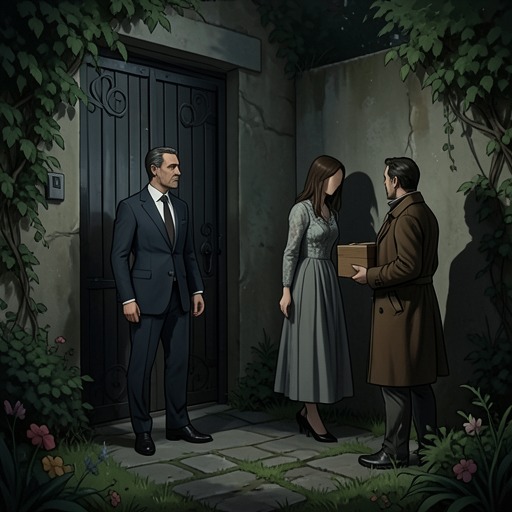
The plan was carefully staged as a ritual. Michael instructed Miranda to tell him if she were leaving Woodleigh Common and to meet him at the inn where Ariadne Oliver and Judith Butler had lunched. He intended her to be found on Kilterbury Ring beside the sign of the double axe, with a golden goblet at her side. Poirot describes the arrangement as a ritual sacrifice, and says Michael had indoctrinated Miranda with the idea. The imagined ceremony would make a child's death appear to belong to an ordered symbolic design; in reality, the ritual form served Michael's attempt to save himself. Miranda's safety, confirmed by Poirot, is the decisive limit placed on his design.
Recognition and significance
Hercule Poirot explains that Michael fitted the pattern of suspicion, but that their final conversation made him certain. Michael laughed and told him, 'Get thee beyond me, Satan. Go and join your police friends.' Poirot recognized the words as a reversal: rather than accepting Michael's dismissal, he understood himself as leaving Michael behind. The exchange supplies the moment of recognition through which the beautiful, charming artist becomes legible as the danger Poirot has been tracing.
The image of Lucifer makes the contrast explicit. When another woman in the room identifies him with Lucifer, Poirot agrees that Michael was very beautiful. He connects that beauty to the work of his brain, imagination, and hands, then to the willingness to sacrifice everything to it. Beauty is therefore neither dismissed as false nor treated as an innocent virtue: Michael genuinely makes beautiful things, but his devotion has become destructive because it sets creation above human life. Poirot's closing allusion, 'Whom the gods destroy, they first drive mad,' frames that transformation as a ruinous extremity. The obsession that began in the capacity to imagine a garden ends in a scheme to turn a child into its ritual victim.