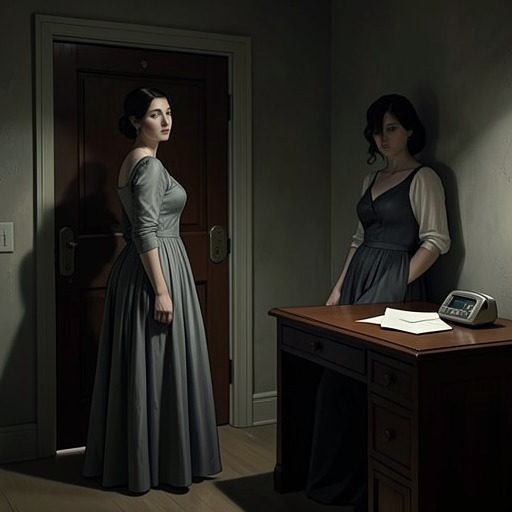
Olga Seminoff's missing-person status
Hallowe'en PartyOlga Seminoff’s missing-person status turns a disputed inheritance into an unresolved human absence: after a codicil leaves her Mrs Llewellyn-Smythe’s fortune, she disappears just as lawyers prepare to challenge it. Her disappearance initially looks like flight from prosecution, but the later discovery of a murdered woman in a well transforms the question of where she went into a question of who killed her.
Identity and the Inheritance Dispute
For years, Mrs Llewellyn-Smythe’s testamentary arrangements had followed a familiar pattern. Her estate went principally to her nephew, Hugo Drake, and his wife, Rowena Drake, who was also Mrs Llewellyn-Smythe’s cousin and niece. Charitable bequests and gifts to old servants could change, but the central disposition remained stable. A new codicil, made about three weeks before Mrs Llewellyn-Smythe’s death, broke sharply with that history: it left the residue of her considerable fortune to Olga, in gratitude for her service and affection.
Olga was not an implausible beneficiary simply because she was a servant. Mrs Llewellyn-Smythe disliked using a typewriter and had often asked Olga to write personal letters, copying her employer’s handwriting. Olga had even signed some letters with Mrs Llewellyn-Smythe’s signature. That practice gave her unusual familiarity with the handwriting—and, in the view later reported by the solicitor Jeremy Fullerton, the opportunity to imitate it. But the same fact that made the bequest possible to forge also made Olga a natural focus of suspicion.
Disappearance as Legal Challenge Approaches
Handwriting experts concluded that the codicil submitted for probate was a complete forgery: it bore only a faint resemblance to Mrs Llewellyn-Smythe’s writing. The lawyers had noticed the problem quickly, and legal proceedings to contest the document were being prepared. A delay before the case could reach court gave Olga time to disappear; Fullerton recalls that she lost her nerve and was gone before the challenge proceeded. Her absence therefore follows the exposure of the document and the approach of formal legal scrutiny, rather than preceding them.
Fullerton later imagines her back in a trouble-stricken part of Central Europe, where she had come from and, as he supposes, had been driven to return because she saw no alternative if she wished to avoid losing her liberty. This is his conjecture, not confirmation of her whereabouts. He wonders how she managed to leave and whether anyone helped her, while acknowledging that he does not know. His belief in the law coexists with compassion for Olga: he feels sorry for her, although her passionate arguments in her own defense had not persuaded him.
The Codicil and the Unsettled Evidence
The forgery did not settle whether Mrs Llewellyn-Smythe had ever made a genuine codicil. Harriet Leaman recounts seeing her employer write on a paper presented as a will, sign it, and ask Harriet and a young garden worker, Jim, to add their names and addresses as witnesses. Mrs Llewellyn-Smythe had covered the upper part of the paper with blotting paper, and had first sent Olga out of the room, saying she must not be involved in that part of the business. Harriet’s recollection thus describes a document distinct from the forged codicil that was later submitted for probate.
The witness details sharpen that distinction. According to Fullerton, the forged probate document named Mary Doherty, a former servant who had died, and James Jenkins, the garden worker who had gone to Australia—not Harriet and Jim as witnesses. Harriet’s story could therefore point to a real codicil without authenticating the forged one. Her memory also explains why suspicion gathers around Olga without proving that she forged the document or caused Mrs Llewellyn-Smythe’s death.
Harriet herself connects Olga’s disappearance to the inheritance and to a separate murder. After Joyce Reynolds was killed, Harriet feared that Olga might have murdered Mrs Llewellyn-Smythe for the money, then fled when lawyers and police began asking questions. Harriet says she had heard Joyce speak of knowing something about a murder, and her anxiety about what she had seen while dusting a bookshelf prompts her to seek help. This is explicitly her suspicion, not a finding. The account makes Olga’s absence seem incriminating while also showing how fear, uncertain recollection, and several different deaths become entangled in the story.
Discovery and the End of the Missing-Person Status
The search’s apparent answer comes with the discovery of a body in the well. Asked whether it is the missing au pair girl, Elspeth McKay is told that it seems to be. The death is not suicide: the woman was knifed, and the police identify it as murder. The initial wording preserves a measure of uncertainty about identification, but the discovery changes the meaning of Olga’s disappearance. What had looked like flight from the threatened legal contest now appears to have ended in her death and the concealment of her body.
The status therefore closes not with a confirmed account of Olga’s route or an explanation of how she vanished, but with the recovery of a murdered woman believed to be her. The codicil remains important to the suspicion surrounding her, yet the distinction between the forged probate document and Harriet’s account of a separate document prevents the inheritance evidence from serving as a simple explanation. Olga’s absence links the legal puzzle to the murder investigation: her disappearance first invites judgment, then becomes evidence of a crime whose full circumstances remain to be established.