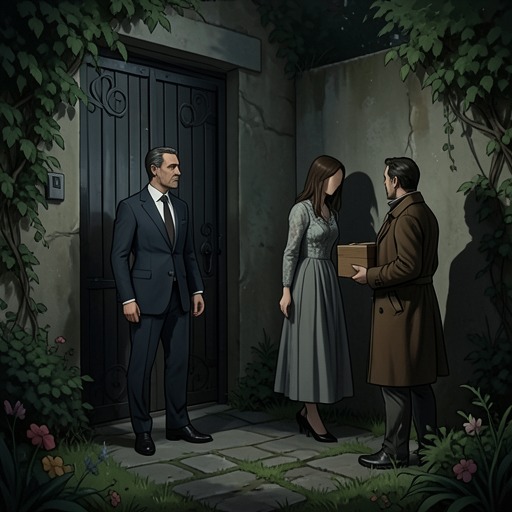
The Green Swan
Hallowe'en PartyThe Green Swan is an unpretentious pub at Woodleigh Common, but its local importance in the novel comes from the unresolved stabbing of Lesley Ferrier near its premises. The pub is where accounts of Ferrier’s relationships and a reported quarrel converge, making it a social landmark in the investigation as well as a place associated with violence. Yet its apparent usefulness as a clue is matched by uncertainty: the weapon was never found, no arrest followed, and suspicion did not settle conclusively on either the landlord or his wife.
Setting and Local Character
The Green Swan is described as an unpretentious establishment at Woodleigh Common. The evidence gives no elaborate portrait of its interior or business, instead defining the place through its landlord, its patrons’ knowledge of one another, and the incidents attached to it. It functions as a recognisable local meeting place: personal relationships become public talk there, and a quarrel at the pub can be recalled later as part of the circumstances preceding a killing.
The pub’s ordinary character sharpens the contrast between everyday sociability and the violence associated with it. Ferrier was stabbed on his way home after a row one night at the Green Swan. The account places the crime near the pub, not inside it; the distinction matters because the establishment supplies the social context and the last reported conflict, while the actual attack remains unwitnessed. The Green Swan is therefore central to the story of the murder without being identified as the exact scene of the stabbing.
Ferrier and the Pub’s Social World
Ferrier was a young man employed as a junior clerk in a Medchester solicitor’s office, Fullerton, Harrison and Leadbetter. He was remembered as good-looking, handled clients well, and was studying for his articles. His employer’s retrospective assessment was qualified: Ferrier had strengths, but did not always maintain the standard of conduct expected of him. That judgment sits alongside reports that he was involved with one woman after another, making his private life a subject of local discussion as well as a possible source of conflict.
The most consequential reported relationship connected Ferrier to the Green Swan’s landlord, Harry Griffin. Ferrier was said to have been having an affair with Griffin’s wife. He was also said to have broken with her and taken up with another young woman, whose identity was never satisfactorily discovered. The sequence is presented through recollection and hearsay rather than a fully established account, so the details suggest a possible emotional motive without proving what happened between the people involved. The pub’s social network supplies names, allegations, and a possible quarrel, but not certainty.
The Stabbing and Competing Suspicions
Ferrier was stabbed in the back near the Green Swan and was found dead after the attack. A row at the pub was recalled as preceding the stabbing on his way home. The knife was not found, leaving the investigation without the weapon and without a direct account of the assault. No one was known to have seen it happen, and no arrest was made. The police were thought to have had some idea who might be responsible, but obtaining evidence remained the difficulty.
Both the landlord and his wife were considered possible suspects. The wife was described as the more likely of the two by one account, partly through a characterization of her as temperamental; the landlord remained a possibility as well. These judgments are explicitly tentative. Ferrier’s reported affair, his alleged change of partner, and the quarrel at the pub form a plausible jealousy narrative, but the missing weapon, lack of a known witness, and absence of an arrest prevent that narrative from becoming a demonstrated solution. Other possibilities also remained open, particularly because Ferrier’s own conduct and relationships were described as complicated.
Recollection and Narrative Function
The Green Swan returns in later conversations as investigators and acquaintances reconstruct an old case. One speaker initially struggles to remember Ferrier’s name, then recalls that he was knifed near the pub and that no arrest followed. Another recollection supplies the affair, the husband’s occupation as a publican, Ferrier’s involvement with other women, and the quarrel on the night of the murder. These accounts gradually build a setting around the crime, but their qualifications—what was said, what was thought likely, and what remained unknown—keep the reader alert to the difference between local reputation and proof.
The possibility of an unlikely witness also emerges in discussion of the case. Hercule Poirot imagines that a child might have been coming home from a friend’s house, using a footpath or looking from behind a hedge, and might have seen something near the Green Swan. The response is sceptical, emphasizing how late the hour was and how improbable a child’s presence seemed. This remains a hypothesis, not evidence that any child witnessed the stabbing. The exchange nonetheless shows how the pub’s surroundings matter to the investigation: paths, hedges, and the route home offer possible lines of sight where the known adult witnesses had failed to provide an answer. The Green Swan thus anchors a chain of recollections and suspicions, while the decisive event remains just beyond what those recollections can establish.