The Past Shaping the Present
Hallowe'en PartyThe Past Shaping the Present is the principle that gives apparently separate crimes their hidden continuity: what happens now may be the consequence of an older crime, a witness’s memory, or a secret that someone believed safely buried. Hercule Poirot turns the investigation away from the immediate scene and toward the dates and relationships connecting it to earlier events. In doing so, he shows that the present is not a self-contained moment but a surface on which the past continues to act.
From the Immediate Event to Its Earlier Causes
At first, Ariadne Oliver sees little relevance in dates. The recent event under discussion took place only days earlier, and she doubts that such a short span of time could explain what happened. Poirot answers by distinguishing the date of a present crime from the history that made it possible: each event has a past, already incorporated into the present, even if that past lies a year, two years, or further back. His point is not simply that chronology should be checked. A date can connect a present death to a long-hidden event and establish when a witness acquired dangerous knowledge.
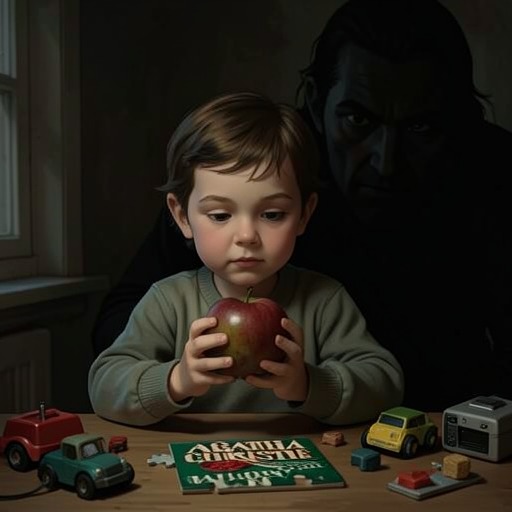
Poirot makes this temporal reversal explicit by imagining a child who saw a murder on a particular date years earlier. The child’s observation belongs to the past, but its consequences arrive in the present: the child dies only four days before the conversation. The sequence transforms what might look like a random, recent killing into the possible end of a delayed chain. Oliver recognizes the method when she observes that the facts are leading backward rather than remaining at the scene or moving forward. The backward movement is not a digression from the case; it is the route by which its present becomes explainable.
Old Crimes and the Forgery
The forged codicil provides a concrete test of that method. The accepted account was that an au pair girl had become so dear to a wealthy, elderly widow that the widow left her money in a will or codicil. Poirot reopens the question of who forged the document instead of accepting the apparent beneficiary as its author. He points to a local man who had practised forgery, lived in the area, and died about two years earlier. The exact date of his death remains unknown to Poirot at this stage, but he insists that he will need to establish it. The man had been knifed after a dispute involving a woman and jealousy; Poirot suspects that this death and other separated incidents may be more closely connected than anyone has supposed, while allowing that not every incident will necessarily belong to the same chain.
The later reconstruction shows how the forgery was designed to produce consequences beyond the document itself. Mrs Llewellyn-Smythe had hidden the original, so Lesley Ferrier was paid to create a similar but conspicuously false document. Its obvious defects made suspicion likely to fall on Olga Seminoff, whose ability to copy her employer’s handwriting could be used against her. Olga did not need to be convicted: suspicion, followed by her disappearance, could make her seem both the forger and a possible accomplice in the widow’s death. The past was therefore being shaped into a weapon in the present, with a forged record intended to make an old disappearance look like the solution to a new financial question.
Witnesses, Clues, and the Return of the Past
Poirot’s account links the scheme to Michael Garfield and Rowena Drake. He concludes that Michael, rather than Lesley, had introduced the suggestion that Lesley and Olga were lovers, and that Michael paid Lesley. Michael had pursued Olga’s affections, urged her to keep quiet, and spoken of possible marriage while treating her as someone who could be sacrificed so that he and Rowena might obtain the money. The proposed future marriage thus sits beside a concealed plan to make Olga a scapegoat. The contrast exposes how the language of intimacy and the machinery of the fraud served opposing purposes.
Olga’s body, too, remained part of the buried past. Poirot knew it had to be hidden in the neighbourhood but did not know where until Miranda Butler asked Michael to take her to a wishing well and he refused. Later, Mrs Goodbody’s recitation of the nursery rhyme about a cat in a well supplied the decisive association. Poirot became sure that Olga’s body was in the wishing well and found it in Quarry Wood, on an incline not far from Michael’s cottage. A casual question and a familiar rhyme acquire investigative force because they bring an old, concealed crime into the present. Poirot further reasons that Miranda may have seen either the killing or the later disposal of the body; Michael and Rowena feared that there had been a witness but did not know who it was.
The Past Reasserts Itself
For a time, the conspirators were lulled into security because nothing seemed to follow the suspected witnessing. Rowena spoke of buying land abroad and encouraged the impression that she wished to leave Woodleigh Common, attributing that wish to grief over her husband’s death. Then came Hallowe'en and Joyce Reynolds’s sudden assertion that she had witnessed a murder. Rowena believed, or thought she knew, who had been in the wood; the past had returned not as a complete account but as a threat that demanded immediate action. When Joyce’s brother Leopold later asked for money, Rowena and Michael may have assumed that he knew more than he did. He, too, died. In Poirot’s reconstruction, the present killings arise from attempts to control what earlier crimes left behind: a document, a body, and the possibility of a witness.
The concept also clarifies why Poirot resists explanations that treat a killing as merely a mentally disturbed person’s random act. That possibility exists in Oliver’s speculation, but Poirot’s investigation instead tests how older events might account for the present one. His conclusion remains measured: several incidents may connect, not necessarily all of them. The past is neither a vague atmosphere nor an automatic explanation. It becomes legible through dates, identities, objects, and the consequences of what people did—and believed they had concealed. The investigation’s backward reach reveals the present as the accumulated result of decisions made long before the latest death.