Zinc iron bucket
Hallowe'en PartyThe galvanised bucket begins as an ordinary piece of party equipment, selected because it will stay upright during apple-bobbing. It becomes the instrument used to drown Joyce Reynolds, and later a physical clue: its water, weight and position help turn a familiar Hallowe’en activity into a reconstruction of the killing.
Selection for the party
While preparations are under way, Mrs Hargreaves brings in a large green plastic pail. Miss Lee, the doctor’s dispenser, recommends a galvanised bucket instead, judging that it will not tip over so easily. Rowena Drake plans to hold the apple-bobbing in the library, where the carpet is already old and often gets wet. The choice is practical on both sides: the party needs a stable container, and the room is treated as a place where spilled water will do relatively little additional harm.
The bucket is not simply accepted without comparison. When Joyce Reynolds mentions an incident from years earlier but refuses to tell the other children about it, Miss Lee brings in another type of bucket, and the conversation turns back to which vessel suits the game. Helpers go to the library to inspect the alternatives; some of the younger guests rehearse the bobbing. Hair gets wet, water spills, and towels are fetched. After this trial, the galvanised bucket is preferred to the more showy plastic pail, which overturns too readily. Ariadne Oliver carries in more apples and takes one for herself, placing the selected bucket amid the bustle of preparation and the recurring apple motif.
The bucket at the scene of the crime
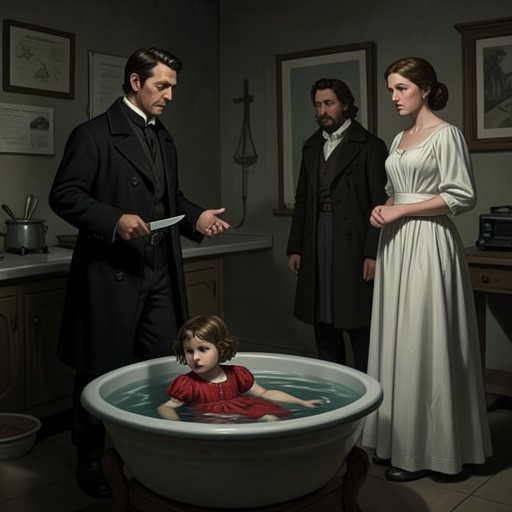
The container’s reliability acquires a grim consequence. Ariadne Oliver later recounts that Joyce Reynolds was found in the library, where the bobbing had taken place. A large galvanised bucket was there, nearly full of water. Joyce had been kneeling as though reaching for an apple when someone forced her head down into the water and held her there until she drowned. The equipment chosen to keep the game steady thus becomes the means by which Joyce is kept submerged.
In recalling the discovery, Ariadne Oliver focuses on the difference between the two containers. She wonders whether a plastic pail might have tipped over and whether, if it had, the killing might not have happened in the same way. This remains her speculation, not a settled explanation of what would have occurred. But the contrast gives the choice of bucket a disturbing weight: the very quality that recommended it for a children’s game—its resistance to overturning—also made it capable of holding water while Joyce was forced beneath the surface.
Water, weight and reconstruction
When Rowena Drake shows Hercule Poirot the library, she identifies the spot where the bucket had stood, on a plastic sheet. Ariadne Oliver cannot enter the room; she waits in the hall because the place makes her think too strongly of the murder. Her response makes the room’s ordinary furnishings recede, while the remembered bucket and its water remain central to the scene.
Poirot asks about the water around the container. Rowena confirms that there had been water both in the bucket and on the sheet. Poirot reasons that if Joyce’s head was pushed beneath the surface, water would have splashed out, and asks whether the person who did it would therefore have become wet. Rowena agrees that this seems likely. The earlier rehearsal supplies a concrete point of comparison: even before the murder, the bucket needed to be filled once or twice during the bobbing. The water was not incidental to the game, and in the investigation it becomes evidence of the physical actions the killing required.
Narrative significance
The bucket changes function without changing form. First it is a sensible choice among party supplies, judged against a plastic pail by how securely it stands; then it is the vessel in which Joyce Reynolds is drowned; finally, its water and placement provide a basis for questioning how the crime was carried out. Its material steadiness links preparation, murder and investigation, giving an everyday object a consequential role without making it anything other than a bucket.
For Ariadne Oliver, the association becomes personal as well as evidential. After describing Joyce’s death, she says she hates apples and never wants to see one again; later, she cannot bear to enter the library. The bucket belongs to the same chain of memory as the apples, the water and the room. What had been a practical object for a seasonal party is left inseparable from the violence that took place there.