Shakespeare's theatre company
HamnetShakespeare's theatre company is William Shakespeare’s working community and a fragile professional world whose performances turn private writing into shared experience. For William, it offers both the livelihood he fears losing and the craft through which he can shelter from bereavement; in Hamlet, the company’s actors and stage give Agnes a way to see Hamnet’s remembered gestures return in another body.
Identity and precarious livelihood
The company is presented through William’s dependence on it, rather than through a formal account of its structure. While back in Stratford after Hamnet’s death, he fears that grief may prevent him from returning to London and destroy what he has built there. Without him, he imagines, the company might fall into disorder, lose money, or fail to have a new play ready for the next season; it might also find another writer whose work eclipses his. These are his fears, not confirmed events, but they reveal how uncertain he believes theatrical success to be.
He compares the visible beauty of the company’s work to the embroidery on his father’s gloves: the audience sees only the finished surface, while behind it lies a complicated structure of labor, skill, frustration, and sweat. William feels he must remain present to ensure that everything required for a production is in place. The comparison connects his father’s trade to the hidden work of the theatre and makes the company’s apparent spectacle inseparable from the labor that supports it.
Repertory as shelter
The company performs histories and comedies as well as the later tragedy of Hamlet. After a court performance of a history play about a long-dead king, William recognizes that the distant past can be safe material: its battles and court scenes do not carry him into memories he cannot bear. He can continue working in these forms and, for a time, forget who he is and what has happened. The repertory is therefore not merely a sequence of genres; for him, it offers a refuge from grief.
That refuge has limits. The memories that threaten to break into his thoughts include a shrouded body, a child’s clothes left on a chair, a grieving woman, and a lock of blond hair preserved in a small jar. At night, even among the audience, he searches for Hamnet’s face, unable to accept that his son has disappeared. The company can give William a place to work and a means of temporary escape, but it cannot remove the loss that follows him into the theatre.
Work, rehearsal, and transformation
The company’s performance depends on the passage from written verse to practiced speech and embodied action. William has spent week after week writing, often scarcely leaving his room, eating little, or speaking with anyone. Hearing the actors recite his lines, he alternates between believing the play has come close to his intention and fearing that it has missed entirely. He cannot settle the question by private judgment; he can only write and hope that some of his efforts will reach their mark.
Before a performance, the actors prepare through visible transformations. William will exchange ordinary clothes for a costume, paint his cheeks, nose, and beard with chalk and lime, darken his eye sockets and eyebrows with charcoal, and put on such pieces as a breastplate, helmet, or shroud. He waits for his cue, follows the verses, and enters the light to embody another person. The company’s theatre thus makes identity a practical, repeated act: the actor’s body, clothing, and timing carry the written role before an audience.
The theatre as a working space
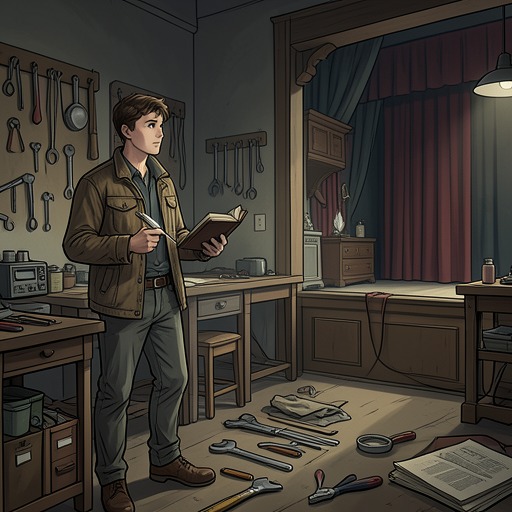
At the playhouse, William keeps a small opening behind the musicians’ gallery, in the tiring-house area, from which he can see the whole theatre. His fellow actors know the habit and leave that patch of window clear of costumes and accessories. They assume he watches to estimate the arriving crowd and the likely takings; the account makes clear that this is not his purpose.
From the opening, he can look down at the stage, watch the circular space gradually fill with spectators, and sense the actors behind him changing into spirits, princes, soldiers, ladies, or monsters. The position lets him be alone amid the company and its audience, set apart as an observer. Below, spectators call out, greet one another, and buy nuts or sweets; behind him, actors curse, laugh, search for a missing sword, and prepare to go on. The scene places theatrical imagination alongside the noisy, practical business of a live performance.
Hamlet and the company’s act of remembrance
When Agnes reaches the theatre, trumpets sound, the crowd falls quiet, and two actors enter the stage. She has momentarily forgotten that she came to see a play; then she recognizes that the men are speaking of a feared and desired apparition. The audience’s shared attention gives way to concentrated watching as the Ghost appears in armor, with its visor closed and a shroud partly around it.
Agnes studies the Ghost’s height, the movement of its arm, the way its fingers bend, and the motion of its shoulder. The costume does not deceive her: she knows that William is beneath it. Onstage, the young Hamlet resembles Hamnet in his manner and gestures, though the actor never knew the child. Agnes understands that William has taught the actor how to speak and move, and has written the words he must say and hear. The company’s performance brings her husband’s careful making together with her own recognition of Hamnet, without making the actor literally her son.
As the play continues, Agnes moves toward the stage, drawn by the young Hamlet’s distress and by the familiar impulse to comfort him. At the front, she stands within a short distance of the actor playing Hamlet and William as the Ghost. When the Ghost turns toward her and holds her gaze before leaving the stage, the theatrical boundary becomes the scene’s emotional focus: Agnes reaches toward the air between them, where memory, performance, and living bodies meet. Shakespeare's theatre company does not undo Hamnet’s death; it gives his absence a form that Agnes can face, and lets William’s work communicate what he has not managed to tell her directly.