David Zetterberg
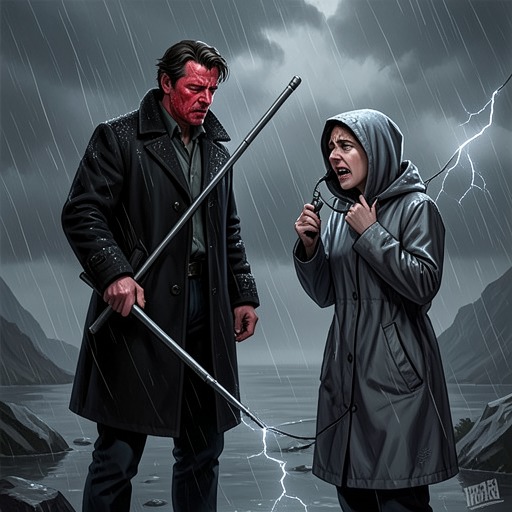
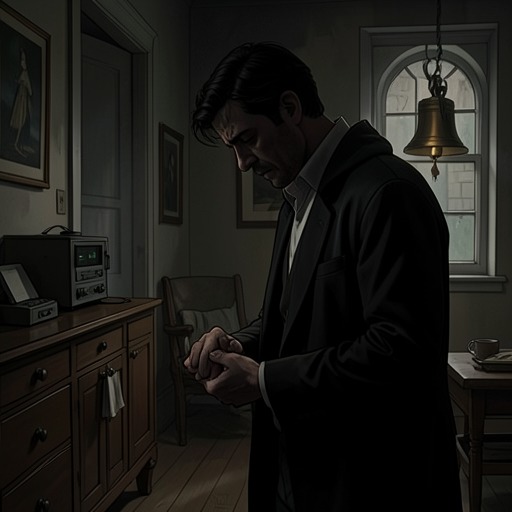
Handling the UndeadDavid Zetterberg’s story turns on the difference between loving someone and being able to keep them. First Eva is his wife, whose sudden death reduces his world to an unbearable present; then she returns, recognisable yet altered, and the old intimacy cannot simply be resumed. At the end, David must answer the plea carried to him through a white caterpillar: he tells Eva he loves her, and releases his hold.
Identity and Ordinary Life
Before the crisis becomes personal, David appears in scenes of domestic routine with Eva and their son, Magnus. At 16:03 on Svarvagatan, he looks up from his desk at a framed image of Duane Hanson’s Supermarket Lady. The sculpture presents a heavily laden shopping trolley pushed by a woman in a pink top and turquoise skirt, with curlers, a cigarette, worn shoes and a nearly empty gaze. Violet marks on her arms suggest, but do not prove, that her husband beats her. David’s attention settles on the contrast between the woman’s visible hardship and the trolley filled to bursting. The image makes abundance and damage coexist in the same frame, an uneasy counterpoint to the losses that will soon define his own life.
David and Magnus talk about laughter: David suggests that people laugh because they have paid to do so, while Magnus says he does not understand. David admits that he does not understand it either. The exchange is small and unresolved, but it shows a father trying to explain an adult world whose conventions do not satisfy him any more than they satisfy his son. When Eva comes home from work at half past five, the scene shifts to familiar greeting and touch. She asks what is wrong; David answers with a repeated reference to death, holds his hands over his stomach and kisses her. Her upper lip is salty with sweat. The ordinary physical detail of that welcome becomes a measure of what the catastrophe will take away.
Eva’s Death and David’s Grief
A telephone call from Goran Dahlman, a physician at Danderyd Hospital, breaks into the household. Anxiety rises in David before the news is fully delivered. As he listens, his body gives way: he slides down the hall wall to the concrete floor and throws the phone away from him. At the hospital, he can barely orient himself. The blinking lamps above the doors and the continuous alarm seem to match a world in which catastrophe has eclipsed everything else.
Eva has collided with an elk. The doctor had said there was no hope, though her heart was still beating; by the time David reaches her, it has stopped. The precise time, 22:36, fixes the loss to a single bodily event, but David experiences it as the destruction of his entire future and the last twelve years of his past. Beside her bed, he stands with his arms at his sides and a headache burning behind his forehead. The narration contracts time to one intolerable now: a measure of grief that is not merely sadness but the collapse of the future he had imagined with his wife.
When David sees Eva again at 23:07, he approaches on the strength of their marriage—she is his wife, and he asks himself how he could be afraid of her. Yet her eye is covered by a thin grey membrane; it seems not simply injured but absent of life and presence. The familiar body no longer confirms the familiar person. David leans over and whispers her name, but recognition and intimacy now have to confront the possibility that the person before him is not fully there.
A Return That Does Not Restore the Past
David’s later visit to Eva at Danderyd Hospital offers a reunion, but not a return to their former life. He arrives with Magnus, whose birthday rabbit, Balthazar, travels with them in a basket. Magnus wants Eva to see the rabbit, and David explains that it is the boy’s birthday and asks whether Eva is there. When Roy says she is, he takes them into the room.
Eva’s condition is visibly changed. A thick gauze stocking covers much of her damaged face, her blue hospital gown curves inward on one side of her chest, and cables connect her head to a machine. The grey membrane in her eye has almost dissolved, and the eye appears nearly healthy; at the same time, her face has lost weight, one cheek has collapsed, and her smile resembles a grimace. Her voice is hoarse, yet David recognises it. She greets him and Magnus as her own, calling Magnus her boy. David releases his son’s shoulder and approaches the bed. Afraid that an embrace might break Eva’s body, he sits on the edge and rests his hands on her shoulders instead. His tenderness must take the form her fragile, altered body will allow.
The reunion occurs amid a larger public crisis. At The Heath, David stands with Magnus and Sture as a senior figure from the Department of Neurology at Danderyd Hospital speaks about the reliving. The neurologist states that people can read one another’s thoughts in the reliving’s proximity. David’s part in the moment is also familial: when Magnus keeps hold of the basket containing Balthazar, David notices that his arms must be tired but does not insist on taking it. While the speech punctures the surrounding carnival atmosphere with a disturbing fact, the boy’s grip gives David an immediate, private concern to attend to.
The Dream and the Final Release
At 22:30 on Svarvagatan, David dreams of being trapped in a labyrinth. Doors remain closed as he runs from something pursuing him, something with Eva’s face that is not Eva. The terror is compounded by his conviction that he has left Magnus behind, alone in a dark room. The dream’s counterfeit image of his wife turns recognition itself into a threat: a beloved face can be assumed by something opposed to love.
The dream narrows to a final encounter. The lawn, canal, boat, light and Eva collapse into a point, and David wakes in Magnus’s bed with his arms stretched out. A whining sound comes from his right, where he is not permitted to look; a white caterpillar lies curled on his stomach. The scent of cheap perfume and a glimpse of pink connect the presence to the woman in the grocery store, the Death figure associated with the Supermarket Lady image. A hand adorned with colourful bracelets reaches toward the caterpillar, its fingertips ending in hooks. David covers the creature with both hands. The hooks stop about ten centimetres away: they cannot touch him while he is living.
The caterpillar wriggles against his palm, and a plea reaches him through his body. Its meaning is made explicit as Eva asks him to let her go if he loves her. David sobs and lifts his hands, telling her that he loves her. Beneath them, the caterpillar has swollen and turned pink, looking sick and close to death; as he withdraws his protection, the hooks recede and Eva’s voice fades. His response is not a recovery of Eva but a surrender of the last physical hold he can offer. The ending completes the contrast running through his story: at the hospital he feared that touching her might break her, while in the dream he must stop shielding what remains of her so that she can leave.