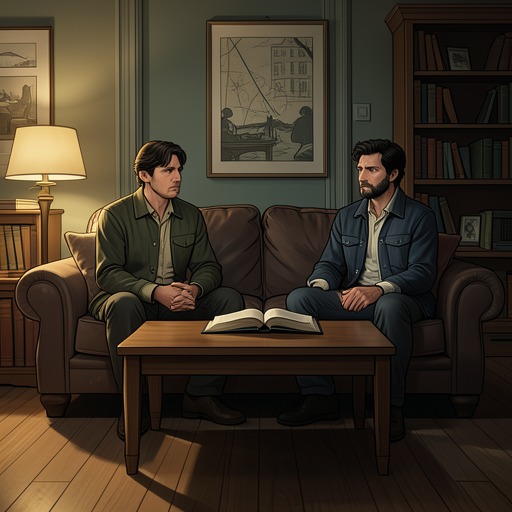
David and Magnus
Handling the UndeadDavid and Magnus’s relationship is shown under the pressure of crisis, where ordinary acts of care become a way to stay connected amid confusion and grief. David carries what Magnus cannot, listens when his son struggles to make sense of the thoughts around him, and rejects Magnus’s belief that he caused Balthazar’s death. Their bond is not presented as a solution to what has happened: David cannot remove the strain, and Magnus cannot yet escape his guilt. Instead, their mutual dependence takes shape through a journey, a small funeral, and the exhausted quiet that follows.
Care in the midst of crisis
On the journey toward The Heath, Magnus crawls into the back seat of Sture’s Volvo 740. David hands him the basket containing Balthazar before taking the passenger seat, a brief, practical exchange that places the child and the rabbit in his care. Sture searches torn-out phone-book maps for The Heath, and David explains that it is not marked there, identifying it as a field toward Järva. Even the destination is difficult to locate; the adults’ effort to find it frames Magnus’s dependence on them as they move through an unfamiliar situation.
At The Heath, the crowd’s thoughts make the surroundings difficult to inhabit. David can hear thoughts associated with Sture, Magnus, and other people, but what unsettles him most is not the ability to read them: it is his uncertainty about which thoughts belong to him. He understands why the denser gathering at the hospital had been untenable. Here the voices and images are fainter, and after ten minutes of wandering he can begin to distinguish his own consciousness. The contrast matters to his relationship with Magnus: the father is himself struggling to orient and hold onto a sense of self even as he tries to guide his son.
Magnus tells him, “Dad, I'm tired,” then asks where they are going. They are in a passageway between two courtyards, with people moving in and out of buildings; many seem to have found the right place, but Magnus is still asking for direction. David crouches and says, “We'll find it soon,” then points to Magnus’s head and asks how things are “in here?” Magnus answers, “It's like there's a lot of people talking.” David does not dismiss the experience or pretend to understand it away. His gesture and question make room for Magnus to report what is happening to him, while his reassurance offers a modest promise of continued care rather than certainty about the wider situation.
Balthazar’s burial
After returning from The Heath, the family makes a grave for Balthazar in an overgrown thicket along the beach at Kungsholmen, halfway between the apartment and the parliament building. David assumes that burying an animal in the city without permission is against the law, but proceeds because there is little else they can do. The setting is informal and perhaps unauthorized; the care invested in the burial is not. Before leaving, they make a cross from pieces of string and skirting board, and Magnus writes BALTHAZAR on it in felt pen.
David stands guard while Magnus and Sture dig a hole large enough for the shoebox. Magnus has cried a great deal on the way back from The Heath, but once home he begins talking about the funeral and what they should do. The change in his behavior is specific: he turns toward the practical work of mourning, attending to the box and the flowers that will go into it. David observes that making the cross satisfies Magnus in a way that words and comfort alone cannot. The burial therefore gives the father a way to understand what his son needs without assuming that reassurance can replace action. David also recognizes that, from the smaller scale of this animal’s funeral, he can understand the purpose of burial.
Blame and reassurance
At the grave, David and Sture each place a hand on Magnus’s shoulders. David cannot shake the feeling that they are really enacting Eva’s funeral, so the burial of Balthazar carries an additional emotional weight for him. Magnus crosses his arms over his chest, and David feels his shoulders draw together as he says, “It was my fault.” The gesture and the words make his self-accusation visible; he follows it with the claim, “I was the one who did it.”
David answers, “No,” and tells him, “It was certainly not your fault.” Magnus nods, but then repeats his insistence that he was the one who did it. The exchange does not establish that Magnus accepts David’s reassurance. Instead, it shows the limit and the necessity of the father’s response: David can refuse to confirm the blame, but he cannot instantly make his son stop carrying it. His presence, with a hand on Magnus’s shoulder, accompanies rather than resolves the grief.
Exhaustion and mutual dependence
After the burial, Magnus continues talking as David carries him back to the apartment. He does not stop until he is in bed, his eyes red and eyelids heavy. David tucks him in; only after Magnus has fallen asleep does he go to the kitchen, where he collapses onto a chair. The sequence sets the child’s need to keep talking against the father’s delayed exhaustion: David remains available until Magnus can rest, then his own strain becomes apparent.
David tells Sture that Magnus is finished, that the past few days have left him sleeping poorly, and that the events of the day are too much for him to handle. He asks how Magnus is supposed to cope. Sture does not answer immediately; after a silence, he says, “I think he'll manage. If you do. Then he will too.” The reassurance makes David’s condition part of the bond rather than treating care as something he can provide without limit. Magnus depends on his father’s steadiness, while David, at this moment, needs another adult to affirm that his own capacity matters. The relationship’s strength lies not in either of them being untouched by the crisis, but in care passing between them and being supported by Sture when David falters.