David lets Eva go
Handling the UndeadDavid lets Eva go in a night-time encounter that turns his effort to hold on to her into an act of release. The scene moves from a dream labyrinth into a bedside vision: Eva’s plea comes through a white caterpillar, which David first protects from Death and then allows to be taken. Its transformation into a butterfly gives visible form to Eva’s departure, while the last image of the encounter is not reunion but David crying alone after Magnus calls for his mother.
The dream of pursuit
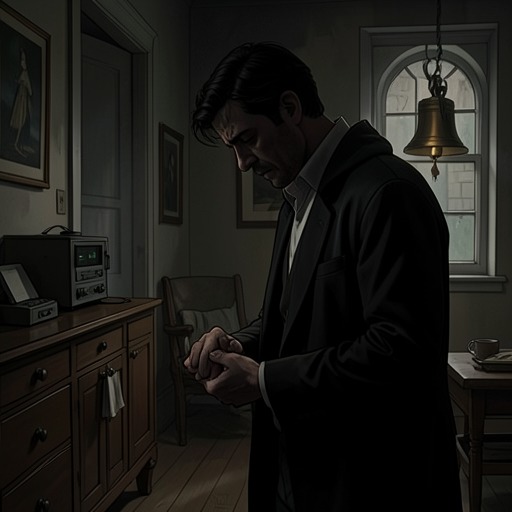
At 22.30 on Svarvagatan, David is asleep and running through a labyrinth of corridors. Doors promise escape but remain closed, and an unseen pursuer stays close behind him. He recognizes Eva’s face in the figure chasing him, yet knows that it is not Eva: something has assumed her appearance in order to reach him. The dream separates the loved person from the threatening likeness, making David’s fear a struggle over what Eva’s image means rather than a simple pursuit by Eva herself.
The corridors have been lit by cold neon. As David runs toward another door he expects to find closed, the ceiling disappears and summer daylight enters the scene. This change opens the dream briefly onto another kind of space: instead of enclosed passages, David sees the sky. The shift prepares the vision of Eva on the lawn, but does not resolve the pursuit or deliver him from fear. The remembered dream and the later bedside scene remain bound by his awareness that something is coming for him, and by his inability to reach a secure place through the doors he keeps trying.
Eva’s plea at the bedside
David wakes in Magnus’s bed with his arms outstretched, reaching toward the image of Eva and crying out. The lawn, canal, boat, light, and Eva contract and disappear, leaving him in the bedroom. A whining sound is close by, and a white caterpillar lies curled on his stomach. The transition collapses the dream’s landscape into a small, physical presence; what had been a distant figure and open sky is now something David can cover with his hands.
He recognizes the cheap perfume and a glimpse of pink as signs of the woman he associates with Death, the woman from the grocery store. Her hand enters his vision, its colorful bracelets ending in hooks. The hooks stop about ten centimetres from David’s hand: they are not permitted to touch him because he is living. But the caterpillar can reach him in another way. Its wriggling tickles his palm, and its plea comes through his hand and into his bones. The scene makes the appeal bodily before David can answer it in words.
David cups his hands over the caterpillar and refuses to let it go. Though he wants to escape the house and even the world in which events must happen this way, fear leaves him paralyzed beside Death. The protective gesture therefore has two meanings at once: it shields the small creature from the hooks, but it also keeps Eva from leaving. As the caterpillar swells beneath his hand, the hooks withdraw and Eva’s voice grows fainter, as if his attempt to retain her is separating him from the person he is trying to save.
From refusal to release
The plea becomes quieter and more difficult to hear, until Eva asks, “If you love me ... let me go ...” David sobs, lifts his hands, and answers, “I love you.” The order of the gestures matters: he does not begin by consenting to a loss he has accepted. He begins by resisting, then responds to Eva’s appeal by uncovering the caterpillar. His declaration of love is thus joined to the act that ends his immediate hold over her.
The caterpillar on his stomach has become swollen and pink, and appears sick and close to death. When Death’s hooks return, one catches the creature and lifts it. The image initially seems to repeat the danger David was trying to prevent. But at the point where the hook enters, a crack opens in the caterpillar’s body. The hand lingers before David’s eyes as the crack widens, and the creature is revealed not to be a caterpillar but a pupa. That reversal changes the meaning of the hooked hand: its arrival coincides not with the creature’s destruction, but with the emergence of what it has become.
A butterfly works its way out of the pupa. The dry shell falls away and dissolves; the butterfly rests motionless on the hook before flying upward and disappearing through the ceiling. David watches it go. The whining abates, the hooked hand is gone, and the creature he had tried to keep safe is no longer on his body. The sequence offers a concrete ending to the encounter without making it a reunion: Eva’s voice has faded, and the butterfly’s passage is away from David, beyond the room.
Grief and the scene’s resolution
Magnus moves beside David in his sleep and says, “Mummy ... ” David gets out of bed carefully, so as not to wake him, and closes the door behind him. He then lies on the kitchen floor and cries until the tears dry up and he feels empty. The child’s word connects Eva’s departure to the family life continuing around David, but Magnus is asleep and cannot share or answer his father’s grief in this moment. David withdraws so that his crying will not wake him.
The final movement from the bedroom to the kitchen replaces the scene’s supernatural images with the aftermath of loss: a closed door, a sleeping child, and David on the floor. The encounter has made release possible, but not painless. Its transformation imagery does not erase the separation; it gives that separation a visible form in the butterfly’s flight and the dissolving shell. David’s final emptiness preserves the cost of letting Eva go, while the brief vision and Eva’s plea define the act as an expression of love rather than indifference.