Dead Room
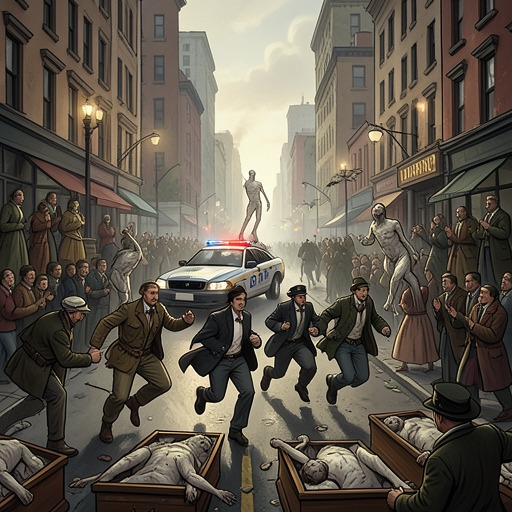
Handling the UndeadThe Dead Room is the temporary crisis command centre established at the Ministry of Health and Social Affairs as reports of cemetery awakenings reached the authorities. Its formation makes the emergency visible as an institutional problem: the returning dead are not only a source of fear and grief, but a situation requiring coordination among government departments, the Police, and medical experts.
Formation and Structure
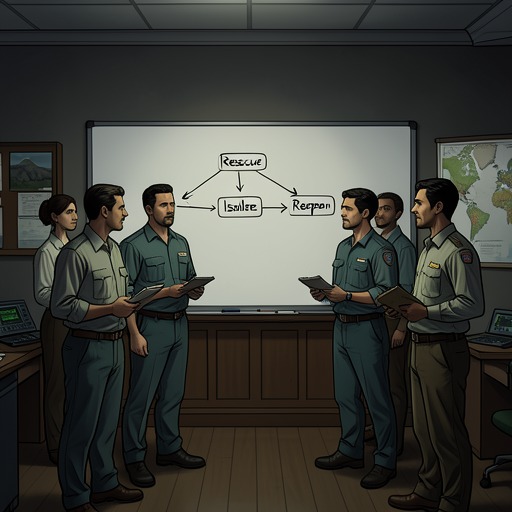
At 00:22, the Minister of Health and Social Affairs arrived at the department and supervised the creation of a provisional command unit. Its members included representatives of various departments and the Police, alongside eminent physicians from several disciplines. The composition joined administrative, law-enforcement, and medical perspectives in one response, though the account does not specify a formal chain of command beyond the minister’s supervision.
A conference room in the department was converted into a temporary command centre. It quickly acquired the name Dead Room, a blunt label that fused the location with the crisis occupying it. The room was provisional in both its physical arrangement and its institutional status: a conference space repurposed for an emergency that had arrived faster than ordinary procedures could contain.
First Reports and Immediate Pressures
At 00:42, the Dead Room received the first reliable report of awakenings at cemeteries. The estimate was approximately 980 people. The scale of the report immediately exposed a practical limit: the Police stated that they did not have the resources to manage the exhumations. The Dead Room therefore begins not with a demonstrated solution, but with the collision between a rapidly expanding emergency and the available capacity to respond.
The sequence is telling. The command unit had been assembled only twenty minutes before the reliable cemetery report reached it; within that interval, an improvised administrative centre had become the destination for information about a crisis involving hundreds of graves. The figures and timing give the room’s name a concrete institutional setting: it is where the returned dead first enter the government’s organized field of attention.
Role in the Narrative
The Dead Room represents the state’s initial attempt to make an unprecedented event legible and manageable through familiar structures: departmental representation, police reporting, medical expertise, and a designated command space. Yet the first operational problem it confronts is not a question of interpretation alone. Nearly 980 reported awakenings imply work on a scale that the Police say they cannot perform with their existing resources.
The room’s temporary character and the short interval between its formation and the first reliable report emphasize the imbalance between the speed of events and the pace of institutional response. Its narrative function is consequently defined by both coordination and insufficiency: it gathers the relevant authorities, but its first documented report also reveals that gathering them does not itself provide the capacity needed to act.