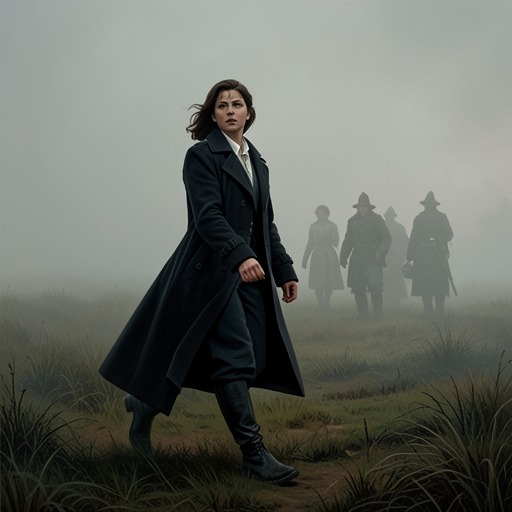
Death as a twin sister
Handling the UndeadDeath as a twin sister is the image through which Flora recognizes an unsettling truth about herself: she has not merely imagined Death as another figure, but understood Death as her own double. The idea begins with a mirror and returns in a moment bound to Peter’s visceral fear, turning private play into a belief that reshapes how the novel’s death-haunted world can be read.
Origin of the Image
Flora’s idea arose a couple of years earlier, when she stood before a mirror holding a candle and tried to summon the Dark Lady. The encounter offered no separate supernatural figure: she saw only herself. From that failure, or revelation, came the notion of Death as a twin sister. The mirror makes the image intimate and uneasy at once. A twin suggests a distinct counterpart, someone who can stand beside the self; the reflection insists that the supposed other may be inseparable from the person looking. The metaphor therefore does not simply give death a human appearance. It makes death resemble Flora closely enough to collapse the distance between them.
The text distinguishes this image from other familiar personifications. Death might be imagined as a man with a scythe, the Phantom Charioteer, a leering skeleton, or an old African woman. Flora, however, is drawn to the twin sister. That preference matters because the alternatives make Death visibly other, while the twin makes otherness a likeness. The candlelit mirror supplies the image’s origin, and the phrase supplies its structure: Death is at once companion, counterpart, and self-recognition. The account does not say that a separate figure appeared in the mirror; its force rests precisely on Flora seeing herself.
Peter’s Wolf and Flora’s Recognition
The image becomes more than imaginative play in a scene associated with Peter’s remembered encounter with a wolf. Cycling along a gravel road between spruce trees, Peter reached a bend and found the animal five metres ahead. He was frightened, unable to get a scream past his mouth, and certain that it was about to kill him. The wolf watched him, then went into the forest. Peter was left unable to move for several minutes and turned back rather than pass the place where it had stood.
The memory is conveyed through bodily fear as much as through its sequence of events. When its image arrives with force, Flora feels her sphincter relax; her consciousness takes control of her muscles just in time. The narration then places Peter’s thought, “For me death is a wolf,” beside Flora’s realization that what she had considered imaginative play was her own fundamental belief: “she herself was Death.” The two images are not interchangeable. Peter’s wolf is a frightening presence outside him, first encountered on the road; Flora’s twin is a figure that leads back to herself. Their juxtaposition nevertheless makes the recognition concrete: Death can be experienced as a predator, while Flora understands herself as Death’s human likeness.
A Double Rather Than a Distant Figure
The twin-sister image changes the meaning of personification. A scythe-bearing man or a skeleton can be recognized as a conventional sign of mortality, but Flora’s double is grounded in a particular act of self-confrontation. The mirror does not reveal what Death looks like in general; it gives Flora a way to imagine Death through her own face. The metaphor thus makes identity its central problem. Flora is not simply describing a character she has invented; she recognizes that the invention expresses something she believes about herself.
The scene also preserves a tension between play and conviction. Flora had taken the idea as imaginative play, but the recognition revises that understanding: it was not merely a fanciful image chosen among many. The narrative does not explain the belief by supplying a history of supernatural instruction, nor does it show a literal twin. Instead, it sets a bodily response, Peter’s thought, and Flora’s sudden recognition beside one another. The reader encounters the shift as a discovery rather than as a definition imposed from outside her experience.
Death in a World Without Certain Boundaries
The image resonates with the novel’s wider challenge to the ordinary definition of death. In a discussion of the returned dead, death is described biologically as the cessation of metabolism, but the possibility that the body can restart that process unsettles the usual signs by which death is declared. The account concludes that there is no longer a reliable way to declare someone dead and that everyone may come back. Against this uncertain boundary, Flora’s idea gives death a face without making it remote or final: it is imagined as a near relation, the self’s double.
That connection does not turn Flora’s recognition into a scientific explanation of the returned dead, or establish that she controls what happens to them. Its significance is more intimate. The novel places a disputed bodily state beside an image of death that is at once personal and divided: a twin seems separate, yet belongs to the same likeness. The resulting uncertainty is captured in the gap between the fearful wolf Peter remembers and the Death Flora recognizes in herself. The phrase names neither a simple monster nor an abstract principle; it names the closeness of the boundary, and the disturbing possibility that what appears to approach from outside may also be understood as part of the self.