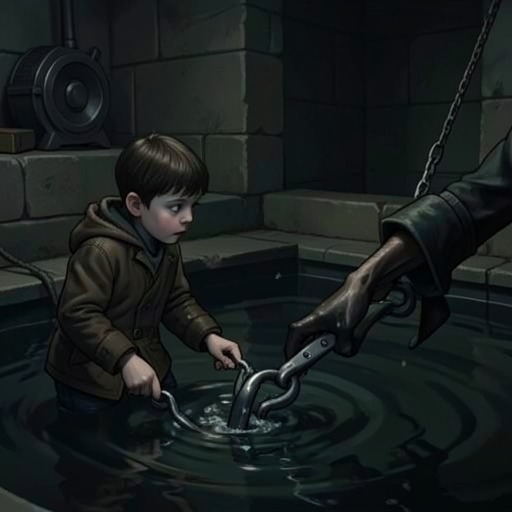
Elias's Release at Sea
Handling the UndeadElias’s Release at Sea is the final separation between Anna and her son: a departure that becomes a physical and intimate encounter before Anna chooses to let him go. The scene turns on a painful reversal. She first accepts his withdrawal into her, then changes her mind when she senses something approaching across the water, and finally releases the small white caterpillar that emerges from his chest. Her farewell is neither a simple acceptance nor a clean escape from grief; it holds love, fear, and a last act of relinquishment together.
The conversation before the departure
The scene begins after Anna has listened to David’s story. She thanks him and ends the phone call, then remains seated for a long time, looking at Elias. The pause gives the news time to settle before she acts. She pulls him up into her lap, lays her forehead against his, and begins telling him what David has just said. The news itself is not repeated here; what matters in this moment is that Anna brings it to Elias rather than leaving him outside a conversation that will determine their parting.
The exchange is close and bodily. Anna feels that Elias is listening, and the narration moves from her perception of him to the voice echoing inside her head. Elias asks whether she is sure, and she assures him that he should stay with her until the time comes. She asks him to remain inside her. Through the blankets, she feels his body slump and become dead weight. The change is at once a loss of responsiveness and a movement toward intimacy: Elias is no longer held upright as a separate body, but goes into Anna. Their closeness does not remove the approaching separation; for a moment, it changes the form in which they meet it.
The approaching presence and Anna’s reversal
Elias wonders what it is like there and whether he might be able to fly. Anna cannot give him certainty; she thinks he may be light, and answers that perhaps he can fly. The tentative exchange gives their conversation a fragile openness. Neither can explain what awaits Elias, and neither turns that uncertainty into a promise of safety. Their words remain small and direct, shaped by the limits of what Anna knows.
A whining sound grows louder over the water. It resembles a ferry approaching, but the only light is that of the moon and stars. As the sound draws nearer, Anna changes her mind: with Elias inside her again, she no longer wants to give him up. At the moment this resolve forms, she feels him begin to pull away. The reversal is immediate and makes her desire to keep him inseparable from her awareness that he is already leaving.
The sound reaches the dinghy. From the corner of her left eye, Anna sees a shadow pass across the moon and senses something seated on the thwart. She cannot look toward it. The approaching presence is presented through sound, movement, and Anna’s refusal to turn her gaze, rather than through an explanation of what it is. That restraint keeps attention on the choice in front of her: she can feel Elias pulling away, but fear makes her ask him to stay. Elias says he is frightened; Anna tells him not to be afraid and that she is with him. Her reassurance does not undo the departure. It accompanies him through it.
The release
Elias asks whether they will see each other again soon. Anna answers that they will, but as he is about to say more, his speech weakens. A white caterpillar breaks free from his chest. The image gives the separation a visible form: Elias’s voice is fading, while something small and living-looking emerges from the body Anna has been holding close. A clump of darkness reaches toward it, ending in a hook. The narration makes the threat legible without explaining the shadow or naming the force that has come for him.
Anna cups her hand around the caterpillar and holds it for a couple of seconds. This brief pause is the scene’s last interval of physical contact: the departure has become something she can cradle, though not keep. She thinks that she will always think of Elias, then lets him go. The action completes the shift from asking him to remain inside her to allowing him to leave. Her promise of remembrance does not erase the fear and hesitation that precede it; it makes the final release an act of attachment rather than indifference.
Form and significance
The scene’s movement from a phone call to a shared farewell narrows the scale of the larger crisis to two people and a few precise gestures: a forehead against a forehead, a body sagging beneath blankets, a hand cupped around a white caterpillar. The sea setting expands that intimate exchange without supplying a clear account of what lies beyond it. Moonlight, stars, the ferry-like whine, and the shadow on the thwart mark the threshold of departure, while the dialogue keeps Anna and Elias’s attention on one another.
The ending preserves uncertainty about what Elias experiences after leaving Anna. She answers his question about meeting again with hope, not knowledge; the scene confirms that she releases him, but does not show a reunion or explain the destination. Its final movement is therefore not a triumphant resolution but a completed choice within grief. Anna cannot make the parting painless, and she cannot explain it. She can listen, stay with Elias as he is afraid, hold what emerges from him for a moment, and then let him go.