Eva Zetterberg’s awakening
Handling the UndeadEva Zetterberg’s awakening is the reversal at the heart of the event: after an elk collision leaves her dead, a small movement of her hand signals that she has returned, before David can understand what her changed body means.
Death Before the Awakening
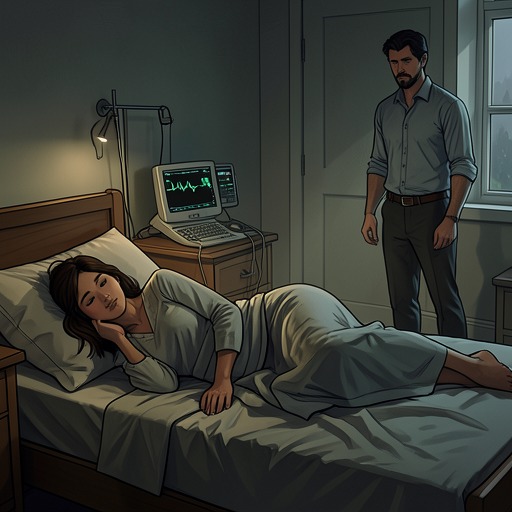
Eva died while David was making his way to the hospital. The doctor had told him that there was no hope, although her heart was still beating; by the time David reached her room, it had stopped at 22:36. The precise time gives the loss a stark, clinical boundary, while David experiences it as the collapse of any imaginable future. He stands beside her bed as alarms sound and the lights blink in the hospital corridor, surroundings that seem to match the scale of his catastrophe. For him, the moment is not simply the end of Eva’s life: it is the destruction of their shared past and the future he had expected them to have together.
The First Sign of Return
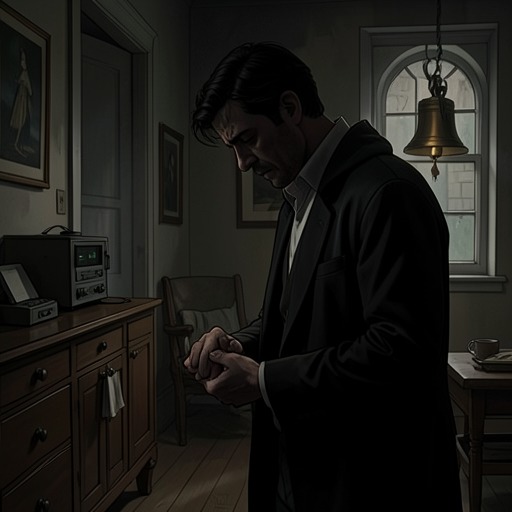
The first indication comes not from Eva’s face or voice but from her hand. After David’s grief peaks in a headache so intense that he believes he is dying, the alarms and sirens stop and the room’s lights dim. The pain abruptly disappears; David moves Eva’s hand across his forehead, its wedding band passing over his skin, and finds that the ache in his chest remains. He has not seen the white caterpillar enter through the ceiling and burrow into the blanket covering her. The moment holds together a bodily crisis, a change in the room, and an unnoticed arrival, while David can register only his own loss.
Still holding Eva’s hand, David recalls that nothing was supposed to come between them. Her hand jerks and squeezes his in response. He does not cry out or move at first: he presses her hand again, and it presses back. The exchange is small enough to be mistaken for a spasm, but its repetition turns it into contact. David’s response is not uncomplicated happiness; he feels disoriented, like someone emerging from a nightmare, and must make his legs carry him closer to see her.
The movement that follows is unmistakable. Eva’s arm strikes David’s legs, and she sits up without warning, sending the blanket sliding away. Only then does he confront the bodily damage the bedclothes had hidden. Her clothes have been cut away; the right side of her chest is an open wound, and metal clamps suspended among broken veins clink against one another as she moves. For an instant David sees a monster and wants to flee, but he cannot make his legs carry him away. He comes back to himself and steps beside the bed. Her awakening restores movement and contact, not her former body: the first reunion is also a shock that David has to endure before he can recognize Eva within it.
Medical Examination and the Limits of Speech
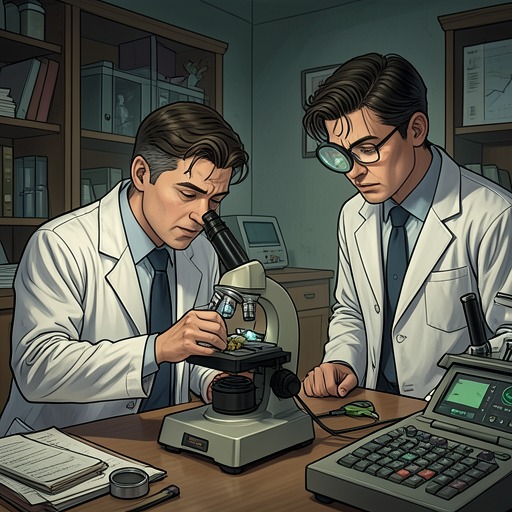
At 02:30, Eva was transferred from Danderyd Hospital to the Medical Examiner’s office at the Karolinska Institute in Solna, among the returned dead considered especially important to understanding the phenomenon. Her significance was twofold: she could speak, and the interval between the cessation of her life-sustaining functions and her awakening had been exceptionally short. Rudolf Albin, who had been dead longer than anyone else before awakening, was moved there as well. The event that David had encountered first as an intimate, bodily shock thus became part of a wider attempt to establish what the returned dead could do and how their return related to death.
At 02:56 on Wednesday, 14 August 2002, Professor of Neurology Tomas Berggren began Eva’s first interview. His record notes that her ability to speak had continued to improve since she awakened, but the transcript also marks a stark limit: asked why he could not talk to her, the answer identifies Eva as having no mouth and being afraid. Speech makes Eva available to questioning without making her condition transparent. Her words disclose fear and bodily absence at once, while the interview’s clinical structure cannot turn either into a complete explanation.
Significance of the Awakening
Eva’s return is presented at two scales that do not settle into one explanation. David experiences it through touch and bodily shock, while the hospital records a case defined by the brief interval between the cessation of her life-sustaining functions and her awakening. The precise time of her death, 22:36, can be entered in a record; what her responsive hand means to David, and what her damaged body means for Eva, cannot be made equally legible by measurement.
The interview in Solna extends that uncertainty rather than resolving it. Eva’s speech is improving, yet her answer identifies both the absence of a mouth and fear, leaving the medical staff with evidence of communication but no complete account of her condition. Her awakening therefore marks a return to contact without a return to ordinary life: she can answer, but remains physically altered and frightened. The event opens a larger inquiry into the returned dead while keeping its central fact intimate and unsettled—the person David recognizes has moved again, but neither love nor clinical observation can make that transformation whole or familiar.