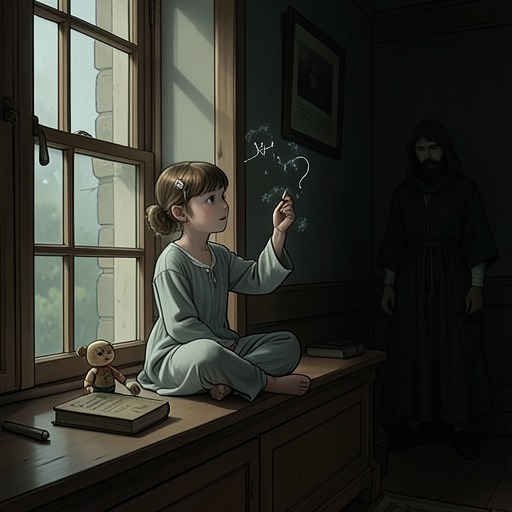
Eva and David Puppets
Handling the UndeadEva and David Puppets are a boy-and-girl pair of wooden dolls whose history turns a childhood toy into a tangible reminder of Eva Zetterberg and David Zetterberg’s shared life. Carved by Sture for his daughter, the dolls became her favorites, and the names she gave them later lent them an intimate story of attachment and fate. Sture eventually brings them to David, who closes his eyes and runs his fingers over the wood.
Appearance and Provenance
The dolls are about fifteen centimetres tall, one a boy and the other a girl. Their wood is described as silken from the sanding of hands and fingers: their smoothness records the labor of making them and the handling they received as toys. They are not elaborate objects in the account; their significance gathers instead around their handmade material and the family history attached to them.
Sture carved the pair while working as a construction carpenter in Norway. His work kept him away for two weeks at a time, followed by a week at home. During one of those weeks home, he made the dolls and gave them to his then six-year-old daughter, Eva. They became her favorite toys even though she also had Barbie, Ken, and Barbie’s dog. That preference establishes the dolls not merely as keepsakes made by her father, but as objects she actively chose among the toys she owned.
The Names and Their Story
Eva named the figures Eva and David. The names turned a boy-and-girl pair into a small imagined version of the couple she would later form with David Zetterberg. A couple of months after they met, she told him about the dolls and framed their names as a sign that their relationship had been destined from her childhood. She said, “I've been fated to be with you since I was six years old.” The account remains Eva’s remembered interpretation of a childhood choice; the dolls themselves preserve the names that made that interpretation possible.
The story gives the objects a double chronology. They belong first to Eva’s childhood, when she named and played with them, and then to her relationship with David, when she shared their history with him. Their meanings do not depend on any supernatural property: the coincidence of the names, and Eva’s way of reading it, make them intimate tokens of how she understood their meeting.
David Receives the Dolls
Later, when David is reluctant to drive, Sture opens the glove compartment and gives him the pair, saying he has brought them. Sture takes the wheel, and David recognizes their story. He closes his eyes and rubs his fingers over the dolls. The gesture returns attention to their hand-smoothed surface while placing the remembered account between the two men: Sture made them for his daughter, and David knows what she later made their names mean.
In David’s hands, the dolls connect a private childhood memory to a present act of remembrance. Their smallness and tactile finish contrast with the weight of the story attached to them: a father’s handmade gift, a child’s naming, and Eva’s later account of being fated to be with David. The scene leaves their meaning concentrated in the objects themselves and in David’s quiet touch, rather than explaining what he feels.