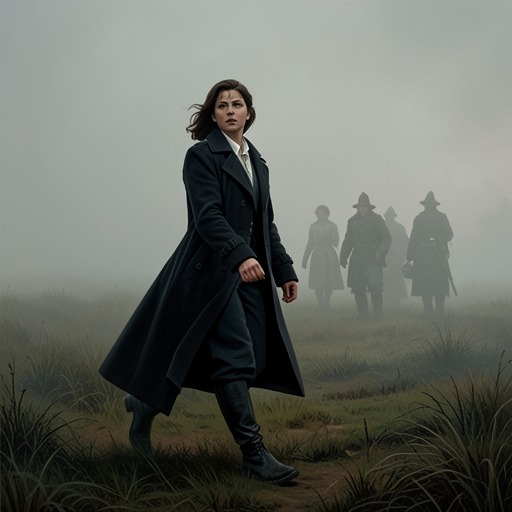
Flora’s first encounter with her Death double
Handling the UndeadFlora’s first encounter with her Death double is a brief but decisive confrontation at The Heath: as the surrounding field presses fear and despair into her awareness, a piercing sound tries to prevent her from looking at its source, and she sees another Flora moving away across the yard. The double’s near-perfect likeness, marked by a pair of shoes that Flora no longer has, turns an invisible threat into a figure she can recognize but cannot follow.
The Field at The Heath
At 12:50, Flora walks toward the buildings and feels the field grow stronger with each step. Beyond the gates it had seemed like streams running through her head; among the buildings it thickens into something like fog. The comparison is not only visual: as fog magnifies sound, the field makes individual thoughts faintly audible, like distant cries. The change in her perception is gradual, but the accumulating sensation brings her into a mental environment that is difficult to hold at a distance.
The field consists of many consciousnesses, yet Flora does not experience them as a crowd of people actively thinking. They are simply present, a strong collective awareness without thoughts. Alongside that presence, however, come mental exclamations of horror. These do not merely register the field’s intensity; they increase it. Flora understands the process through the image of an electrical conductor warming as power runs through it. Fear is therefore both something she perceives and a force that changes the conditions around her.
By the time she stops between the buildings, the field has become an inward pressure. Flora feels that there is not enough room for her, as though a miniature version of everything happening in the area has entered her head. What fills that interior space is terror and despair, described as basic, reflexive emotions. Their force is so pervasive that she imagines the field should be visible, swelling like heat above asphalt. The threat is not yet a visible attacker; it is an atmosphere that reaches her through sensation and seems to make the surrounding fear materially present.
A Sound That Forbids Looking
At 12:55, a sound begins as a distant hum and approaches through the other noises, becoming sharp enough to feel physical. It pushes Flora’s head down and to the right. The progression—from something heard at a distance to a force acting on her body—makes this encounter more than an ordinary perception. Flora can locate the sound precisely, at a point ten metres to her left, and understands that she is not allowed to look there. When its source changes position and moves away, the restriction remains legible as an attempt to govern her attention.
Flora wonders whether her gift is allowing her to pinpoint the sound. The question marks a moment of partial understanding, but it does not give her control over what is happening. The field has already made other people’s fear available to her; now a sound makes its own demand on her body. Her response is initially constrained: the sound presses her head away from the place she has identified, while her growing knowledge of its location tells her exactly what she is being prevented from seeing.
The words “The more you fear us, the bigger we get” give the field’s escalation a concise expression. In the scene, fear is not simply a private reaction to something frightening. The surrounding horror feeds intensity back into the field, while Flora’s experience of that intensity makes it harder for her to maintain separation from it. The encounter thus joins mental and bodily pressure: consciousnesses and exclamations produce an atmosphere, and the sharp sound translates that atmosphere into a force that turns her head.
The Double in the Yard
Flora resists the enforced direction of her gaze. Her neck muscles strain as though she were straightening beneath a heavy load, and she turns her head up and to the left. What she sees is herself moving away from herself. The girl crossing the yard wears the same oversized outfit and carries the same backpack; her straggly red hair matches Flora’s. The resemblance is exact enough to make the sight an encounter with a double rather than a stranger who merely looks familiar.
One difference makes the likeness uncanny and concrete. The girl wears Flora’s favorite sneakers—the pair that had broken—but on the double they are intact. The shoes do not explain what the apparition is, yet they bind it closely to Flora’s own life and to a loss embedded in an ordinary object. The double is not a generalized figure: it repeats Flora’s clothing, bag, and hair, while carrying a version of something Flora remembers as damaged. That contrast makes recognition immediate without making the vision comprehensible.
The double stops, as if she has felt Flora’s eyes at her back. The sound in Flora’s head continues as a screech of grinding metal, and Flora has no strength to stand and follow when the girl resumes walking toward the next courtyard. The apparition therefore does not approach or speak; it moves away, and Flora cannot close the distance. Its departure turns the sight into an experience of separation as well as recognition. She has forced herself to look, but looking gives her no power to pursue what she sees.
Collapse and Significance
Flora collapses onto a bench, sobbing and averting her gaze. The screech stops. The sequence leaves the relationship between the sound and the double unresolved, but its immediate effect is clear: the sound ceases after Flora has seen the girl and turned away, while her body remains overwhelmed. She lies on the bench with her backpack as a pillow, turns her back toward the direction in which the double went, and hugs herself. These small actions make withdrawal physical: she shields herself from the direction of the encounter rather than following it into the next courtyard.
The event’s force comes from the difference between recognition and mastery. Flora sees the figure, identifies it as herself, and remembers the broken shoes that distinguish the double’s intact pair. Yet the field and the sound still dictate the terms of what she can endure: she struggles to turn her head, loses the strength in her legs, and cannot follow. Her thought afterward insists on the fact of sight—she saw it, and it was there—without supplying an explanation. The encounter ends not with an answer about the double, but with Flora’s certainty that the vision was real to her and with her body folded away from where it appeared.