Government ban on burials and cremations
Handling the UndeadThe Government ban on burials and cremations is an emergency measure that suspends the ordinary disposal of the dead while the possibility of revival remains unresolved. Announced after four people died in the Stockholm area overnight, it has no specified end date. Its force lies in that uncertainty: a body can no longer be treated as conclusively beyond return, yet keeping it also exposes families and institutions to new practical and ethical demands.
Decision and Immediate Scope
At a press conference, the Minister of Social Affairs reported that the government had decided at a parliamentary meeting that evening to prohibit all burials and cremations for an indeterminate period. The minister acknowledged that the four people who had died in the Stockholm area during the night had shown no signs of awakening, but that absence of visible change did not prevent the prohibition. The policy therefore responds not only to confirmed revivals but to the possibility that a person declared dead might revive later.
The announcement also addressed the immediate question of where bodies could be kept. Asked whether there was enough room to store them, the minister said there was, at least for the moment, and noted that morgues had never been so empty. The answer frames the ban as both a change in funeral practice and a logistical measure: burial and cremation are stopped, while temporary storage is treated as feasible under current conditions. The announcement gives no criteria for lifting the prohibition and sets no definite timetable for its review.
Death Becomes Uncertain
The policy reflects a crisis in the definition of death. Medical and public understanding had relied on established signs to determine when life had ended, but the new possibility that metabolism could restart destabilizes that judgment. The account of a death at 22:36 makes the change starkly bodily: a heart stops, and a family experiences the loss as final, even as the wider crisis makes finality uncertain. The measure does not erase grief; it suspends the customary acts that would ordinarily follow it.
That suspension reaches into intimate mourning. Before the prohibition, Gustav Mahler stood beside his grandson Elias's open coffin, where Elias lay in his penguin-patterned pyjamas with his teddy bear. Mahler had placed a box of Harry Potter Legos beside him. Elias was buried, and later Mahler pressed his ear to the grass above the grave and heard scraping before beginning to dig with his bare hands. The scene shows the material consequence of a body already laid underground: once burial is no longer safe to regard as an irreversible conclusion, the grave becomes a site of possible return as well as remembrance.
Medical and Legal Questions
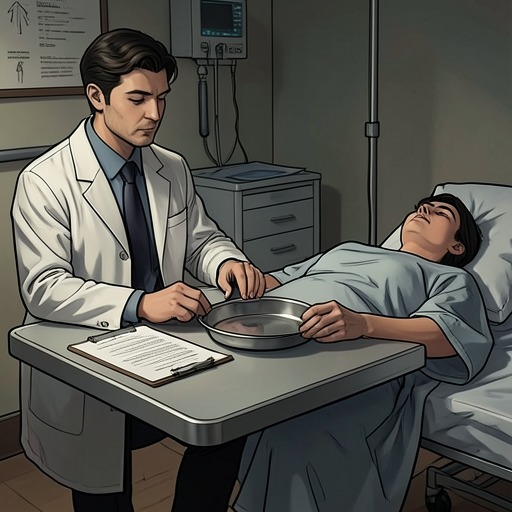
The suspension of funerals coexists with medical examination of bodies. A toxicologist explains that a body is being examined on the assumption that something may have been introduced that should not be present, and that the facility has equipment unavailable elsewhere. The prohibition itself does not specify what examinations are permitted; rather, the surrounding response reveals that the bodies occupy an unsettled status, subject to investigation even as familiar rites of disposal are halted.
That uncertainty is also legal. A published philosophical argument observes that existing law treats someone declared deceased as outside ordinary judicial protection, apart from the peace of the grave, and questions whether that protection applies to the reliving. It anticipates that laws will be changed, while warning that the interval before reform could allow experiments and tests that might later be illegal. The argument cites sixty-five deaths in Stockholm without awakening over two days and approximately 300,000 deaths worldwide in the same period, using those figures to urge research that might prevent future deaths. These are arguments about the crisis, not provisions stated in the ban; they expose the ethical conflict surrounding a policy that preserves bodies while their legal and medical status remains unsettled.
Reach and Significance
The ban is a collective response to a fundamental mismatch: people continue to die and mourners continue to experience loss, but neither familiar medical criteria nor funeral customs can confidently settle what death means. An indefinite moratorium protects against treating a potentially revivable body as irretrievably gone, while leaving families without the customary completion of burial or cremation. Its practical rationale is inseparable from the larger question of whether a returning body is a patient, a deceased person, or both.
The measure also marks the difference between private certainty and public rule. A family may confront a stopped heart, an open coffin, or a grave, while the government must act across cases in which no awakening has yet occurred. By prohibiting both burial and cremation rather than waiting for individual signs of revival, the policy makes uncertainty itself the basis for intervention. The announcement specifies the prohibition and its indefinite duration, but does not establish when ordinary funeral practices will resume.