Government of Sweden
Handling the UndeadThe Government of Sweden is the central state authority responding to the mass return of the dead in the Stockholm region. Its response moves from urgent mobilization to improvised command and public explanation, while events at Danderyd Hospital expose how quickly the crisis exceeds ordinary institutional routines.
A crisis reaches the state
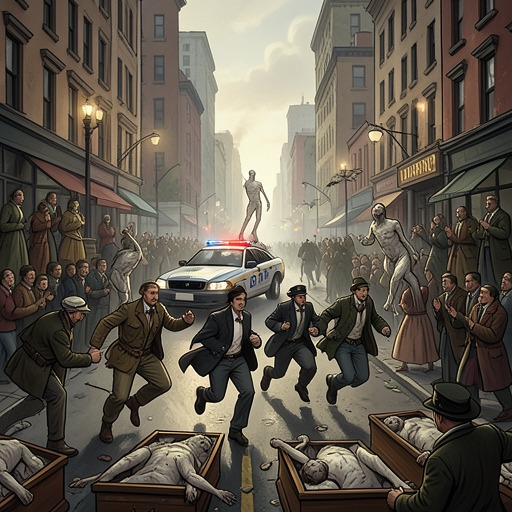
The first reports describe the dead coming back to life at morgues across the greater Stockholm area. As reports of returned relatives flood the emergency call centre, the scale of the event becomes both public and intimate: callers are shocked, sometimes hysterical, and emergency workers, counsellors, and religious ministers are quickly gathered to support affected families. The Ministry of Health and Social Affairs is informed as police communications establish that people being found disoriented had died in recent weeks.
At 00.25, the Prime Minister is informed while in Cape Town. The situation is judged extraordinary enough that a planned meeting with Nelson Mandela is cancelled and the state plane prepared for the eleven-hour flight back. The detail makes the crisis national before its practical consequences can be contained: the head of government is abroad, and even the quickest available return entails a substantial delay.
The Dead Room and the limits of coordination
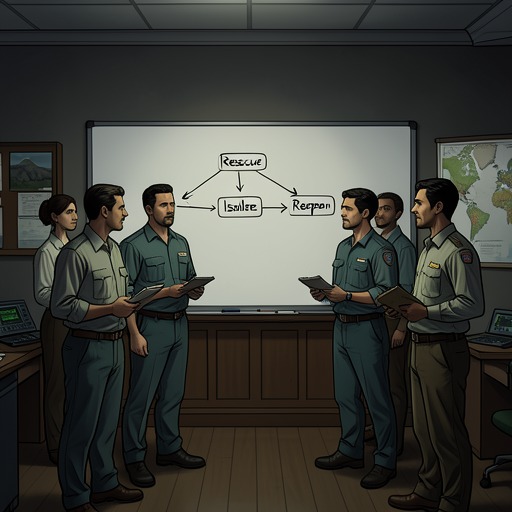
At 00.22, the Minister of Health and Social Affairs arrives at Danderyd Hospital and supervises the formation of a provisional command unit. It brings together representatives of various departments and the police, alongside eminent physicians from several disciplines. A conference room at the department becomes the temporary command centre, soon known as the Dead Room. Its name captures the unprecedented subject of government administration, but the unit itself is an emergency arrangement assembled in the middle of events rather than an established structure.
The pressure is immediate. Danderyd Hospital is designated as a temporary gathering place, and by 01.45 it has admitted 715 returned dead. Disputes and fistfights break out among staff members in direct contact with them. At 01.50, the military calls in members of the Army Corps to erect a temporary holding facility without consulting the Dead Room. The action shows that response is not proceeding through a single, fully coordinated chain of command: the military acts to address the mounting logistical problem, but does so outside the new civilian command unit's consultation.
Evacuation and public accountability
By the time the crisis reaches its next public phase, all staff have left Danderyd Hospital and a large number of military vehicles have gathered outside. The account notes that there is, for the moment, no information about what is happening, while the Prime Minister announces a press conference for seven the following morning. The contrast between visible military deployment and the absence of an explanation underscores the gap between state action and what the public can understand about it.
At a later public gathering, the Minister of Social Affairs approaches the microphone before a crowd watched by television cameras. The minister apologizes on behalf of the government, saying that the response has taken too long and acknowledging that decisions made under surprise may, in retrospect, have been poorly judged. The apology marks a shift from emergency organization to public accountability. As David watches, he recognizes that what he had experienced as a private family crisis has become a collective one: the Government of Sweden's response is part of a story in which personal bereavement and national emergency cannot be separated.