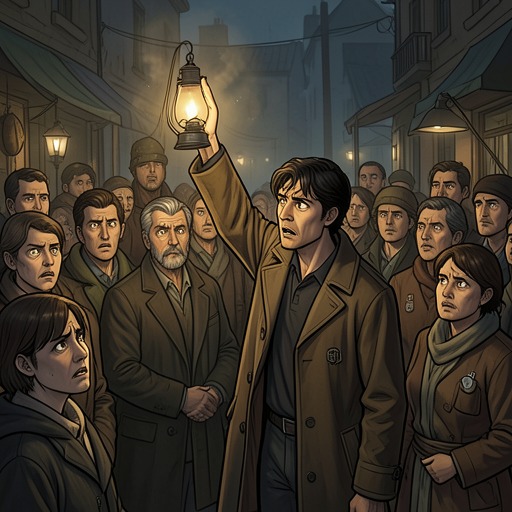
Gustav Mahler's Newspaper Article on the Reliving
Handling the UndeadGustav Mahler's Newspaper Article on the Reliving is both a work of reportage and an appeal against leaving decisions about the returned dead solely to the state. Its closing turn toward family, love, and the limits of official authority gives David Zetterberg a language for his own private crisis. The article does not merely inform him: he keeps it close, rereads it, and uses it as the reason to seek out its author.
Form and Argument
The article is presented as rigorous reporting until its ending, where Gustav Mahler breaks from the report's established tone and speaks in his own voice. David notices the shift as a breach of journalistic form: the personal appeal seems to him inappropriate precisely because the preceding writing has been so measured. Yet the ending's departure from that discipline is also what makes the article reach him. Its questions concern who has the right to decide what should be done with the reliving, and whether state authorities can settle a matter that is ultimately about love.
The appeal places family members, rather than government alone, at the center of decisions affecting the returned dead. It does not present the issue as a purely administrative problem; it asks whether public authority can make a final decision about something rooted in intimate bonds. The article's force, as David encounters it, lies in holding those two registers together: the state has power over the situation, but the families have a claim grounded in their relationships. The evidence presents this as Mahler's closing argument, not as proof that the authorities accept it or that policy changes as a result.
David's Reading of the Article
David first reads the closing appeal while looking at photographs and text about the dead. He lowers the paper and recognizes the argument as personally true: for him, the crisis is ultimately about love. He folds the newspaper into his pocket, treating it as a silent support, and takes a taxi to Solna, where Eva Zetterberg is being held. The sequence gives the physical paper a role beyond conveying information. It accompanies David from reading into action, connecting Mahler's public argument about families to David's effort to reach his wife.
The article returns to David later, after a visit to the State Pathologist. He has spent the day feeling detached from ordinary life: after drinking water at a pizzeria, he sleeps beneath a tree in a park while other people picnic and children run on the grass. The approaching black clouds and his sense of estrangement form the setting for his rereading. The article now seems to him to be about his own experience. That response does not establish that Mahler wrote about David or knew his circumstances; it shows how the article's concern with family and love gives David a point of recognition amid an event that has left him feeling cut off from the world.
From Reading to Contact
After rereading, David calls the newspaper and asks for Gustav Mahler, explaining who he is. He learns that Mahler is a freelancer and that the newspaper cannot give out his number, but can pass on a message. David offers no detailed request; he says only that he wants to talk. The restraint matters. The article has prompted contact, but David has not yet turned that impulse into a clear account of what he needs or what he intends to disclose.
The message is relayed, and the two later speak by telephone. When Mahler asks how things are going, David tells him about the accident, the awakening, Magnus, his visit to the State Pathologist, his feeling of having fallen off the edge of life, and his love for Eva. He speaks for at least ten minutes, stopping only when his mouth is dry and he needs more wine. Mahler's observation that death can isolate people from one another gives a name to the separation David has been describing. The conversation therefore extends the article's concerns beyond its printed appeal: family love is no longer an argument at the end of a report, but part of the painful account David entrusts to its author.
Journalism, Privacy, and Trust
David's openness turns abruptly into alarm when he realizes that he has told a journalist highly personal details. He asks whether Mahler intends to write about what he has heard, then protests that the story involves people who may learn more than he wants them to know. He thinks of his mother, Eva's father, his colleagues, Magnus's classmates, and their parents. His concern makes the potential reach of a newspaper story concrete: disclosure would not affect David alone, but could expose the people surrounding his family to information they have not chosen to share.
Mahler responds by promising not to write a word without David's approval and clarifying that they are talking, with David speaking and Mahler listening. That promise establishes a personal boundary between the professional purpose associated with the article and the conversation that has followed from it. The distinction does not erase David's fear, but it allows the exchange to continue under an explicit assurance of consent. The article's author thus becomes, for this moment, not only a reporter who has made a public argument about family authority but also a listener who recognizes David's right to control his own story.
Significance in the Narrative
The article links two forms of voice. Mahler's closing appeal interrupts formal reportage to argue that family feeling must count in decisions about the reliving; David's response begins as silent recognition, becomes a request to speak, and then opens into an account of grief and love. The progression gives the newspaper a distinct narrative function: it carries an argument from public debate into a private relationship without making the two identical. David does not cite the article as a solution to his situation. He uses it as support and as a bridge to a stranger whom he needs to address.
That bridge is especially significant because David's surrounding experience is one of disconnection. In the park, he feels excluded from the ordinary life visible around him; on the subway, talk about the dead and the sudden silence of someone who recognizes him sharpen his isolation. Against that backdrop, a printed article becomes something he can hold, reread, and answer. Its final appeal matters not because the evidence shows it changing the state's decisions, but because it gives David a route from solitary conviction to speech, and from speech toward a relationship shaped by the promise of privacy.