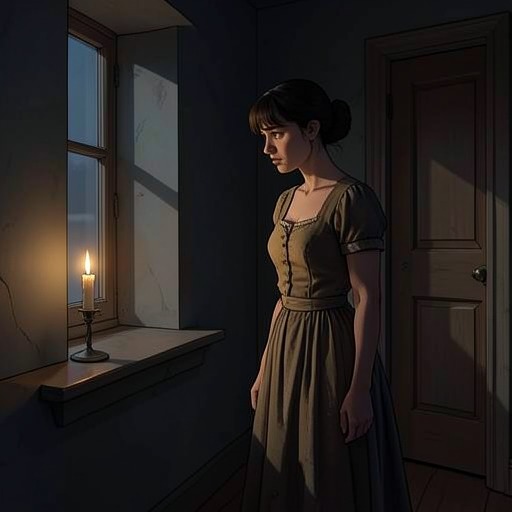
Hagar
Handling the UndeadHagar is Elvy’s longtime friend from church and a steady companion as the return of the dead turns ordinary religious fellowship into a public mission. She helps sustain their Saturday meetings, listens while Elvy makes sense of the crisis through faith, and remains beside her through physical discomfort and fear. Hagar’s role is not that of a solitary visionary: her importance lies in the durable friendship through which Elvy’s conviction becomes shared work.
Identity and Church Life
For twelve years, Hagar, Elvy, and Agnes took turns making coffee and providing cake for the church’s Saturday meetings. When sciatica made Agnes less active, Hagar and Elvy carried most of that work for the next three years. Their closeness is rooted in repeated, practical service rather than a sudden alliance formed in the emergency. Hagar is the friend Elvy turns to when she is distressed, and the one she trusts to understand a question that she can barely articulate.
The narrative gives Hagar a body with its own limits. She has a hearing aid, which she adjusts when she cannot hear well, and her knee hurts enough to make kneeling difficult. These details recur in scenes where the women are trying to respond to events larger than themselves. They do not disappear into an abstract image of faith: Hagar must strain to hear, manage pain, and move carefully, even as she takes part in the work Elvy believes has been entrusted to her.
Friendship in the Crisis
After Elvy returns home, Hagar asks whether she has come home and listens as Elvy explains that the news is not the whole matter. The two discuss the Prime Minister and what is happening, but their exchange turns on a question Elvy poses slowly: whether Hagar is thinking what she is thinking. Elvy’s gesture of shaking her head cannot be seen over the telephone; the scene instead makes their understanding audible in the hesitation and care with which she approaches the subject. Hagar is the person Elvy expects to share the weight of that interpretation.
Their friendship also makes room for unequal certainty. Elvy believes that the returned dead are the spirits of the departed, released, and she later understands the crisis through the Virgin Mary’s suffering and the prospect of tribulation. Hagar is not presented as having the same vision or the same authority. Instead, she stays in the conversation and, when Elvy explains the task of bringing people to the Virgin Mary, Hagar identifies its demand plainly: people must believe. Her response is brief, but it shows that she grasps the purpose Elvy is trying to set before her.
Faith Put into Practice
Elvy is careful to distinguish the work from excitement or spectacle. She warns Hagar that this is not a circus, then insists that the Virgin Mary has personally told her to bring people to her. The warning reveals the seriousness Elvy attaches to the mission; Hagar’s willingness to remain in the discussion makes their friendship a channel through which that private conviction can become collective action. When Elvy addresses a man and says that they have come to prepare him for the return of Jesus Christ, Hagar is part of the setting in which this preaching takes shape, though the words themselves belong to Elvy.
The women’s religious action is not insulated from the storm or from fear. Thunder draws closer, and Hagar looks anxiously toward the ceiling. When the lamps go out and the house becomes completely dark, she squeezes Elvy’s hand and asks whether they should pray. As they get down on their knees, Hagar grimaces because of her knee. The scene places faith alongside bodily vulnerability: prayer is proposed not from a position of ease, but while the women are frightened, in darkness, and trying to manage pain.
When the group tries to find something to sing, Hagar supplies the suggestion: Nearer My God to Thee. Everyone joins in as best they can, singing loudly while candle flames flicker in their breath and the storm continues outside. Her contribution is modest and concrete, but it changes what the group does together. Faced with the noise and uncertainty, Hagar offers a familiar hymn, turning the gathering toward a shared act of endurance rather than leaving each person alone with the storm.
Public Witness and Narrative Role
In a later public intervention, Hagar is associated with the pair of elderly women who climb onto a stage and switch on the public-address system. One approaches the microphone and declares that the dead have awakened because their souls have returned, framing the event as a crisis of souls and warning that people are lost if they do not act. Security cuts off the address and escorts the speaker away; the other woman follows. The intervention carries the women’s religious interpretation beyond the home, while its abrupt interruption shows how little room the public platform allows for their message.
Hagar’s narrative significance comes from the way she accompanies rather than eclipses Elvy. She shares years of unshowy church labor, recognizes the seriousness of Elvy’s belief, helps sustain prayer and song, and joins the attempt to speak publicly about the returned dead. Her hearing difficulty and aching knee do not become symbols detached from the action: they shape how she hears, moves, and participates. Across these scenes, faith appears as something practiced between people—in calls, questions, a hand held in the dark, a hymn proposed, and a warning spoken before the microphone is taken away.