Isolation and containment policy for the reliving
Handling the UndeadThe isolation and containment policy for the reliving is the attempt by medical and government authorities to manage the returned dead as a danger requiring separation while their condition remains poorly understood. Its course runs from isolating individuals and restraining bodies at opened graves to moving a hospital population into the Heath. The policy is presented as a means of providing care and limiting distress, yet the evidence also makes its central uncertainty plain: the reliving may be affected by their surroundings and by other people’s thoughts, so containment can itself shape the behavior it is meant to control.
Definition and Initial Rationale
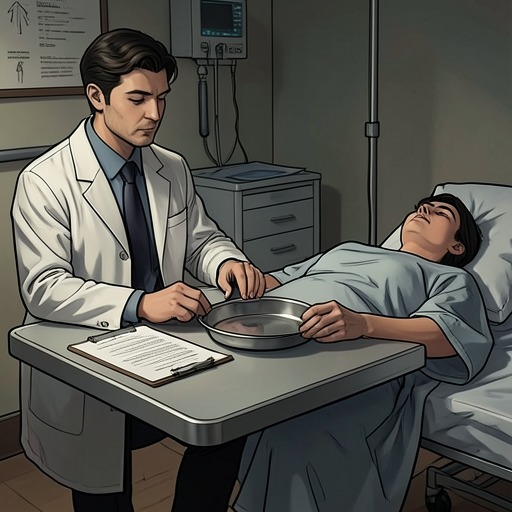
The first stated rationale is precaution. When David Zetterberg seeks access to Eva Zetterberg, a toxicologist explains that the examination is proceeding on the assumption that something may have been introduced into dead bodies. The inquiry uses equipment not available elsewhere and is compared to an investigation of suspected murder. The possibility of bacteria is raised, but the explanation is not presented as a settled account of the return. The authorities are investigating an unknown condition, not applying a confirmed diagnosis.
The same uncertainty underlies the statement that all the reliving have been isolated until more is known. The assurance that David is not the only one indicates that the restriction reaches beyond Eva and is being applied as a general precaution. Isolation functions simultaneously as a medical safeguard and as a boundary around people whose status has become difficult to classify. The policy does not resolve whether they are infectious, conscious, or capable of directing their actions; it places them under control while those questions remain open.
That uncertainty is visible in the contrast between clinical description and the reliving’s limited expressions. In an interview conducted after Eva’s awakening, her speech is described as improving, but she says that she has no mouth and is afraid. The exchange offers no clear account of her experience, yet it complicates any assumption that the isolated are simply inert bodies. In this context, containment protects against an unknown risk while also restricting people whose capacity and needs are not readily measured by ordinary clinical language.
Grave Searches and Physical Restraint
The policy’s most forceful early expression appears at Stockholm Forest Cemetery, where military personnel begin examining at least 200 graves. One man, aged 87 and buried for six weeks, is found alive in an advanced state of decomposition. He tries to escape. His flesh peels away when touched, and soldiers use his burial shroud to force him to the ground; two people are needed to restrain him. The scene makes containment a physical act imposed on bodies that are both severely damaged and moving under their own power.
Military engineers build an enclosure to hold the dead as other personnel continue opening coffins. Johan Stenberg calls the fence a temporary measure and says there is no alternative. The temporary structure is complete by half past two in the morning, while soldiers restrain the newly uncovered dead and prevent others from getting away. The account stresses that the dead fumble uncertainly as they try to find their way out, rather than describing them only as objects being recovered from graves. The enclosure answers an immediate practical problem, but its necessity does not make the encounter less coercive.
The operation also reveals the pressure placed on those carrying out the policy. A cadet describes the scene as hell on earth, sits apathetically beside the enclosure, and then puts his hands over his ears as fifteen dead press against the fence. Containment is therefore not simply a line drawn around the reliving: it organizes a frightening encounter between them, military personnel, and observers. The grave search turns an abstract response to an unexplained phenomenon into a visible system of fences, restraint, and exposure.
Relocation to the Heath
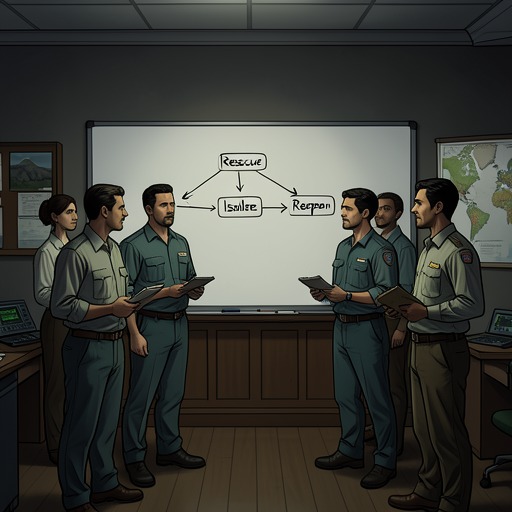
By 16 August, the government has moved from containing individuals to relocating the hospital population. The Prime Minister announces that military personnel carried out the move during the night, presenting it as necessary to provide proper care and to keep the reliving separated. Dividing them among hospitals had been considered, but the government says this would have compromised ordinary health services. The Heath in north-west Stockholm is selected as the temporary solution, with personnel sent there and rehabilitation intended to begin shortly. The announcement also promises that a place will be made for the reliving in society.
The change in setting does not eliminate the tension between care and restriction. The government presents separation as a way to take medical staff’s concerns about mental stress seriously. Before the move, however, a spokesperson has argued that the reliving cannot be kept together as they were in the hospital and must be spread out. The official account describes a facility where they can be separated, while the earlier statement emphasizes dispersal. Together these explanations show that the policy is still being improvised: the authorities seek an arrangement that limits harmful proximity without disrupting the rest of the health system.
The Heath plan thus combines several aims that are not identical. It is a relocation, a containment measure, and a proposed setting for rehabilitation. Its language offers a future return to social membership, even as military action removes the reliving from the hospital and places them in a designated residential area. The promise of eventual inclusion sits beside the immediate fact of separation; the policy offers no completed account of how one is to lead to the other.
Consequences and Unresolved Questions
A contemporary warning challenges the assumptions behind the policy. The reliving, it argues, are not vegetables without will or thought; they are more like jellyfish, with behavior influenced by their environment. The writer argues that they have a will, and that the will of the person thinking of them affects their behavior. This account contests the image of passive patients who can simply be sorted and housed. It also makes the surroundings created by containment consequential: the policy manages the reliving, but the environment and attitudes of those managing them may affect what they do.
The warning recommends complete isolation and destruction by burning, then condemns the decision to release the reliving into the uncontrolled thoughts of the public at large. That grim alternative exposes the policy’s moral and practical bind rather than supplying an accepted solution. Authorities have already isolated people, built an enclosure, and moved a group under military direction; yet dispersal and rehabilitation remain the announced goals. The policy is caught between fear of contact and the need to treat the reliving as people who may require care and a place in society.
The return of the dead has also unsettled the ordinary definition of death. One account argues that if religious or paranormal explanations are set aside, the body’s metabolic process may be capable of restarting; it concludes that none of the classic signs of death can now reliably establish that someone is dead. That claim does not explain how the policy should work, but it clarifies why authorities are acting amid such uncertainty. Isolation and containment are not responses to a settled medical category: they are provisional controls imposed while the boundaries between death, bodily activity, and personhood remain in dispute. The policy’s promise of care therefore carries a persistent contradiction: the reliving are managed as a collective problem even as the evidence challenges the assumption that they lack individual will.