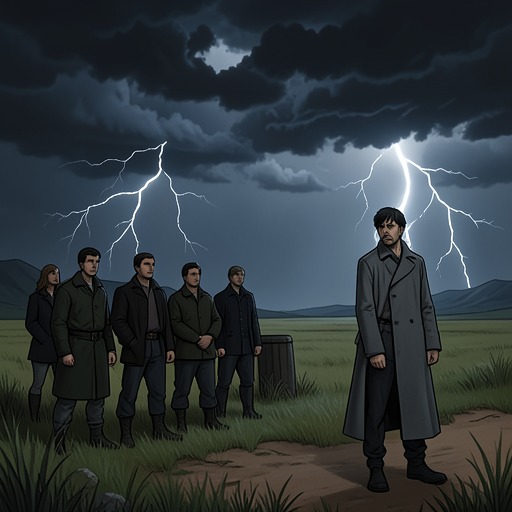
Johan Stenberg
Handling the UndeadJohan Stenberg is a colonel and the military’s public representative during the emergency examination of graves at Stockholm Woodland Cemetery. He confronts the immediate practical problem of restraining the returned dead, then draws a boundary around what the military can claim to understand about them. Between those scenes, his authority appears both necessary and sharply limited: he can speak for an operation, but not make its horrors orderly or settle the questions raised by the dead’s return.
Identity and Institutional Position
The evidence identifies Stenberg by his military rank rather than supplying a personal history. He is presented as a colonel involved in the operation at Stockholm Woodland Cemetery, where military personnel begin examining at least 200 graves. In the account of the operation, his remarks concern the construction of an enclosure and the personnel needed to restrain the dead. Later, on the TV4 morning news, he appears alongside medical and parapsychological voices as a representative of the military’s position.
These appearances give Stenberg two related but distinct functions. At the cemetery, he addresses an immediate question of control: how to keep the returned dead from escaping while graves are opened. On television, he is asked to respond to claims that the crisis might involve telepathy, souls, or other phenomena beyond ordinary military expertise. The novel does not establish him as an investigator of those questions; instead, it shows him marking the boundary between military action and theological speculation.
The Grave-Opening Operation
The cemetery operation gives Stenberg’s authority its most concrete test. The dead are found alive in their graves, and the first reported case is an 87-year-old man buried six weeks earlier. His body is in an advanced state of decomposition, yet he attempts to flee when uncovered. The military must restrain him; the burial shroud is used to force him to the ground, and two people are needed to hold him. As other graves are opened, more of the dead fumble toward escape, while personnel bring them back.
Stenberg describes the fence being built around the dead as unavoidable but temporary: “There is no alternative, but it is only a temporary measure,” he says. The sentence tries to frame the enclosure as a limited expedient, not a solution. That distinction matters because the scenes offer no sign that containment restores the ordinary order of a cemetery. The enclosure holds the dead in place while the operation continues; it does not explain their condition or undo the exposure of the graves.
The work is hurried and visibly improvised. Military engineers erect the enclosure as other personnel dig up coffins without opening them; the fence is finished at half past two in the morning, and the cemetery is filled with military personnel. Stenberg acknowledges the emotional cost as well as the practical need for manpower. When he says, “We assumed this would happen,” he presents the staffing as preparation for the dead’s attempts to escape. He then adds, “I feel sorry for the kid. Psychological pressure.” The narration immediately observes that it is obvious he does not mean what he is saying. That correction unsettles the reassurance in his words: Stenberg can name the pressure, but his formula does not make the experience comprehensible or manageable.
The Televised Debate
Stenberg’s second major appearance shifts from containment to interpretation. On the TV4 morning news, he is asked about reports of telepathic phenomena and whether people who have been in direct contact with the returned dead can read their thoughts. The exchange places military testimony beside medical explanation and speculation about the soul, but Stenberg does not treat the military as qualified to resolve the metaphysical dispute.
When asked what he makes of the discussion, he replies, “I don't believe it is the role of the military to speculate in questions of theology.” He looks toward the parapsychologist as he says this, directing attention to the difference between an operational institution and those better positioned, in his view, to debate theology. His answer is not evidence that he has disproved the claims, nor does it explain the returned dead. It is a refusal to turn military authority into a theological verdict. In a crisis that has already overturned accepted definitions of death, that restraint is also an admission of the limits of the institution he represents.
Character and Narrative Significance
Stenberg is characterized chiefly through public speech, not private experience. The cemetery scenes place him beside an operation that is both organized and appalling: a fence is built, personnel are assigned, and the dead repeatedly try to get out. His language of necessity and temporary measures belongs to administration, while the physical circumstances resist administrative scale. The gap between the two becomes clearest when his expression of sympathy is undercut by the narrator’s observation that he does not mean it.
The televised exchange repeats this contrast in another register. At the cemetery, Stenberg’s task is to describe what the military is doing; on television, he insists on what it should not claim to know. His refusal to speculate about theology does not settle the questions raised by the crisis, but it gives his role a clear limit. Stenberg stands at the threshold between practical authority and inexplicable events: able to help contain the dead, yet unable to make containment equivalent to understanding.