Magnus
Handling the UndeadMagnus, the nine-year-old son of David and Eva, anchors the story’s extraordinary crisis in a child’s everyday needs: time with his father, reassurance about his mother, and the chance to show her a new rabbit. After Eva’s death and return, his confusion hardens into grief and guilt. His arc culminates in a devastating confession that he believes his hostile thoughts caused her to leave, exposing the emotional cost of a catastrophe he is too young to understand.
Identity and Family Life
Magnus is introduced through familiar domestic details. He emerges from his room holding a Pokémon card and asks David whether Dark Golduck is an eye or a kind of water. On another morning, while David is nervous about a performance, the two spend half an hour sorting cards and figuring out what they say. Magnus asks what his father’s job is; David explains that he tells stories, makes people laugh, and gets paid. Their conversation makes fatherhood feel less like an abstract role than a practice of attention: David takes Magnus’s questions seriously and joins him in his small enthusiasms.
Magnus’s life is also organized around Eva’s care. Before the crisis, he is due to spend the night at David’s mother’s home while Eva visits her father and plans to return in the middle of the night. The three share a farewell toast of aspirin and water, and both parents kiss him before they part. That ordinary separation acquires a terrible afterlife when Eva does not return as expected. The family’s routines—visits, bedtime, and a cake planned for his birthday—become measures of what has been interrupted.
Eva’s Absence and Magnus’s Grief
After the accident, David struggles to tell Magnus that Eva is in the hospital. He explains that she has been in a car crash with an elk. Later, Magnus asks whether his mother has become like one of the orcs discussed at school. The question reveals how a child’s available language for the frightening and unfamiliar is drawn from the stories around him; David, who had hoped to tell him gradually, has to answer within the frightening uncertainty of the moment.
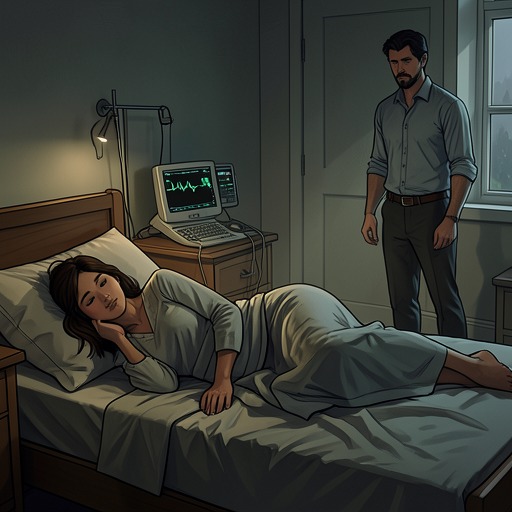
David’s own terror becomes inseparable from Magnus’s future. At Eva’s bedside he begs her to come back and speaks of Magnus turning nine the next week, the pancake cake she had planned, and the raspberries already waiting in the freezer. After Eva’s death, Magnus asks when she will return. David can offer no certain explanation, only the hope that she will come back somehow. The two sit together as Magnus quietly examines his cards, then begins to cry and curls against his father, saying he wants his mother home. David holds and rocks him, sharing rather than resolving the grief.
The crisis follows them into the household. David’s performance at Norra Brunn is cancelled because of the electrical disturbance. When he returns to collect Magnus, the child cheerfully reports watching television until half past ten; David’s mother explains that the set would not turn off and that the headache kept her from dealing with it. Magnus adds that he had a headache too, but watched Tarzan anyway. His matter-of-fact account places a supernatural disruption beside an ordinary child’s choice to keep watching television, while showing that its physical effects have reached the family.
Birthday, Reunion, and Loss
By Magnus’s birthday, his grief has become harder to approach directly. When David and the others enter his room, Magnus lies stiffly on his back with his hands on his stomach, watching them gravely. The packages briefly draw him out of himself: there are Pokémon cards, Legos, and movies. His unfeigned delight comes when they bring in a rabbit. He lifts it into bed, strokes its head, and kisses its nose. Almost at once, he asks if he can bring it to show his mother.
David understands the importance of that request. Since the accident, Magnus has scarcely mentioned Eva; when David tries to draw him out, he realizes that the child resents her for disappearing, then seems ashamed of the resentment and falls silent. The rabbit gives Magnus a way to approach her without having to explain those conflicting feelings. David lets him bring it. They travel with Sture, and Magnus rides in the back seat with the rabbit’s basket while David sits beside Sture. At the Heath, Magnus asks why a man is talking; David answers that the man wants everyone to like him. The child’s attention remains direct and concrete amid circumstances the adults cannot make clear.
As they search for Eva, David experiences the thoughts of people around him as a confusing mental murmur, so intense when the returned dead are close together that he struggles to distinguish his own thoughts from theirs. Magnus, meanwhile, tells his father he is tired and asks where they are. When David explains that the rabbit is for Eva, Roy confirms that she is there and leads them onward. In the room, Magnus points out Balthazar to Eva as the rabbit climbs onto her belly. Their reunion is filtered through the simple act he has carried all this way: showing his mother the animal he loves.
The reprieve ends abruptly. Magnus cries out, and David hears the scream in his mind before it reaches his ears; the sound seems to come from Balthazar. Magnus’s own cry follows, then a birdlike sound and a crack. David lunges toward the bed but is too late. The scene turns the rabbit from a birthday gift and a bridge to Eva into another sudden loss, arriving precisely where Magnus had hoped to make contact with his mother.
Guilt and Narrative Significance
Afterward, Magnus crosses his arms over his chest and says it was his fault. David and Sture tell him that it was not, but Magnus insists that he was the one who did it. Carried back to the apartment in David’s arms, he explains the thoughts he has been unable to say aloud: he thought Eva spoke strangely because she did not care; he disliked her, thought she was ugly, and hated her, though he did not want to. He believes that when he thought those things, that was when she did it. The account does not establish that his thoughts caused her departure; it establishes the explanation a frightened child has made from grief, resentment, and the uncanny events surrounding her return.
Magnus’s story repeatedly places supernatural disturbance beside objects and rituals that children can understand: cards to sort, a television that will not switch off, a birthday rabbit, and a mother to whom the rabbit must be shown. His questions do not solve the crisis, and his guilt cannot reverse it. Instead, they reveal how its consequences enter family life—through interrupted plans, withheld feelings, and a child’s conviction that a thought can harm someone he loves. David’s repeated efforts to hold and comfort him offer companionship, but not an answer large enough to make the loss comprehensible.