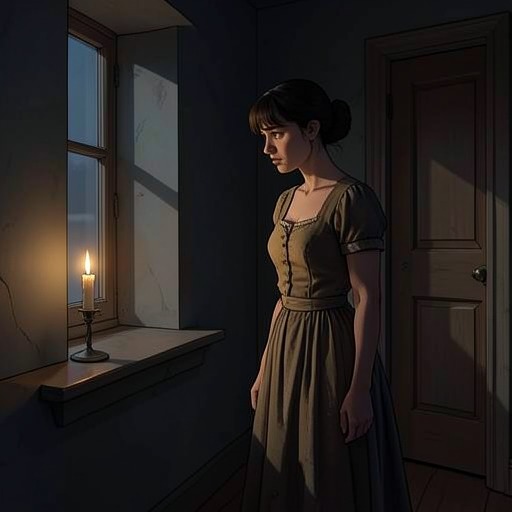
Mary Appears to Elvy and Entrusts Her with a Mission
Handling the UndeadMary Appears to Elvy and Entrusts Her with a Mission transforms an encounter with the Virgin Mary into a charge that Elvy Lundberg must carry beyond the vision. The scene moves from an ordinary domestic moment to an overwhelming religious image, then returns Elvy to the room with a wound she treats as something she cannot simply discard. Its decisive change is from private belief to an assigned task: Mary tells Elvy that others must come to her and makes a sign whose precise cause the scene leaves unsettled.
The television apparition
Before the encounter, Elvy Lundberg’s thoughts have wandered through a disordered mixture of images, and she has nodded off in her chair. The television turning on wakes her. Its brightness first makes her close her eyes again; as she adjusts to it, the screen appears to glow like a small sun, with a central figure surrounded by billowing brightness—or seeming to send rays outward. The uncertainty belongs to Elvy’s perception, but her recognition of the woman is immediate. Recognition arrives before explanation, and trepidation rises in her chest.
The woman wears a dark blue shawl over black hair. The narration presents her eyes through the grief of a mother who has seen her child die: it evokes Mary at the foot of the cross and the removal of her son’s nails with a crowbar. The image dwells on the child’s once-small fingers, the tearing of hands, and the loss that follows. This is not an apparition framed only by radiance or reassurance. The holy figure’s appearance carries the memory of bodily suffering and of a world in which such suffering can happen. Elvy whispers an address to the Holy Virgin and understands the terror she associates with tribulation through the grief in Mary’s eyes.
The commission
Mary tells Elvy Lundberg that she may sit. The permission is intimate and particular: Mary knows Elvy’s name, and the words suggest an awareness of a life spent running and working. Elvy looks briefly at the screen and sees tiny stars, or perhaps tears, on Mary’s fingertips. That uncertainty preserves the scene’s close, hesitant point of view; Elvy can report what she sees, but cannot settle what the brightness or the glistening marks are.
Mary then tells Elvy that a task awaits her. Elvy answers in a whisper so faint that no sound is heard. Mary’s instruction is that they must come to her and that their only salvation is to do so; Elvy must make them understand. The pronoun remains unexplained in the encounter itself. Elvy’s immediate difficulty, however, is concrete: she imagines her neighbours, their hard eyes, and the approaches they have rebuffed, and asks how she can make anyone listen. The vision therefore offers no easy method or guarantee of persuasion. It gives Elvy a duty while bringing the prospect of refusal into the same moment.
The sign and its aftermath
For one second Elvy looks directly into Mary’s eyes and is filled with terror. She sees there the suffering that will befall mankind if it does not repent and seek redemption in Mary’s arms. Mary holds out her hand and identifies what follows as a sign. Something touches Elvy’s forehead; the television goes dark, and she falls sideways in the chair, overwhelmed by a sudden explosion of pain in her head.
When Elvy opens her eyes, the edge of the glass table is pressed against her forehead. She is dizzy as she straightens up. In the hall mirror she finds a shallow, level cut three centimetres long above her eyebrows, running like a minus sign; blood continues to well from it. The sequence connects Mary’s gesture, the abrupt end of the television image, Elvy’s fall, and the injury, but does not make the cut’s physical cause explicit. It is the material fact left behind by an experience that might otherwise remain wholly inward or visionary.
Elvy blots away the blood in the kitchen with paper towel. She cannot bring herself to throw the bloodied paper away, so she puts it in a glass jar and screws on the lid. The small act of keeping it gives the aftermath a second form: the wound is not merely seen and cleaned but preserved. She then calls Hagar. The scene ends with that call rather than with any account of what Hagar says or what Elvy does next, leaving the mission’s practical consequences open while showing that Elvy responds to the encounter by reaching toward another person.
Narrative significance
The apparition’s force lies in the distance between the scale of its demand and the limits of Elvy’s immediate circumstances. Mary speaks of salvation and the suffering of mankind; Elvy thinks of neighbours whose hard expressions and refusals make even a first approach difficult. The task does not dissolve that resistance. Instead, it makes Elvy responsible for trying to overcome it.
The episode also joins spiritual authority to bodily vulnerability. Mary’s grief is rendered through a dead child’s injured hands, while Elvy’s encounter ends with blood above her own eyes. The vision’s brightness is therefore inseparable from pain, and its sign is not explained away as spectacle: Elvy has to face a visible wound, decide what to do with the blood, and call Hagar. By ending at the threshold between vision and action, the event establishes a commission without confirming its reception or success.