Ministry of Health and Social Affairs
Handling the UndeadThe Ministry of Health and Social Affairs is the central government institution drawn into the response to the mass return of the dead in the Stockholm region. As reports spread from hospitals, cemeteries, and families, the ministry moves from receiving urgent information to helping direct an improvised national response. Its minister convenes officials, police, and physicians, then turns to emergency epidemic law before medical analysis has resolved what the returned dead are. The ministry’s role therefore lies at the intersection of uncertain medical knowledge and the immediate demands of public order.
Position in the Emerging Crisis
The ministry enters the crisis as the scale of the event becomes impossible to treat as a series of isolated incidents. Between 23:30 and 23:50, police radio reports indicate that the disoriented people found wandering outside have all died within the preceding weeks. The Ministry of Health and Social Affairs is informed. At the same time, the emergency call centre is inundated with shocked, sometimes hysterical callers reporting the return of dead relatives; paramedics, counsellors, and religious ministers are assembled to support affected families. The ministry receives the news amid both an expanding public emergency and an intimate one, as households confront relatives who had already been mourned as dead.
The early record establishes the ministry as a recipient of police information, not as the originator of a settled explanation. Reports identify who has returned and when they died, but do not explain how life-sustaining functions have resumed or what condition the returned people are in. The institution must act while the basic categories of the crisis remain unstable: the people involved are at once dead according to recent records and physically present again, sometimes disoriented and unable to communicate normally.
Command and Coordination
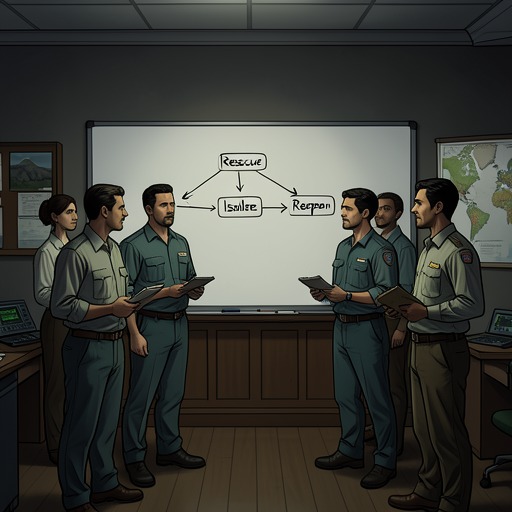
At 00:22, the Minister of Health and Social Affairs arrives at the department. Under his supervision, a provisional command unit is formed from representatives of various departments, the police, and prominent physicians from several disciplines. A conference room is converted into a temporary command centre, soon known as the Dead Room. The arrangement gives the ministry a coordinating role, but its provisional character is significant: the response is assembled in the middle of the emergency, from institutions whose expertise and authority differ.
The crisis is already placing heavy demands on medical facilities. Danderyd Hospital’s infectious diseases ward has been designated as a temporary gathering place, and extra staff have been summoned. By 01:45, 715 returned dead have been admitted there, and disputes and fistfights have broken out among staff members in direct contact with them. The ministry’s command structure thus confronts more than a question of diagnosis. Hospitals must receive and contain a large population while staff face a stressful, unfamiliar situation and reports of extraordinary effects among people working near the returned dead.
The government’s response also develops alongside decisions and actions by other bodies. The Prime Minister, then in Cape Town, is informed of the situation; because it is judged extraordinary, a planned meeting with Nelson Mandela is cancelled and the state plane is prepared for the eleven-hour flight back. The chronology places the ministry’s emergency organization within a broader national mobilization, without suggesting that one institution alone controls every response.
Emergency Authority Before Medical Certainty
At 01:23, the minister, in consultation with judicial experts, decides to apply laws relating to mass epidemics. Their application gives the police corresponding interim authority before medical analysis is complete. A request is sent for the medical examination to be expedited. The sequence is central to the ministry’s function in the crisis: it uses an existing legal framework to make immediate action possible, while acknowledging through the request for faster analysis that the medical basis for the situation has not yet been established.
This decision does not amount to a final explanation of the returned dead or a permanent settlement of their status. It is an interim measure made under pressure. The ministry’s response therefore depends on provisional knowledge and provisional powers at once: officials lack conclusive medical findings, yet police need authority to respond to an unfolding emergency. In this way, the institution helps translate uncertainty into administratively actionable rules, while the uncertainty itself remains visible in the demand to hurry the analysis.
Limits and Significance
The ministry’s command role does not eliminate the strain on the institutions involved. Danderyd’s admissions continue to rise, and the staff’s conflicts illustrate how quickly ordinary professional routines are destabilized by the crisis. At 01:50, the military calls in members of the Army Corps, without consulting the Dead Room, to erect a temporary holding facility for the returned dead before their transport. The episode shows that the provisional command centre operates amid actions not fully coordinated through it; the record does not present a seamless chain of authority.
Later, all staff have left Danderyd Hospital, and a large number of military vehicles are gathered outside its entrances. There is no information about what is happening, while the Prime Minister announces a press conference for seven the next morning. This documented endpoint emphasizes how far the situation has moved beyond routine hospital management, but it does not specify what the ministry itself ordered at the hospital. Across the crisis, the ministry’s documented contribution is more precise: it receives the first official reports, helps establish a cross-departmental command unit, and activates epidemic-law powers while medical inquiry is still in progress. Its significance lies in that urgent bridge between what the authorities do not yet understand and what they must nevertheless attempt to govern.