Stockholm Woodland Cemetery
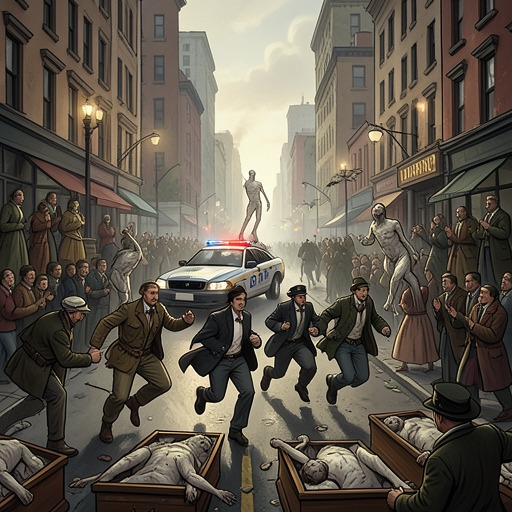
Handling the UndeadStockholm Woodland Cemetery is a burial ground transformed, during the return of the dead, into the starting point of an urgent and perilous investigation. Authorities first send a delegation to listen at the graves; within hours, military teams begin opening them. The first person freed from a grave is found in a waterlogged part of the cemetery and tries to get away, making the site the place where a national crisis becomes immediate physical work.
From counting the dead to listening at graves
Reports that some of the dead had not awakened establish an apparent limit: those who had been dead for two months or less seemed to be returning. When officials correlate databases of the unburied dead in the greater Stockholm area, they arrive at a total of 1,042. At 23:57, they decide that the possibility must be investigated and dispatch a delegation equipped with sound amplification and digging tools to Stockholm Woodland Cemetery. The first task is to listen to the graves, with opening them a possibility rather than an announced certainty. The cemetery thus enters the crisis as a test site: the authorities have figures and reports, but still need evidence from beneath the ground.
Military exhumation
At 01:17, the first military exhumation division sets out for Stockholm Woodland Cemetery. It includes mine-clearance specialists and personnel with United Nations experience opening mass graves in Bosnia. Their presence marks a sharp escalation from listening to graves to physically opening them. The operation is organized under the pressure of a citywide emergency, but at the cemetery the larger uncertainty is concentrated in individual graves and the people inside them.
At 01:40, the first reliving at the cemetery is freed. He is described as being in the most miserable state imaginable, having been lifted from a deep-lying area where the ground is waterlogged. The terrain is not incidental: the first recovery is made harder by the grave’s position and wet surroundings. At the same time, the word freed conveys the operation’s central contradiction. The people in the graves are treated as bodies to be exhumed, yet their return makes the act resemble rescue as well as recovery.
A burial ground unsettled
At 01:41, the cemetery asks the general public for people with strong stomachs. The request suggests that the military effort is not enough to meet the physical and emotional demands of the work. In the same minute, the man just exhumed attempts to get away. The scene shifts the operation from a controlled search toward confrontation with a moving person whose condition and intentions remain difficult to comprehend.
The cemetery’s role is therefore more than logistical. Burial ordinarily gives the dead a place and makes separation visible; here, the graves become sites of uncertain presence, and opening them unsettles that boundary. The sequence—from listening, to military excavation, to a recovered man trying to escape—makes Stockholm Woodland Cemetery the crisis’s first concrete encounter with the possibility that burial has not ended the story.