Sture
Handling the UndeadSture is Eva Zetterberg’s father and Magnus’s grandfather, a broad-shouldered carpenter whose reserve gives way to steady, tangible care. During the family’s crisis, he brings a rabbit to Magnus, accompanies David Zetterberg and the boy to see Eva, and helps uncover the childhood near-drowning that shaped one of her most persistent images. His practical gestures and recovered memories make him a bridge between Eva’s childhood and the family’s bewildering present.
Identity and Presence
On the morning of 17 August, Sture arrives at David’s apartment on Svarvagatan for Magnus’s ninth birthday. Instead of his usual blue trousers and cardigan, he wears a red-and-orange plaid shirt and dress pants that are too tight: he has dressed for the occasion. He carries a cat carrier, which proves to contain the rabbit intended for Magnus. The offering is modest, but it gives the strained household a new, living focus.
Sture is six foot four and broad-shouldered. His size changes David’s sense of the apartment: a roomy two-bedroom seems, in his presence, almost like a prison. The contrast suggests how much Sture needs open space and trees, though he does not make a speech of that need. At the door, he sets down the carrier and hugs David for five seconds. The embrace is neither consolation nor a request for it; it feels instead like the two men accepting a shared fate. David only recognizes afterward that he would have liked to rest his head against Sture’s chest.
Sture is a carpenter, and the details around him are practical and tactile. His newly washed Volvo 740 still smells strongly of wood and linseed oil. He lives in a hexagonal cottage with an extension at the front, which he designed for summer guests. The car and house place his craft in the background of the narrative without making it an abstraction: his work is present in the materials, objects, and spaces through which he cares for his family.
Care for David and Magnus
At the kitchen table, Sture strokes the rabbit’s ears while David makes coffee. His nose is redder than David remembers, veins visible beneath the skin of his cheeks, and David catches the smell of whisky, probably from the previous night. David nevertheless knows that Sture would never drive while drunk. The moment gives Sture a private vulnerability without undermining the confidence David places in his judgment.
When David tells him that Eva is much better and that there have been great strides in her condition, Sture asks when she can come home. David cannot give him a date: those caring for Eva are still working out what will happen. Sture listens while the rabbit rests in his hands, both secure and vulnerable. His concern is direct, but the scene’s quietness matters; he does not crowd David with demands for explanation.
David’s mother arrives with a cage, and she and Sture furnish it with torn newspaper, which Sture recommends as a cheaper alternative to sawdust. As they prepare the enclosure, David watches with the rabbit in his hands. He and Eva had once joked about fixing up their two lonely parents, an idea that had seemed impractical because each was settled in a different life. Now, seeing them work together, David can imagine the arrangement differently. For a moment, the parents seem like a couple and David the solitary one. Sture’s place in the family is thus not only that of an older relative offering help: his presence briefly rearranges David’s sense of who belongs together.
The rabbit becomes Magnus’s birthday present. When the cage is brought to his bed alongside Pokémon cards, Legos, and movies, Magnus’s serious expression softens. His delight is unmistakable as he lifts the animal, strokes its head, and kisses it on the nose. He immediately wants to take the rabbit to show his mother. Since Eva’s accident, Magnus has hardly spoken about her; David has sensed that the boy resents her disappearance and is ashamed of that feeling, so he avoids the subject. The rabbit offers Magnus a way to approach Eva without first having to explain his hurt. Sture’s gift therefore travels beyond the birthday itself, helping father and son make a visit possible.
Family Memory and the Dolls
At 11:15, Sture drives David and Magnus toward Eva in his Volvo. David sits in the passenger seat, Magnus in the back with Balthazar, and Sture studies maps cut from a telephone book to find the place. Before they leave the car, Sture produces two wooden dolls, each about fifteen centimetres tall, and carries them toward Eva in tightly clenched fists.
The dolls hold a family history. When Eva was six, Sture was working as a construction carpenter in Norway, away for two weeks and home for one. During one week at home, he carved a boy and a girl and gave them to his daughter. To his delight, they became her favourite toys, even though she also had Barbie, Ken, and Barbie’s dog. Eva named the figures Eva and David, and later told David the story. The pair, Eva and David Puppets, makes Sture’s care visible across generations: a childhood gift has survived into Eva’s adult life and now accompanies her husband and son to her bedside. Holding the dolls so tightly, Sture brings more than presents; he brings an object through which David can encounter a part of Eva’s life that preceded him.
The Near-Drowning and the Fisher
Later, as David and Magnus attend to Eva, the voices around them grow muted. David experiences an image of tall, yellow bending stalks and soft warmth from a body close beside him. Sture also stands gaping and turning around, holding his head. David understands that Sture is seeing the same thing, though neither initially knows what it means. The shared experience places Sture inside the strange mental disturbance surrounding Eva, rather than leaving him only an observer of her condition.
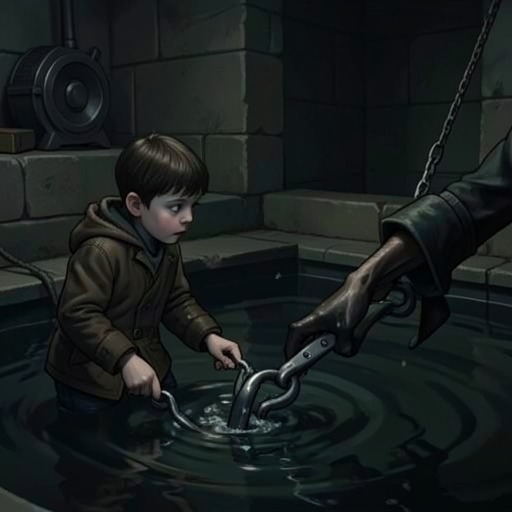
When David mentions the Fisher, Sture recognizes the subject as something from Eva’s childhood. He recalls that she was seven when she came very close to drowning. Sture blames himself for not watching her closely enough; Eva’s mother knew what to do, and the family brought Eva back to life. The memory is painful, but Sture does not withhold it. His recollection supplies a concrete history for the frightening figure Eva has repeatedly described.
He connects that history to a scene in Bruno the Beaver Finds His Way Home: Bruno finds a place to build a house, only to discover that the Waterman also lives in the lake. Sture points to the blurry figure in the water and explains that, several days after Eva nearly drowned, she told her family that some kind of creature had been down there with her. David says Eva had described it as the thing that came to take her, the Waterman. The name she uses now is the Fisher, but Sture remembers how the image first entered the family’s understanding: through a child’s account of an encounter during the aftermath of drowning.
After the near-drowning, Eva drew many pictures of the Fisher, and Sture and the family encouraged her, thinking drawing might help her. He and David search a box of childhood papers, photographs, school yearbooks, rocks, and drawings that Eva had kept. Sture lingers over a photograph of Eva, perhaps ten years old, holding a large pike. He remembers the day with tenderness: Eva caught the fish herself, while he helped with the net. The drawings show that even at nine she could render animals and people with striking skill, suggesting the artist she would become.
Narrative Role
Sture’s importance lies in how he makes connection possible without claiming to explain everything. He cannot resolve Eva’s condition, and the shared vision leaves him as bewildered as David. What he can offer is a remembered childhood event, a book image, old drawings, and the objects Eva chose to keep. Those fragments help David relate the present Fisher to the Waterman of Eva’s near-drowning without reducing the uncanny experience to a simple explanation.
His care also takes several distinct forms: the five-second embrace that acknowledges shared danger, the rabbit that gives Magnus a reason to seek his mother, and the wooden dolls carried to Eva as a record of her childhood. The narrative sets these small, physical acts beside experiences that resist ordinary understanding. Sture’s role is not to master the crisis but to remain useful within it—to help furnish a cage, find a route, hold a family memory, and accompany his daughter’s family toward her.