The Awakening of the Reliving
Handling the UndeadThe Awakening of the Reliving is the crisis that overturns the ordinary meaning of death, transforming a private bereavement into a public and scientific emergency. Its force lies not only in the apparent return of the dead but in the collapse of the procedures that once made death seem final: a heart stops, a coffin is closed, a grave is filled, yet none of these actions can guarantee that the dead will remain still. The event gathers intimate encounters, bodily signs, official announcements, and improvised funerary acts into a single unsettling question about what it means to be dead.
The Failure of Death as a Boundary
A medical account frames the crisis as a problem of definition. Death is ordinarily understood as the cessation of metabolism; if religious and paranormal explanations are set aside, the new possibility is that the body’s biological process can restart. The account stresses that research remains inconclusive, even as indications accumulate. More radically, it argues that the classic signs of death can no longer be trusted and that anyone may come back. The awakening therefore unsettles not just a scientific explanation but the practical authority to declare a life over.
The shock is already legible in David’s arrival at Danderyd Hospital after Eva has collided with an elk. Her heart, which was still beating when the doctor spoke to him, stops at 22:36, before David reaches her. The exact time makes death at once measurable and devastatingly small: one bodily function ends, and David experiences the loss as the collapse of his future and of the past twelve years they shared. The scene preserves the force of conventional death even as the wider crisis makes its finality uncertain. A stopped heart remains a real loss; what has changed is the confidence that stopping marks an irreversible end.
Graves, Rooms, and the Work of Mourning
The crisis enters the Mahler family through the grave of Elias. Before the funeral, Gustav Mahler and Anna stand beside Elias’s open coffin. He wears his favourite penguin pyjamas, with his teddy bear tucked under his arm; Gustav has brought the Harry Potter Lego Elias wanted. Anna strokes his cheek and tries to wake him, while Gustav shares the desperate wish that the scene might still be undone. The careful details of the funeral make the later disturbance more painful: Elias has been prepared and mourned as a child who will not rise again.
At the grave, Gustav lies against the earth and hears scraping from inside the coffin. He calls Elias’s name and begins clawing at the soil with his bare hands, breaking his nails and getting dirt in his mouth and eyes. He has come without tools or a plan, and the sound he hears turns the grave from a place of completed mourning into an urgent barrier between Elias and the surface. The scene does not make the funeral meaningless; it makes its certainty impossible. The ground that was meant to secure a final separation now has to be opened again.
Other domestic spaces register the same effort to live with death’s unsettled status. In Täby Municipality, Elvy prepares Tore’s room for Flora. Three weeks earlier, the hospital smell had been softened with almond-oil soap and detergent, but the day after Tore died Elvy threw out the mattress, pillows, and bed linen and bought new ones. Flora has no objection to sleeping in the room where her grandfather died so recently; she knew him, and he does not frighten her. The replaced bedding and Flora’s calm acceptance offer contrasting responses to a death that remains present in the household without being treated as a threat.
The awakening also invites religious interpretation, though it does not make that interpretation simple. In an encounter with Mary, Elvy asks how she can make people listen. Mary offers a sign; something touches Elvy’s forehead, the television goes off, and Elvy falls sideways against the glass table. When she sits up, she is dizzy and sees blood on the table and rug. The episode joins a claimed revelation to a concrete injury and a darkened television, leaving the experience both physically immediate and open to interpretation.
From Private Grief to Public Knowledge
For David, the crisis initially feels like a personal catastrophe. That understanding shifts at a public government gathering, where cameras and reporters make visible the scale of attention surrounding the reliving. The Minister of Social Affairs apologizes for the delay and for decisions that, in retrospect, may not have been enlightened. David recognizes that the event cannot be contained within his own family’s story. The ceremony’s crowded, almost festive atmosphere sits uneasily beside the deaths that have brought the audience together.
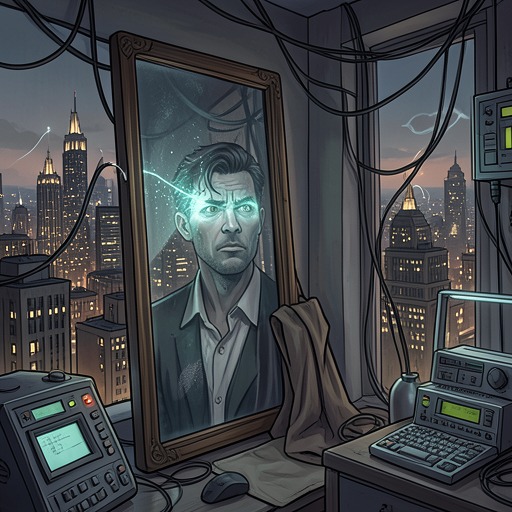
A neurologist from Danderyd Hospital then states what officials and the public have struggled to acknowledge: people can read one another’s thoughts in the proximity of the reliving. He warns that visitors entering the enclosed area will hear what people around them are thinking, although the mechanism is still unknown and the experience may be unpleasant. The audience does not disperse. Their impatience to see their dead outweighs the warning. The announcement makes proximity itself consequential: entering the space is not simply a matter of looking at the dead, but of submitting to an involuntary exchange of thoughts.
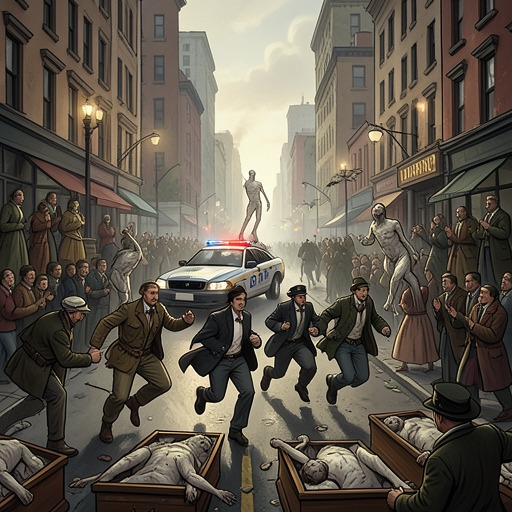
The public account of the crisis later includes violence at The Heath. A report says that police and medical personnel were forced to evacuate the area shortly after one o’clock and that twelve people were injured, three seriously, in attacks by the reliving. A classified summary from the Department of Social Affairs supplies a further, grim measure of urgency: the reliving appear to be using their intracellular resources rapidly, which could be exhausted in at most a week at the observed rate, and earlier in some cases. The report offers no solution. The event thus presents return not as a secure restoration of life but as a precarious condition with its own apparent limits.
Collective Signs and Improvised Rituals
Flora witnesses another form of collective behaviour as the dead gather beneath a lamppost. More arrive from nearby doors until about fifteen are assembled. They begin moving clockwise around the light, forming an irregular circle; when someone bumps into another or falls, that person quickly resumes a place in the ring. Flora watches the dead dance. The movement suggests a pattern emerging among separate bodies, but the scene supplies no explanation for who began it or what it means. Its force comes from the visible gathering itself: the dead are no longer only isolated figures behind individual doors.
Against the crisis’s official uncertainty, people continue to make rituals out of whatever materials they have. After Balthazar’s death, David, Magnus, and Sture find an overgrown thicket on Kungsholmen, between their apartment and the parliament building. David stands guard while Magnus and Sture dig a hole large enough for the shoebox. Before setting out, they have made a cross from string and skirting board; Magnus has written Balthazar’s name on it with a felt pen, and flowers will be placed with the box. David suspects that burying an animal in the city without permission may be unlawful, but the family proceeds. The small funeral gives Magnus something to do that words alone cannot: the burial, flowers, and handmade cross provide a form for grief even while the broader crisis has made burial itself an unsettled practice.
The Awakening of the Reliving is therefore both a bodily event and a crisis of interpretation. Medical language can describe the possible restart of metabolism and the depletion of cellular resources, but it cannot restore a dependable line between the living and the dead. Public authorities can announce the thought-reading effect and issue warnings, but those measures do not answer what families should do with a loved one who has returned—or what it means when that return may not last. The story’s graves, bedrooms, hospital wards, gathering places, and makeshift burial ground show people trying to give the crisis a shape. Their actions do not resolve its uncertainty; they reveal how urgently human beings need forms for death, presence, and farewell.