The Fisher cannot touch the living
Handling the UndeadThe Fisher cannot touch the living is a supernatural limit that separates the living from the dead without separating them from grief. The Fisher can pursue a departing soul, and its hooked hand can reach for the small form associated with Eva, but it cannot touch David while he is alive. That boundary becomes more than a rule of physical contact: David’s living hand can shield the caterpillar, yet his refusal to release it prolongs Eva’s suffering. The limit protects him from the Fisher, not from the cost of holding on.
The Boundary Between Living and Dead
The rule is shown through contrast rather than explained as an abstract law. When Eva’s soul nears the surface of her body, the Fisher swoops toward its prospective catch. It is close enough to threaten her departure, but the sequence does not show it touching her or taking possession of her. Eva escapes before it can reach her: she leaves her chest in a sudden flight, and the Fisher takes up the chase. The distinction is crucial. The Fisher can follow a soul already separating from the body, but Eva’s escape remains possible before the pursuit ends.
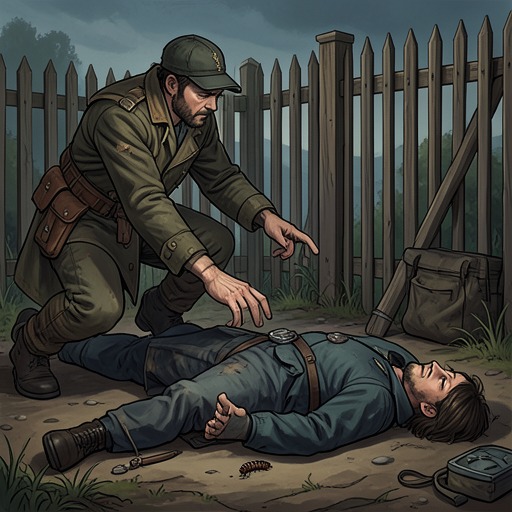
David’s encounter makes the restriction explicit in physical terms. He wakes in Magnus’s bed with his arms outstretched, while a white caterpillar lies curled on his stomach. The Fisher appears beside him as a woman he recognizes from a grocery store, its presence announced by the whining sound and the scent of cheap perfume. Its hand, adorned with colorful bracelets and ending in hooks, enters his field of vision. When David cups the caterpillar, the hooks stop about ten centimeters from his hand. The narration states that they are not permitted to touch him because he is living. The rule is not simply an impression of David’s fear: the hooks halt at a measurable distance.
Eva’s Departure and the Fisher’s Pursuit
The rule frames two different attempts to reach Eva. Flora urges Eva to come out and accept that her body’s door is closed. She communicates the two possible departures for souls: some are collected, while others disappear. As Eva approaches the surface, the Fisher’s whining intensifies behind Flora, and its movement toward the catch makes the danger immediate. Flora’s intervention gives Eva the chance to choose a different outcome before the Fisher can take her.
Eva does not remain to be caught. She leaps from her chest and flies away with the speed of a disembodied spirit. Flora senses a whisper and a brief flicker of consciousness, after which Eva is gone and her body collapses at Flora’s feet. The Fisher then pursues her, but pursuit is not the same as contact or capture. The episode establishes the limit through an unfinished chase: the Fisher can threaten the newly released soul, yet the account does not show whether it catches Eva. Its reach is formidable, but the outcome remains unresolved at this point.
David’s Living Hand and the Caterpillar
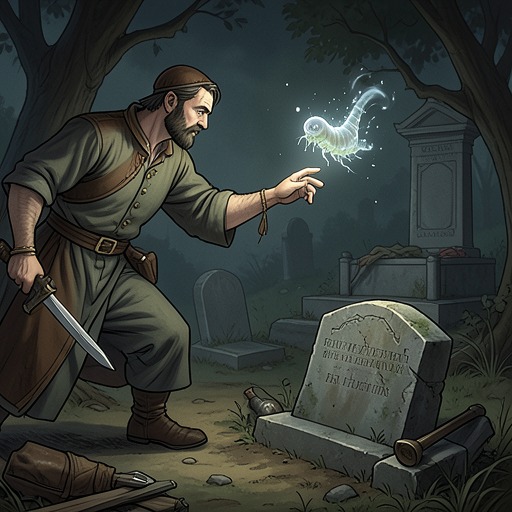
In David’s bedroom, the boundary does not make him a detached witness. He senses Eva’s presence in the caterpillar and hears her plea through it, while the Fisher’s hooks remain unable to touch his hand. David covers the small creature with both hands. The gesture protects it from the hooks, but it also keeps Eva from leaving. He wants to flee the room and escape the world in which events must happen this way, yet fear paralyses him; he refuses to let go.
The caterpillar swells beneath his hand and turns pink, appearing sick and close to death. The hooks return, and one pierces the caterpillar, lifting it from David’s grasp. At the point of entry, a crack opens in what had seemed to be a caterpillar. The image changes: it is a pupa, and a tiny head emerges. A butterfly works its way out; the dry shell falls away and dissolves. After pausing on the hook, the butterfly flies upward and disappears through the ceiling. The hooked hand vanishes, and the whining subsides. The sequence connects Eva’s plea to the transformation and departure of the butterfly, without explaining the mechanism as a general rule of the Fisher’s power.
Consequences and Significance
The rule’s protection is sharply limited. David’s living body is beyond the hooks’ reach, but the living can still be drawn into the dead’s passage through attachment, fear, and the choice to release or retain what remains. His hands can interrupt the Fisher’s approach for a time; they cannot restore Eva to her former life. When he finally witnesses the butterfly’s disappearance, he understands that the encounter has reached its end. He leaves Magnus asleep, closes the door so the child will not hear, and lies on the kitchen floor to cry.
The contrast between Flora and David gives the boundary its emotional force. Flora helps Eva leave her body before the Fisher can reach its catch; David, though physically protected from the Fisher, initially holds on to the form carrying Eva’s voice. The Fisher’s inability to touch the living therefore offers no simple victory over death. It creates a narrow space in which the living can act, but the decisive act is not defeating the Fisher: it is allowing the dead to depart. In David’s scene, the distance between the hooks and his hand marks a limit on supernatural violence, while his own grasp becomes the obstacle that must finally give way.