The Heath Courtyard Attack and Fire
Handling the UndeadThe Heath Courtyard Attack and Fire turns a gathering of the reliving into a violent spectacle: five young men enter a courtyard with baseball bats, and their fear and hatred intensify the danger before the first blow lands. Flora witnesses the attack through her heightened perception, which makes her aware both of the men’s approach and of the vulnerable isolation of the dead.
Approach and Conditions
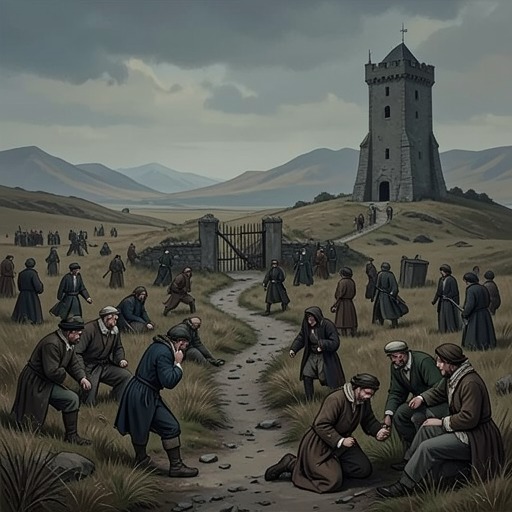
Flora has begun to move on from the courtyard when she senses other living minds approaching from the direction she herself came from. She counts four or five, then recognizes the thoughts of five people as they draw near. Their arrival confirms what she had only suspected: apart from Flora, Peter, and the newcomers, there is not a single living person inside the fence. There are no guards. The reliving are exposed, with no one present to intervene on their behalf. The five young men are too far away for Flora to see clearly at first, but she can tell they are carrying objects. As they approach, she understands that these are baseball bats. Their thoughts are agitated and confused, and she recognizes that they are very drunk. Meanwhile, the reliving continue dancing, apparently unaware of the audience entering the courtyard. The mismatch between the dead people’s absorbed movement and the newcomers’ hostile attention makes the approach ominous: the men have arrived armed, while those they have come to watch do not appear to understand the threat. The young men stop only a couple of metres from the reliving, who have now stopped dancing and turned toward them. Flora feels the hatred and terror emanating from the group grow stronger. The men’s reactions draw on familiar images of zombies and monsters, and Flora understands that they have come looking for a frightening, live encounter. Their excursion treats the reliving not as people but as a spectacle—and the fear and hostility they bring into the courtyard help turn that spectacle into an attack.
Assault and Escalation
The men’s violence begins when the reliving move toward them, seemingly nourished and goaded by the hatred they have brought into the courtyard. A thin old man, shorter than Markus, reaches out and catches his shirt. Markus jumps back, sees the tear, and strikes the old man in the head with his baseball bat. The blow sends the dead man spinning through the air and crashing onto the concrete. One of Markus’s companions celebrates the hit with a high-five; together they move in on the reliving.
Flora cannot intervene. The men’s blood lust and hatred flood her thoughts so completely that she loses command of her body and can only watch. The five young men, fit and armed, knock the reliving down one by one, cheering as they strike. They continue hitting bodies already on the ground, as if dismantling something that must be smashed into pieces. The reliving do not defend themselves: even with broken legs, they keep crawling toward their attackers. Each blow slows them, but does not stop them.
Afterward, the men step away from the crawling bodies and smoke while surveying what they have done. One says he may have been bitten. His companions joke that he will become a flesh-hungry zombie, until he crouches beside a badly damaged old woman and taunts her by offering his arm. Her crushed mouth opens and closes; then her other arm suddenly reaches out, seizes him, and her teeth sink into his flesh. When he tries to pull free, she hangs from his arm like a ragdoll. Her jaws remain locked as he shakes her, and she tears a substantial piece from his lower arm.
Markus tries to help by telling the injured man they need to apply pressure, but the man seems not to hear. He tears open a backpack, takes out two plastic bottles, and splashes their contents over the still-quivering heap of bodies. Running around the pile, he empties both bottles in a frantic attempt to prevent another bite. The other four have battered themselves into exhaustion, and Flora’s paralysis is beginning to lift; but the injured man’s hysteria still overwhelms her perception. As the men take matches from the backpack, she senses another presence across the courtyard: a figure like herself.
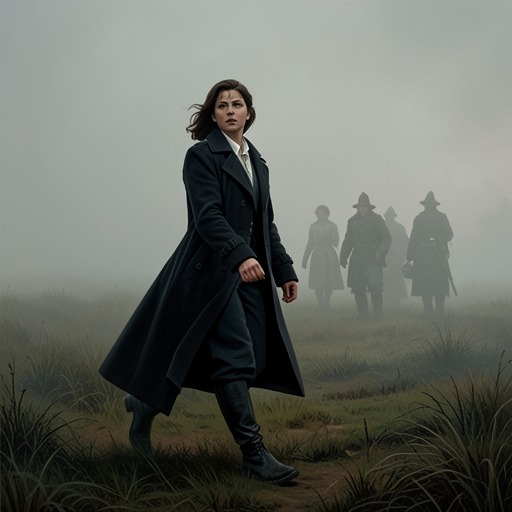
The figure is Death, and Flora mirrors her as she spreads her arms. While the men prepare to set the bodies alight, Death steps into the heap, bends down, and makes small plucking gestures, as if gathering berries. Flora screams a warning as a lit match flies toward the fuel. At the instant it lands, Death raises her head and meets Flora’s gaze. The two faces are identical; in that brief eye contact, they share their secrets. Then the petrol explodes, and a wall of flames rises between them. The men freeze before the fire and then flee, leaving the bodies to burn.
Aftermath and the Other Place
When Flora looks back among the burned bodies, she first mistakes the movement for fingers trying to survive the fire. It is instead white caterpillars burrowing out of some of the corpses. The bonfire’s stench remains unbearable even through her face mask, and she shuffles away from it. Around fifteen people had been in the courtyard; only seven caterpillars emerge. The missing number is part of the horror: the flames have not simply destroyed bodies but left most of the dead without even this visible remainder.
Flora understands the caterpillars as the human element in the dead, given a form she can perceive. The figure she met across the fire was her twin only in appearance; Flora now knows that Death cannot be understood in human terms. During their moment of eye contact, a knowledge beyond ordinary words passed between them. The caterpillars, by contrast, make the fate of the dead briefly visible: Flora hears their anguish as they realize they are being pulled toward The Other Place, an unknowable destination beyond description.
The caterpillars swell until their thin membranes stretch, and their cries grow louder. Flora knows that this is not literally happening in the ordinary material world; her watching renders visible an invisible drama she understands as ancient as humanity. One by one, the caterpillars burst with an audible yet inaudible plop. Their translucent fluid runs over the scorched bones and evaporates in the heat as the screams fade. Flora backs away from the fire and sits on a bench, overwhelmed by what she has learned from Death and unable to bear the knowledge.
The attack’s local violence becomes, in Flora’s newly altered understanding, a minor consequence of a much larger order. Within a bounded area, the dead have awakened; the event is like a hurricane producing the beating of a butterfly’s wings, a small occurrence in a scale of things that reaches beyond the human world. The courtyard’s burning bodies are therefore both the immediate result of hatred and terror and a footnote in a cosmic book—an ending whose meaning Flora can know but cannot put into words.
The Attackers’ Social and Legal Frame
The violence is sharpened by how ordinary and organized the five men appear: Flora reads them less as a lynch mob than as a business-school social club, dressed in light-blue shirts and clean jeans. Their manner makes the attack look like an outing that has slipped into brutality, rather than a confrontation forced upon them. As one begins to invoke the law, Flora senses an image of an older man—presumably his father—at a kitchen table explaining that the reliving remain defenseless because the law has already declared them dead. The young man is interrupted before he can finish. The unfinished appeal exposes the gap between legal classification and the vulnerable bodies in the courtyard: the men can treat the reliving as if no protection is owed, while the scene makes the consequences of that belief brutally physical.