The Other Place
Handling the UndeadThe Other Place is the name for a destination beyond the dead person’s body and beyond ordinary human knowledge. In Flora’s account, it is not a place she can describe or explain: she understands that some souls are drawn toward it, but what happens there remains inaccessible. Its importance lies in this boundary. The novel makes death visible through bodies, apparent signs, and competing routes for the soul, while refusing to turn the ultimate destination into a known geography.
Naming and Limits of Knowledge
Flora’s understanding comes through direct encounters rather than doctrine. After the bodies at the bonfire have been destroyed, she sees white caterpillars emerge from some of them. She recognizes these figures as the human element in the dead, made visible in a form a living observer can comprehend. The image gives her a way to perceive what is otherwise hidden, but does not make the underlying process fully knowable: the caterpillars are a representation of people, not a literal explanation of what a person is.
The distinction becomes explicit when the caterpillars begin to swell and Flora hears their anguish. She knows they are being pulled toward The Other Place, yet her knowledge stops at the destination’s threshold. She understands that this is a place about which nothing can be said, and later recognizes that no one can know anything about the place to which the souls are going unless they are there. The certainty that a passage is occurring therefore coexists with uncertainty about its meaning and outcome.
This limit also separates The Other Place from the other destination Flora names. She knows that there is another place about which nothing can ever be said. The two possibilities are not interchangeable in her account: one is associated with souls going somewhere that cannot be known from outside, while the other is defined by an absolute impossibility of saying anything about it. The distinction is significant even though Flora cannot provide a map, description, or theology that would settle what either destination contains.
Souls, Bodies, and the Fisher
The Other Place belongs to a story in which bodily death does not automatically settle what happens to the person. When Eva’s soul nears the surface, Flora transmits two images of souls leaving their bodies: some are collected, while others disappear. The Fisher is already approaching Eva as a potential catch, but Eva escapes before it can take shape and flies away. The scene establishes that being collected and disappearing are different outcomes; it does not establish what the departed experience after either one.
The bonfire gives this uncertainty a more terrible physical form. Only seven caterpillars emerge from the remains, although around fifteen people had been there to begin with. Those that do emerge have nowhere to go because their hosts have been destroyed. They swell and burst, and Flora hears their cries as they are drawn toward The Other Place. The scene joins an observable consequence—the bodies are burned and the caterpillars appear—with an unseen passage that remains beyond explanation. Its horror comes partly from the mismatch: Flora can witness the signs of departure, but cannot save the souls or follow them.
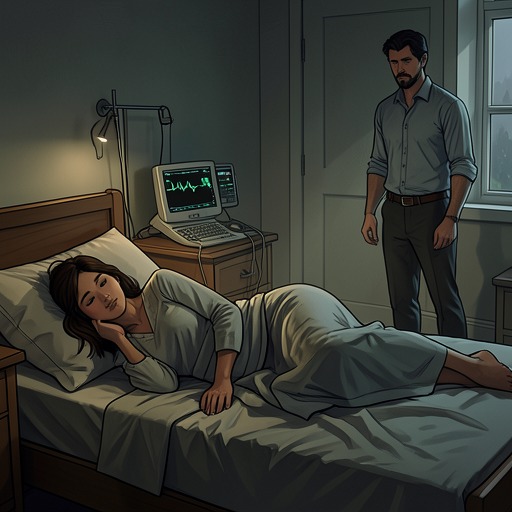
The novel also distinguishes the soul’s fate from the handling of the body left behind. After Eva leaves, Flora thinks of what remains as something that can be burned or buried, while the soul has departed. Earlier, Eva’s heart stops at 22:36; elsewhere, Elvy replaces the bedding in the room where Tore died, and Mahler hears scraping beneath the grass over a coffin. These details make death a bodily and domestic event as well as a metaphysical question. None, however, supplies evidence about The Other Place itself.
A Boundary for Explanation
The uncertain destination is set against attempts to define death materially. One account calls death the cessation of metabolism, then considers the possibility that the body’s biological process can restart; it concludes that the classic signs no longer provide a reliable way to declare someone dead. The possibility of return unsettles the boundary between life and death, but it does not answer where a soul goes when it leaves the body. Biological explanation and spiritual destination address different uncertainties.
Flora’s own response makes that separation personal. After Eva’s departure, she kneels beside the empty body and asks why people are born and what the point of life is. She acknowledges that she knows nothing about those questions, nor about the place beyond death except for the limits she has encountered. Her sense that she has a role in saving souls does not give her mastery over their destination. Rather, the encounter leaves her with responsibility and incomplete knowledge: she must act in the immediate crisis without pretending to understand what follows.
Narrative Significance
The Other Place gives the novel a horizon that its supernatural events do not cross. Caterpillars, the Fisher, and departing souls make the transition perceptible in forms Flora can understand, but each image stops short of describing what lies beyond. The figures are consequently both evidence within the story and limits on explanation: the reader sees more than an ordinary observer could, yet remains unable to turn that vision into a complete account of death.
That restraint sharpens the contrast between what can be counted and what cannot. The number of caterpillars, the destruction of bodies, and the moment Eva’s heart stops are concrete; the destination of a soul is not. Flora’s knowledge is therefore neither simple disbelief nor a finished religious doctrine. She recognizes a passage, distinguishes possible outcomes, and accepts that its ultimate meaning is unavailable from the living side. The Other Place names that unresolved boundary rather than resolving it.