The Power
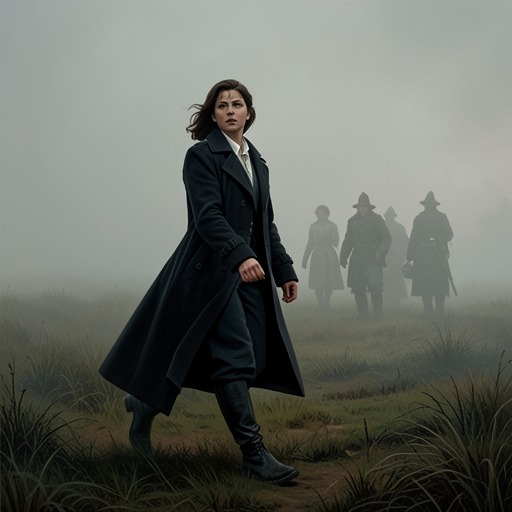
Handling the UndeadThe Power is Flora’s ability to sense minds and thoughts, a capacity that becomes overwhelming at the Heath, where the reliving gather behind a military fence. It lets her register fear, distinguish individual thoughts within a collective field, and detect living people by the presence of their minds. But the power is not simply a tool for gathering information: its intensity changes with the people around her, and what she perceives can leave her needing to withdraw and recover.
How the Power Is Experienced
Flora manages the strain of being among people by counting prime numbers in her head. The counting gives her something to hold on to as fear presses in from every direction. What she senses in people is not limited to what their faces disclose: beneath their ordinary appearance she perceives terror at confronting the unknown. The scene presents the power as an immediate, intrusive experience rather than a conclusion Flora reaches by observing behavior. Her attention is occupied by other people’s inner states even as she tries to keep herself steady.
The sensations vary with place and distance. Near the Heath’s entrance, Flora experiences the thoughts around her as streams running through her head. She walks away from the gate with her fingers trailing over the chain links, and the mental noise gradually fades. Once the people inside have receded from her awareness, she sits in the grass for a mental breather. The change gives the power a felt boundary: distance from the people reduces its pressure, although the passage does not establish a precise range or suggest that the fence itself blocks it.
The Heath’s Collective Field
At 12:50, as Flora moves toward the buildings, the sensation grows stronger. The streams she experienced beyond the gate become a thickening fog. Within it, individual thoughts are faint but clear, like distant cries. Yet the field is not merely a multitude of ordinary, separate thoughts. Flora senses many consciousnesses present together, strongly felt but, in themselves, thinking no thoughts. Mental exclamations of horror break into that presence and make it more intense.
The distinction between the quiet presence of the gathered consciousnesses and the horror rising around them is central to how the power works in this scene. The field intensifies as fear is experienced and expressed; the text compares this to an electrical conductor warming when power flows through it. The statement “The more you fear us, the bigger we get” gives that relationship a stark, reciprocal form: fear is not just a response to the reliving, but a force that enlarges the field Flora is trying to apprehend. The comparison suggests a process rather than a fixed atmosphere, without explaining the field as a literal electrical mechanism.
Reading and Concealing Minds
Flora can also sense living people approaching. While inside the fenced area, she detects other living minds coming from outside and estimates that there are four or five. Their arrival lets her understand something she had only suspected: apart from herself, Peter, and the people now approaching, there is no living person inside the fence—not even a guard. Her power therefore does more than register an indistinct presence; in this moment, it helps her make a practical distinction between the living and the many consciousnesses associated with the reliving.
The approaching group also reverses Flora’s usual position as the one who reads others. As the five enter the courtyard, she senses their excitement and terror, but they become aware that someone is there and begin scanning for her. Flora realizes that they can read her thoughts as clearly as she can read theirs. She tries not to think, then uses the static she had previously tried on Peter. The passage does not explain how the static works or establish that it makes her undetectable; it shows instead that she has a means of responding when her own mind becomes perceptible to others.
Limits and Significance
The encounters at the gate and inside the Heath reveal different pressures within the same capacity. At the gate, Flora can leave the streams of thought behind by moving away and sit alone until she feels able to continue. Near the buildings, the collective field becomes so strong that she must take it in deliberately, and the fear within it contributes to its growing intensity. The power thus has no single, stable experience in these scenes: proximity, attention, and the emotional state of those around her all shape what Flora perceives.
Nor does the ability give her effortless mastery over the people she senses. A guard’s thoughts about youths prying up cobblestones make further debate pointless to Flora, but knowing what he is thinking does not prove her case or persuade him. At the Heath, she can identify approaching minds and attempt to conceal her own, yet the five intruders still enter the courtyard and approach the dead. The Power brings hidden mental states into Flora’s awareness; it does not, on the evidence here, grant control over the people or circumstances those states reveal. Its significance lies in that tension: perception offers knowledge, but the knowledge itself can be exhausting, reciprocal, and insufficient to prevent danger.