The Reliving (the Dead)
Handling the UndeadThe Reliving (the Dead) are people who resume activity after being declared dead or buried, making death an uncertain boundary rather than a dependable endpoint. Their return is visible in bodies that may be profoundly damaged, but also in movement, apparent intention, and responsiveness to their surroundings. The novel does not resolve whether the person has returned in full; instead, it makes the living confront a harder distinction between a body that has restarted and a loved one they can recognize.
Definition and Biological Paradox
The phenomenon overturns the ordinary medical and social meaning of death. An editorial responding to the mass return of roughly two thousand people argues that, if religious and paranormal explanations are set aside, the body may be capable of restarting its metabolism. The explanation is explicitly provisional: there is no definitive research, only indications. Yet the practical consequence is immediate. The classic signs of death can no longer be treated as conclusive, and no one can be certain that a person declared dead will remain so.
That uncertainty reaches into intimate life. When David arrives at Danderyd Hospital, his wife, Eva Zetterberg, has died after colliding with an elk; the doctor had told him that there was no hope, although her heart was still beating. It stops at 22:36, and David stands beside her bed as the loss collapses his sense of past and future into a single unbearable present. The scene makes the crisis more than a scientific puzzle: the body’s status determines whether a family can trust the finality on which mourning depends.
Physical Condition and Return
The first reported military grave opening at Stockholm Woodland Cemetery presents the starkest physical evidence. An 87-year-old man, buried six weeks earlier, is found alive despite advanced decomposition. He tries to flee the cadets opening the grave, but they restrain him; flesh peels away at their touch, and soldiers use his burial shroud to force him to the ground. The military is examining at least 200 graves, so this is not an isolated recovery but the beginning of a large and dangerous operation.
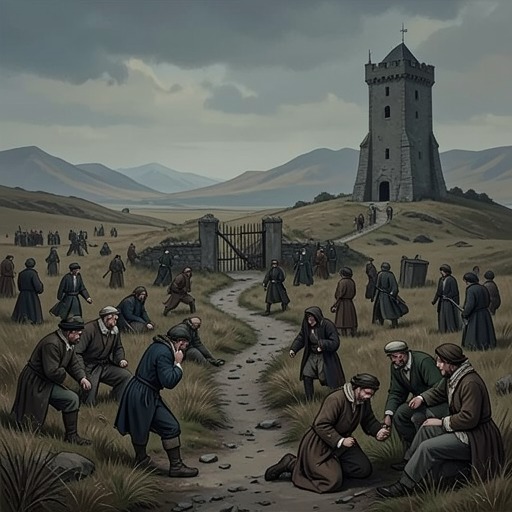
The bodies do not return as restored versions of the people they were. At the cemetery, the dead fumble uncertainly toward a way out, and many attempt to evade their captors. An enclosure is built to contain them; fifteen stand pressed against its fence, their empty eye sockets directed toward the outside. The contrast between movement and visible bodily ruin prevents an easy reading of their actions: they can appear to seek escape while remaining physically devastated and difficult to interpret.
The same bodily estrangement enters the private family story of Gustav Mahler and his grandson, Elias Mahler. Before the funeral, Elias lies in a white coffin wearing penguin pajamas, with a teddy bear beside him. Later, Gustav Mahler hears scraping beneath the grass at the grave and digs with his bare hands. He calls to Elias and carries the recovered body, but the child is cold and rigid rather than warm and soft. The return therefore does not erase the corpse’s material reality or the family’s memory of the child who died.
Behavior and the Influence of Others
The novel resists treating the returned dead as wholly inert or without will. A written reflection calls the assumption that they are mindless vegetables mistaken, comparing their behavior instead to jellyfish: it is affected by the surrounding environment and by the will of the person thinking about them. This account makes the living part of the conditions under which the dead behave. Fear and expectation are not merely reactions to the phenomenon; they are implicated in how it takes shape.
A television report from Danderyd Hospital offers a small, unsettling image of that responsiveness. Around twenty of the Reliving sit or lie in a ward, all with wide eyes and slack mouths, absorbed by a metronome ticking back and forth on a rolling cart. The scene suggests attention without explaining its nature. Their shared focus may look like wonder, but the report cannot establish what they understand or experience; the metronome becomes a visible point of contact between their altered condition and the ordinary efforts of hospital staff to manage it.
Their movements can also gather into patterns that seem larger than individual intention. Flora watches dead people emerge from nearby doors and drift toward a lamppost. Once about fifteen have assembled, they begin moving in an irregular clockwise circle. Some stumble or collide, then resume their place; Flora sees them dancing. The scene offers no definitive account of their purpose, but turns their uncertain behavior into a collective spectacle, at once vulnerable and uncanny.
Care, Containment, and Mourning
The practical response to the returned dead is shaped by the condition of their bodies. Sten Bergwall explains that, technically, they remain dead, with the physical consequences that entails. Because nearly two thousand people have been retrieved from the ground, staff have spent the night converting ordinary rooms into cold storage. Using a morgue is avoided on ethical grounds, yet the scale and bodily condition of the population make refrigeration necessary. Care and containment are not separate solutions: the same people must be housed as human beings and managed as decaying remains.
Families face that contradiction without institutional procedures. After Tore dies, Elvy Lundberg replaces the mattress, pillows, and bedding in his room, where the antiseptic hospital smell had lingered. Three weeks later she prepares the room for her granddaughter Flora, who is willing to sleep there because she knew him and is not frightened of him. The room’s changed bedding registers the physical aftermath of death; Flora’s acceptance registers a continuing relationship that is not reducible to fear of a corpse.
The crisis also makes ordinary language reveal the distance between a child’s understanding and adult dread. When Magnus asks David whether his mother has become like one of the orcs, David takes him by the hand and walks home with him. The question turns a public category into a family possibility. For the living, the Reliving are never only a medical or military problem: they may be a spouse, a child, or someone whose familiar identity has become impossible to confirm.
Narrative Significance
The Reliving unsettle the boundary between biological death, legal classification, and personal loss without replacing it with a clear new rule. Bodies move after burial, yet decomposition continues; apparent intention appears, yet its source remains uncertain; families recognize the dead, yet cannot make physical return equal restoration. Each attempt to manage the phenomenon—opening graves, building enclosures, providing cold storage, or preparing a dead relative’s room—creates a temporary response rather than a settled account of what the returned are.
Their significance lies in this unresolved gap between presence and return. The dead can be seen, heard, restrained, and cared for, but those actions do not answer whether the person who once inhabited the body has come back. By placing public scenes of military containment beside intimate acts of mourning, the novel makes that uncertainty both collective and domestic: death’s finality fails, but the failure does not deliver an uncomplicated reunion.