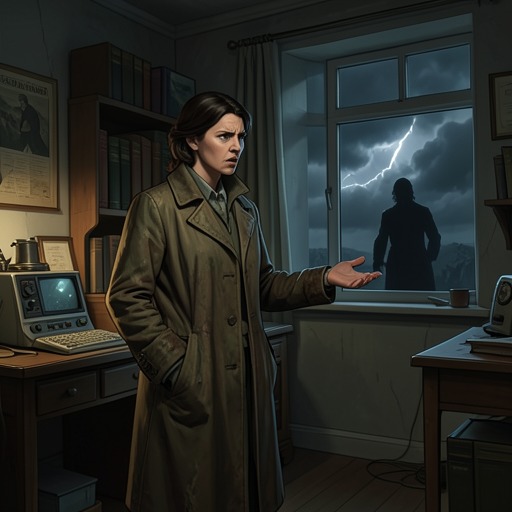
The Virgin Mary's Apparition to Elvy
Handling the UndeadThe Virgin Mary's Apparition to Elvy is a vision in which the Virgin Mary gives Elvy a mission concerning the returned dead. It transforms a moment of fatigue in front of a television into a demand for action: Elvy must persuade others that salvation lies with Mary. The scene binds that commission to an image of maternal grief, while its abrupt physical ending leaves the divine encounter entangled with the ordinary room in which it occurs.
From exhaustion to apparition
Elvy has nodded off where she is sitting, her thoughts drifting through a disorderly mixture of images. The television turning on wakes her. Its light is at first so intense that she has to close her eyes again; when she cautiously opens them, the screen appears like a small sun. The vision does not begin with a deliberate prayer or a journey elsewhere. It breaks into the familiar room through an everyday appliance, and Elvy encounters it first as light that her body cannot yet bear to look at.
As her eyes adjust, she sees a central figure surrounded by brightness, or brightness streaming from the figure. She recognizes the woman immediately: the Virgin Mary. Recognition brings trepidation before Elvy has had time to work out what the sight means. The scene's order matters. Light overwhelms her, the figure comes into focus, and only then does the religious meaning of the encounter gather force. Elvy's response is bodily as well as interpretive: fear wells up in her chest, and she is soon moved to rise and kneel.
The image of a grieving mother
The woman wears a dark blue shawl over black hair. What Elvy sees most strongly, however, is grief: the face of a mother who has seen her child die. Elvy's vision associates that grief with the cross, the removal of nails from her son's hands, and the memory of those hands as once small and reaching for their mother's breast. The imagined grinding of metal through wood and the shredded hands make the sacred image painfully physical. In Elvy's understanding, this is not only a mother's anguish at the torture and execution of a cherished child. It is also anguish at the existence of a world in which such suffering can happen.
Looking at Mary's eyes, Elvy understands the apparition through the language of tribulation: suffering on a scale that, in her perception, has not been seen since the beginning of the world. The vision therefore gives her no easy comfort. Mary's radiance is inseparable from grief, and the encounter makes the suffering of the world part of what Elvy must confront. When Mary spreads her arms in welcome, Elvy starts to get up so that she can kneel. Mary tells her she may remain seated. Her words acknowledge Elvy by name and suggest that she has spent her life running and working; now, for a moment, she is allowed to sit. Tiny points on Mary's fingertips seem to Elvy like stars or like tears wiped from her face, keeping the image poised between welcome and sorrow.
A commission addressed to Elvy
Mary tells Elvy that a task awaits her. Elvy answers in a whisper too faint to be heard, but the direction of the encounter is clear: Mary is not appearing simply to be recognized or revered. She says that the returned dead must come to her, that their only salvation is to come to her, and that Elvy must make them understand. This gives the vision a practical objective. Its message concerns other people, and Elvy is charged with carrying it beyond the room.
The commission immediately meets the difficulty of its audience. Elvy thinks of her neighbors as hard-eyed people who have rebuffed her approaches. Even within the solemnity of the vision, she asks how she can make them listen. Her question exposes the distance between religious certainty and the work of persuasion: Mary states what must happen, but Elvy sees the resistance of the people she is expected to reach. The task is entrusted to someone whose ordinary efforts have not guaranteed an audience, making the vision both a source of authority and a demand she does not know how to fulfill.
The sign and its abrupt end
For a second, Elvy looks straight into Mary's eyes and is filled with terror. She sees there the suffering that will befall mankind if it does not repent and seek redemption in Mary's arms. Mary then holds out her hand and identifies what follows as a sign. Something touches Elvy's forehead; the television goes off, and Elvy falls sideways in the chair, experiencing the blow as an explosion in her head.
When she opens her eyes, the vision has given way to the furniture and injuries of the room. The edge of the glass table is pressed against her forehead. She straightens, dizzy, and sees a red smear on the table's corner and drops of blood on the rug. The television is dark and silent. The physical evidence confirms that Elvy has struck the table, but the passage does not explain the touch or settle whether the apparition should be understood as supernatural or as a vision occurring around her doze. Its ending holds those possibilities together: a message of cosmic suffering and salvation culminates in a concrete wound, and the screen that had blazed like a sun becomes an inert household object. For Elvy, the encounter's lasting weight is the mission it places on her, not an explanation of how the television lit up or how she fell.