The drowned man kills Mahler
Handling the UndeadThe drowned man kills Mahler in a sequence that links two acts of confrontation on Labbskar Island: Anna’s attempt to keep the creature from entering the hut where she is with Elias Mahler, and Gustav Mahler’s decision to approach it outside. The episode makes the threat physical and intimate before ending in a sudden reversal, as Mahler’s effort to destroy the creature leaves him helpless on the rocks.
First Encounter at the Hut
Before the creature appears, Anna recalls a childhood painting of a troll father patiently showing his daughter how to fish. She had imagined having a father who stood close behind her, guiding her with the same tenderness; the memory gives the scene’s sudden intrusion an especially cruel contrast. Looking toward the window, she sees what first seems to be a balloon but resolves into a swollen, white face, its lips gone and teeth exposed. A corpse-white hand rises against the glass. Anna screams, and the face withdraws toward the door.
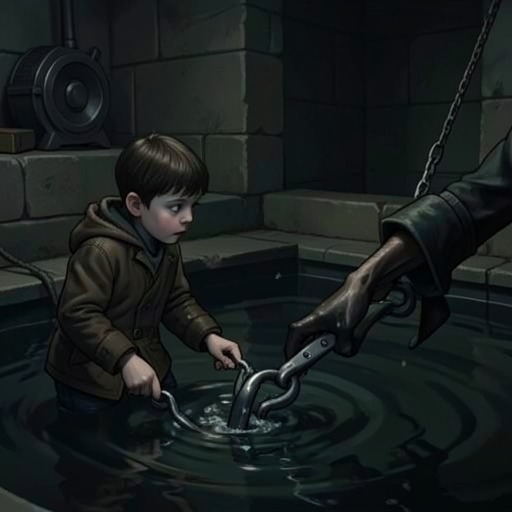
Anna reaches the kitchen door and braces herself against it as something outside pulls from the other side. Elias’s voice comes to her inside her head, asking for his mother; she holds on, aware that the creature is trying to force its way in to them. Though a small axe lies under the counter, she cannot release the door to reach it. When the door opens slightly, she glimpses the figure’s naked, white body, its flesh like lumps of dough thrown over a skeleton, and recognizes it as a drowned man. The recognition does not make the danger manageable: she keeps resisting while catching further glimpses of its dissolved, fish-eaten flesh.
Mahler’s Confrontation on the Shore
Mahler returns to the hut by rowing straight to shore instead of taking time to moor the boat. Water seeps into his shoes as he walks through the dark toward the house, calling for Anna and receiving no answer. When he pulls at the front door, something resists from inside; it suddenly gives way, and a loose broomstick falls toward him. Anna’s croaked explanation—that a dead man, a corpse, someone who drowned, is there—turns the empty darkness into a threat he believes he must face. He takes the heavy torch and searches the rooms with an axe.
In the other room, the torchlight reveals a broken window and shards of glass scattered over the floor and table. At first Mahler mistakes what lies among them for a rat; it is a severed hand, its skin wrinkled and thin, with the flesh missing from the index finger. He prods it with the axe and watches it roll without moving. The detached hand is a grim sign of the violence already done, but Mahler presses on, looking outside rather than retreating.
Anna says they are not doing the right thing, while Mahler insists that they are. When he opens the door and sweeps the torch across the rocks, grass, and raspberry bushes, he finds a white shape lying on the shallow rocks at the inlet, its torso on the stone and its head at the water’s edge. He switches off the light and approaches across slick seaweed with the axe in his hand. From about twenty metres away, he sees the figure stand. It has lost large parts of its body; its head turns as if listening for his steps, though it has no eyes. The moonlight exposes its eaten chest and white ribs, while the stench of rotten fish comes across the breeze.
When Mahler turns on the torch, its light reveals what moves inside the creature’s open chest: a fat black eel, trapped within the cavity and eating its way out. The sight overwhelms him. He vomits onto the rock, then turns back toward the creature before his nausea has passed, unwilling to show it his back. His revulsion narrows into the impulse to destroy what he sees as an abomination, and he advances with the axe. The creature moves toward him with startling speed; the bones of its ruined body click against the rock. Mahler backs away from the eel, slips in his own vomit, and falls hard enough to strike the back of his head against the rock. The axe flies from his hand. As his vision gives way to darkness, he feels the creature’s hands on him.
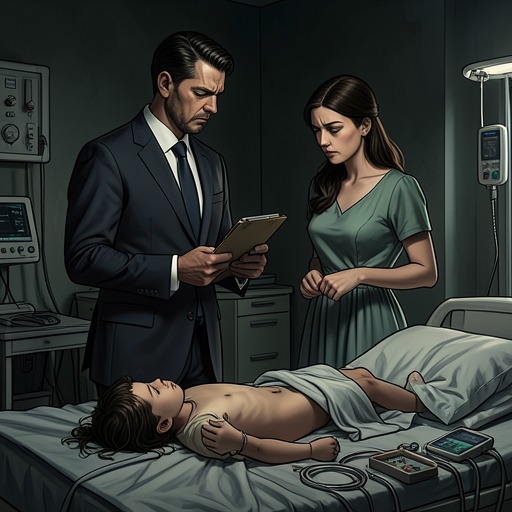
Anna witnesses the fall from the hut, Elias in her arms. She sees her father hit the rock and the creature throw itself over him; as it raises its head toward them, Elias’s voice reaches her inside her mind. The confrontation ends not with Mahler overcoming the corpse but with his daughter watching him fall, the same creature that had tried to force its way into the hut now attacking him on the shore.
The Failure of Control
The scene’s reversal depends on the difference between intending violence and controlling its consequences. Mahler approaches with an axe, but the encounter is decided not by a deliberate blow: his revulsion makes him turn away, and his own body’s response leaves him physically vulnerable. The fall is brutally contingent, produced by the slick rock and the vomit beneath him rather than by any successful act of defense. The episode therefore denies him the mastery he expects when he goes out to eliminate the creature.
That loss of control also unsettles the boundary between threat and witness. Anna’s earlier effort to keep the drowned man outside the hut had made the door a line she could hold; on the shore, Mahler’s collapse carries the danger back toward her and Elias. The creature’s attention shifts to them as Anna watches, so his death is not a contained encounter but a transfer of peril. The killing’s force lies in that unfinished movement: Mahler falls, and the surviving family remains exposed to what he could not stop.
Recognition and the Limits of Naming
The scene repeatedly offers a partial explanation before disclosing the next, making recognition itself part of the danger. At the window, Anna first takes the white shape for a balloon; at the kitchen door, the exposed body lets her identify a drowned man. Later, Mahler is told what she has seen, but the words do not prepare him for the corpse on the shore: even its moving chest first suggests a heartbeat before the flashlight reveals the eel inside. These shifts—from familiar object to face, from apparent life to decay—make the creature difficult to comprehend without making its physical presence any less immediate. Naming it as a drowned man gives Anna and Mahler a category for the threat, not control over it; Mahler’s attempt to act on that knowledge ends in his fall and the creature’s attack.