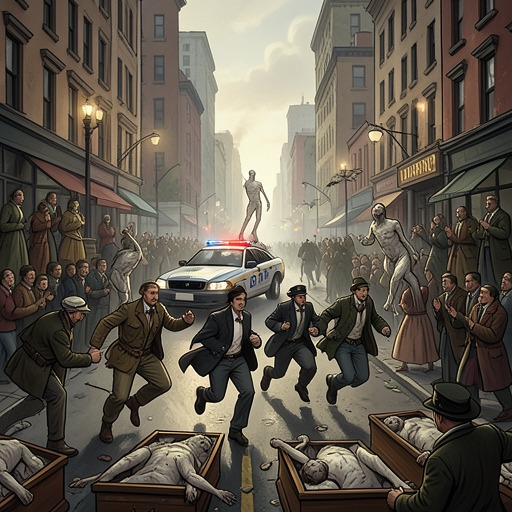
The emergency exhumation of the graves
Handling the UndeadThe emergency exhumation of the graves was the attempt, during the night of 13–14 August 2002, to locate and recover people who had returned to movement in their graves. It turned the discovery of the returned dead into a public operation: authorities had to decide whether to open graves, determine who could do it, and confront the fact that the figures underground were not simply bodies. The first recovery, from waterlogged ground at Stockholm Woodland Cemetery, made that contradiction immediate.
Background and decision
The scale of the crisis emerged through reports arriving from across the Stockholm area. At 23:57, after databases were compared, officials counted exactly 1,042 people who had died within the previous two months and remained unburied. A delegation equipped with sound amplification and digging equipment was dispatched to Stockholm Woodland Cemetery to listen at the graves, with the possibility of opening them. The wording of the decision reflects the uncertainty of the moment: the authorities were not yet acting on a settled procedure, but investigating whether the reports could be true.
By 00:42, a reliable report of awakenings at cemeteries had reached the Dead Room. The calculations then indicated around 980 people, while the police said they did not have the resources to manage the exhumations. At 00:50, responsibility for the digging was transferred to the military. This was not a seamless division of labor: the law forbade cooperation between the police and the armed forces, so military representatives could not join the command unit. The military instead received the authority applicable in a state of emergency and was left to address the work as best it could.
Military operation at the cemetery
At 01:17, the first military exhumation division set off for Stockholm Forest Cemetery. It combined mine-clearing specialists with personnel experienced in opening mass graves in Bosnia for the United Nations. The assignment joined two kinds of expertise—handling dangerous ground and excavating graves on a large scale—because an unprecedented situation had to be approached with the skills already available. The operation was intended to begin there while further groups were being dispatched.
At 01:40, the first returned person at the cemetery was freed. He had been lifted from a deep-lying section where the soil was waterlogged and was described as being in the most miserable state imaginable. A minute later, the cemetery appealed to the public for people with strong stomachs; the newly exhumed man tried to get away. The sequence makes recovery more than a matter of locating and raising a body: those brought out were alive and could move, while their physical condition made the work disturbing even to rescuers. The need for public assistance also indicates how quickly the scale of the task exceeded a routine response.
The wider emergency was already pressing on medical services. Danderyd Hospital had become a temporary gathering place, and by 01:45 it had admitted 715 returned dead; disputes and fistfights had broken out among staff in direct contact with them. The military then called in Army Corps members to build a temporary holding facility without consulting the Dead Room. The exhumations therefore formed one part of a hurried chain—opening graves, transporting the recovered, and finding somewhere to hold them—whose separate components were strained and not fully coordinated.
Private digging and the meaning of recovery
The public operation has a stark personal parallel in Gustav Mahler’s search for Elias. Before the official reports could make the event comprehensible, Mahler remembered standing beside his grandson’s open coffin at the funeral, with Elias in penguin pyjamas and his teddy bear tucked under an arm. Anna had stroked his cheek and tried to wake him; Gustav Mahler had placed a box of Harry Potter Legos beside the teddy bear. Those objects belonged to the rituals of farewell, but the possibility that Elias might return made the farewell unstable rather than final.
At the grave, Gustav Mahler lay on the ground and pressed his ear against the grass. He heard scraping. When he understood that Elias was moving and trying to get out, he had no plan or tools; he dropped to his knees, called Elias, and clawed at the ground with his bare hands. His nails broke, and dirt got into his mouth and eyes. The dry, porous soil had not yet been bound by a net of roots, but the excavation remained an act of desperation, guided by sound rather than equipment or official direction. The scene makes intimate what the military operation would confront at scale: a grave had ceased to guarantee stillness, and opening it meant answering a living person’s movement below ground.
Consequences and significance
The authorities’ response unfolded alongside a rapid revision of what death meant. The early reports suggested that only people dead for two months or less had returned, while medical analysis had not yet established a definitive explanation. The event’s practical boundary was therefore also a conceptual one: grave records and funeral arrangements still classified these people as dead, but the sounds, movements, and recoveries contradicted that status. The exhumation operation tried to manage the contradiction through equipment, divisions, and temporary facilities, without yet resolving it.
Its first hours expose both institutional improvisation and the limits of ordinary categories. Police lacked capacity; the military took over despite a legal bar on joint command; hospital staff and cemetery workers faced people who were at once recovered from graves and physically present among the living. In parallel, families such as Gustav Mahler’s acted on direct signs of life before any public procedure could make sense of them. The exhumation was thus not simply the reversal of burial. It was an emergency effort to create a new practical response to people whose return made the old boundary between corpse and person impossible to enforce.