The reliving field
Handling the UndeadThe reliving field is a collective presence associated with the reliving that makes thoughts perceptible to nearby people and magnifies emotion across the boundary between the dead and the living. At the Heath, it grows from a faint current into an unbearable force as terror circulates through a crowd. The phenomenon is more than a channel for private thoughts: it becomes a shared, escalating condition that alters what individuals can hear, feel, and endure.
Recognition and Limits of Explanation
The field first receives an explicit public explanation at the entrance to the Heath. A neurologist from Danderyd Hospital tells visitors that people can read one another’s thoughts in the proximity of the reliving, and warns that passing through the gates will expose them to what people around them are thinking. He acknowledges that no one knows how this is possible. The announcement makes the field an immediate condition of visiting, not a speculative curiosity: people must decide whether to enter knowing that other minds will no longer remain private.
The crowd’s response shows the tension between warning and desire. The neurologist pauses as if visitors might turn back, but they do not. David, who is used to sensing an audience’s emotions, feels impatience rising; people shift and scratch their arms and legs because they want to see their dead, not hear caveats. Their determination brings them into the very proximity that makes the field perceptible. The episode thus links the wish for contact with the dead to a loss of psychic distance from everyone present.
The explanation remains incomplete. The neurologist identifies thought-reading as a fact and admits that its mechanism is unknown, while the narrative gives the reader a more immediate account through Flora’s experience. Neither account reduces the field to a simple exchange of distinct, intelligible thoughts. Its strongest presence is often collective and difficult to separate into individual voices.
Flora’s Experience at the Heath
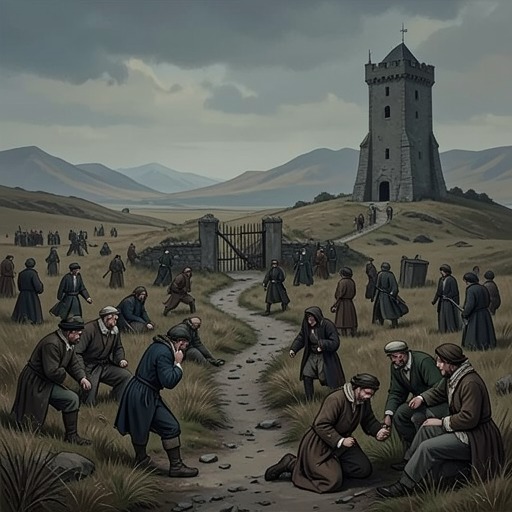
As Flora walks toward the buildings, the field intensifies step by step. Outside the gates it feels like streams running through her head; closer in, it thickens into a fog. The comparison matters: as fog magnifies sound, the field makes individual thoughts faintly but clearly audible, like distant cries. Its reach is gradual rather than a switch suddenly thrown, and Flora’s approach gives that growing pressure a spatial shape.
Between the buildings, Flora encounters something beyond ordinary thought-reading. The field consists of many consciousnesses, strongly present but, at first, thinking no thoughts. Individual mental exclamations of horror break into that presence and make it more intense. Flora understands this increase through the image of an electric conductor growing warm as power flows through it. The field therefore has two distinguishable aspects: a mass of consciousness that can be present without articulated thought, and the emotionally charged thoughts that surge through and strengthen it.
The phrase “The more you fear us, the bigger we get” condenses the field’s feedback. Fear is not merely one response among others; it adds force to the presence that frightens people. Leaning against a wall, Flora feels that there is not enough space for her. A miniature version of the surrounding area seems to exist inside her head, dominated by terror and despair, while the field itself remains unseen. The narration makes an invisible phenomenon legible through pressure, sound, and the failure of mental boundaries: the field feels as if it ought to billow visibly like heat above asphalt, but its evidence is borne by the people caught within it.
Mutual Amplification and Crisis
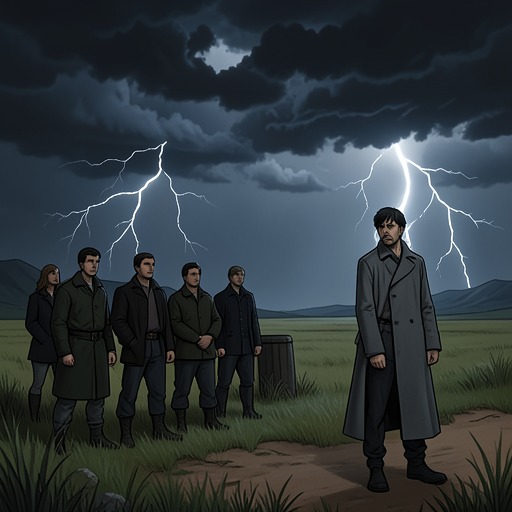
The field is not described as an influence running in only one direction. At the Heath, large numbers of the dead affect the minds of the living, while large numbers of living people also affect the dead. Their emotions are magnified, reflected in one another, and reinforced, like light passing through prisms. With each reflection, the force grows; eventually the experience becomes unbearable. This reciprocal process distinguishes the field from an individual person simply overhearing another’s thoughts. A crowd creates an emotional circuit in which fear returns with greater intensity.
The danger appears in the warnings that David and Sture initially fail to recognize. They have been preoccupied with what has happened to Eva, and David’s attention is filled with Magnus’s despair. When Sture turns his attention outward, he perceives through the field a sound like a large tree just before it falls: sharp cracks, a swaying trunk, and the uncertainty of its direction. Around that warning, thousands of panicked consciousnesses merge into a din in which separate thoughts can no longer be distinguished. Sture grabs David’s shoulder and tells him they must leave at once. The scene shows how an individual’s grief can narrow attention even as a collective danger is gathering around him.
Flora is caught in the same crisis. At 12:50, the field between the buildings has already pressed terror and despair into her awareness; by 13:15, she lies curled on a bench, clutching her backpack, unable to move. She experiences the world within as exploding fireworks and can only wait. The episode gives bodily form to the field’s escalation: perception overwhelms movement, and endurance becomes the only available action.
Ebb, Exposure, and Significance
The intensity does not remain at its peak. After five minutes it begins to abate, and the horrible thoughts ebb away; after ten, Flora dares to open her eyes. She has been overlooked while the courtyard empties. Nearby, a man with scratches on his face and blood on his shirt collar weeps as an emergency worker tends to his cuts. Flora stays completely still, hidden by her black clothes: moving would make her visibly human, and humans have to leave. The field’s retreat changes what she can endure, but it does not undo the physical disorder or the rules of evacuation around her.
The field’s narrative significance lies in its collapse of separateness. Its presence makes private thought audible, but its more consequential effect is to turn emotion into a force shared and amplified by the living and the reliving. The Heath scenes move from an official warning, through Flora’s close perception, to a crowd-wide crisis and partial release. The mechanism remains unexplained; the consequences do not. Fear alters the field, the altered field deepens fear, and people must respond to a danger that can be sensed with overwhelming clarity without ever becoming visible.