The reliving’s legal grey area
Handling the UndeadThe reliving’s legal grey area is the gap between the law’s settled treatment of the dead and the state’s urgent attempt to manage people who have returned to activity. Declared deceased, the reliving are said to fall outside ordinary judicial boundaries; yet they are also subject to medical examination, containment, and official decisions about whether relatives may see them. The crisis makes legal status more than a technical question: the same classification that weakens protection can open the way to institutional control.
A Status the Law Does Not Recognize
A philosophical debate in Dagens Nyheter frames the problem starkly. Existing law, the article argues, gives a simple answer to whether the same ethical criteria should apply to the reliving as to ordinary patients: no. A person declared deceased falls outside judicial boundaries, with the peace of the grave as the stated exception. But whether that protection can be invoked for the reliving is itself doubtful. Their bodies are no longer treated simply as remains, while their position as legal persons has not been settled.
That uncertainty is not presented as a stable legal category with defined rights and procedures. The article anticipates that laws will soon be changed to include the reliving, but focuses on the interval before that change. In that interval, the usual boundary between a dead body and a living patient does not tell officials, physicians, or relatives what they may do. The ambiguity therefore has practical force: it leaves important questions open precisely when decisions must be made.
Emergency Powers and Administrative Control
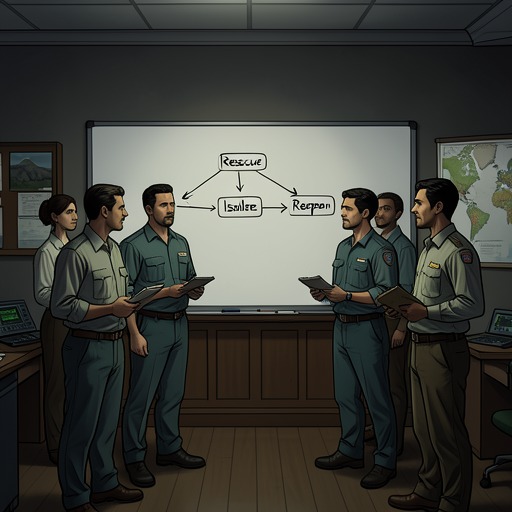
The state’s response turns classification into action. After reports of awakenings reach the Dead Room, officials adopt the term reliving for the newly awakened dead. The word supplies a common administrative label, but it does not resolve their legal standing. At 00:50, the exhumation task is transferred to the Swedish Military because the Police report that they lack the resources to manage it. A legal prohibition on police and military collaboration prevents military representatives from joining the command unit. The military receives authority equivalent to that used in a state of emergency and must handle the work as best it can.
A separate emergency measure expands the Police’s authority. At 01:23, the Minister of Health and Social Affairs, acting in consultation with judicial experts, decides to apply laws concerning mass epidemics to the situation. Those laws provide the Police with corresponding interim authority before medical analysis is complete, while officials press the Medical Examiner's Department to accelerate its work. The sequence exposes the strain between ordinary legal process and immediate public administration: officials act first under emergency provisions, even as the evidence needed to understand the phenomenon is still being gathered.
The law’s uncertain reach is also felt in families’ efforts to keep or visit the reliving. A woman hiding a returned family member recounts that Police and a doctor searched her apartment, moved Lego pieces, looked under a bed, and told her that she had to let them take him because it was illegal and dangerous for him to remain there. At a press conference, the Prime Minister says family members will shortly be allowed to see their reliving and regrets that it has taken so long. The two moments show the human cost of policy made under uncertainty: families face enforcement and separation before access is promised.
Medical Discretion and the Ethics of Experiment
The medical debate gives the grey area a second, more troubling edge. Lennart Hallberg describes the reliving as occupying a kind of legal grey area and says medical-ethical guidelines for their treatment may take time to develop. Because the emergency has not been declared over, physicians have a degree of latitude. His remarks do not establish that every proposed test is lawful; rather, they reveal how emergency conditions can widen professional discretion while the rules meant to govern it remain unfinished.
The philosophical article makes the consequence explicit. In the intervening period before the law changes, experiments and tests may be possible that would later be illegal. It urges medical experts to take advantage of that opportunity, measuring possible suffering among the reliving against benefits for humanity. Its argument is sharpened by the scale of death around them: in the previous two days, sixty-five people in Stockholm have died without awakening, while around 300,000 people have died worldwide. The proposed research is therefore framed as a bargain between uncertain harm to a small group and potential protection for many, but the article offers no settled method for determining the reliving’s suffering or securing their consent.
Meaning and Consequences
The legal grey area is not simply an absence of rules. Emergency epidemic law authorizes intervention; the prohibition on joint police-military operations shapes command; the anticipated revision of law acknowledges that existing categories may not fit. Meanwhile, the dead-letter status assigned to the reliving can coexist with intense institutional attention to their bodies. They are excluded from ordinary judicial boundaries yet managed through medical and public-safety systems, a contradiction that makes the crisis a test of what legal protection depends on: a declaration of life, a declaration of death, or recognition of the person caught between them.
The book leaves the ethical dispute unresolved. The Prime Minister’s promise of family visits indicates a possible adjustment in policy, not a completed legal settlement, while the medical and philosophical discussions expose how quickly provisional authority can become an opportunity for research. The grey area therefore marks both a failure of law to anticipate the returned dead and a dangerous interval in which practical power is exercised before rights, safeguards, and responsibilities have been clearly defined.