The return of the dead
Handling the UndeadThe return of the dead is the sudden reanimation of recently deceased people across the greater Stockholm area. It overturns death as a reliable boundary: morgues fill with movement, a buried child scrapes at his coffin, and hospitals must receive hundreds of returned dead. The event unfolds at once as a logistical emergency and a crisis of mourning, forcing the living to confront the possibility that a funeral may not be final and that the familiar signs of death may no longer settle who is gone.
Causes and First Reports
The first account arrives not as a theory but as an urgent message. Gustav Mahler, a former journalist, is contacted through one of his old sources, a hospital custodian who has heard that the corpses in the morgue have come back to life. Mahler initially tries to redirect the call to an evening editor, but the report is repeated: the pathology department is in a state of alarm and wants more staff sent downstairs. The bluntness of the news precedes any explanation; at this point, even its wording seems less important than the fact that bodies are moving.
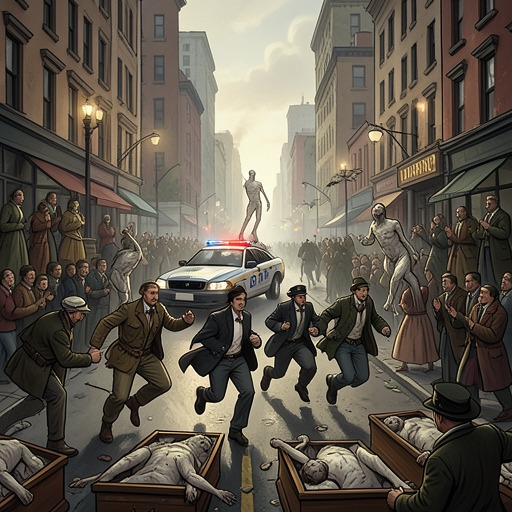
A contemporaneous overview places the first wave between 23:10 and 23:20, when the dead return in morgues throughout the greater Stockholm area. Reports from outside the morgues make the phenomenon harder to contain or dismiss. At 23:18, an elderly naked man is seen outside an aged-care facility in Solkatten and does not respond to speech. Two minutes later, a young man struck by a van near the Medical Examiner's office in Solna walks away from the collision. The driver reports a large abdominal scar and a wound so severe that the man's stomach split open. The returned dead are not confined to institutional rooms, and their condition does not prevent them from walking into ordinary streets.
A Death That Remains Personal
The public emergency coincides with private bereavement. After David reaches Danderyd Hospital, he walks through corridors where alarms sound continuously and lamps blink above the doors. Eva has collided with an elk and died while he was travelling to the hospital. The doctor had earlier said that there was no hope, though her heart was still beating; it stops at 22:36. David stands beside her bed, unable to experience the catastrophe as an abstraction. The return of the dead does not erase this death or make the present loss intelligible to him: in the immediate aftermath, his imagined future and the preceding twelve years collapse into an unbearable now.
The event's larger reversal becomes painfully concrete for Anna and Gustav Mahler through Elias. Before the burial, they stand beside his open white coffin. Elias is dressed in his favourite penguin pyjamas, with his teddy bear tucked under his arm; Gustav has brought the box of Harry Potter Legos Elias had wanted. Anna strokes her son's cheek and urges him to wake, a plea made before the reports from the morgues can transform hope into expectation. Later, at the grave, Gustav lies on the ground and presses his ear to the grass. He hears scraping. When he understands that Elias is trying to get out, he calls his name and claws at the soil with his bare hands, breaking his nails and getting dirt in his mouth and eyes. The phenomenon that began as a report from a hospital becomes an act of desperate recovery at a child's grave.
Scale, Limits, and Emergency Response
As reports accumulate, officials attempt to establish the reach of the event. At Danderyd, two bodies do not awaken; medical records show that one has been dead for ten weeks and the other for twelve, and both have been treated repeatedly with formaldehyde while funeral arrangements were pending. Further reports of non-awakenings suggest a dividing line: only people dead for two months or less have returned. Correlating records of the unburied dead from that period yields an exact total of 1,042 people in the greater Stockholm area. The apparent time limit gives authorities a way to count and anticipate the crisis, but it does not make the return predictable at the level of any family waiting for news.
The infectious-diseases ward at Danderyd Hospital is designated as a temporary gathering place, and more staff are summoned. At 01:00, 430 returned dead have been admitted to the clinic; wards are being cleared, and additional assistance is requested. Only two ambulances at each hospital have been reserved for emergency dispatches, while the rest are being used to transport patients. Funeral homes are considered as a possible source of transport, but officials decide that their involvement could be perceived as inappropriate. Instead, available taxis are called in to move patients from Danderyd to other hospitals. The ordinary systems for medical care and the ordinary business of funerals are suddenly entangled, with neither designed for people who have died and returned.
The response also exposes institutional strain. Exhumation is transferred to the military, but a law forbidding collaboration between the police and armed forces prevents military representatives from joining the command unit. The military receives emergency authority and must act as best it can. At the Dead Room, a press statement describes the returned dead largely as a logistical problem, prompting a reminder that officials should use the correct terminology. Administrative language tries to impose order even as the basic categories of patient, corpse, and relative have become unstable.
What Death Can Mean
The event unsettles the medical definition of death as well as its social rituals. One account reasons that, if religious or paranormal explanations are set aside, the remaining possibility is that the body's biological processes can restart. This is offered as a hypothesis, not a settled finding: there is no definitive research, only indications. But the consequences are stated starkly. The classic signs of death can no longer be treated as conclusive, and there is no dependable way to declare that a person will remain dead. The crisis therefore exceeds the practical problem of moving and housing the returned dead; it puts pressure on the distinction by which the living recognize an ending.
That pressure is visible in Flora's observation of the dead gathering beneath a lamppost. One woman steps out in loose hospital clothes and moves toward a dead man standing in the light. Others emerge from nearby doors, drawn to the same point. When about fifteen have assembled, they begin moving clockwise around the lamp, forming an uneven ring; they stumble or bump into one another, then resume their places. Flora sees the dead dancing and recalls animals circling a pole, a primitive rite organized around a central axis. The scene offers no explanation for the gathering, but changes the scale of what can be witnessed: the returned dead are not only individual medical cases or grieving families' lost relatives. Together, they form an uncanny collective whose movement invites interpretation without yielding a clear answer.
The living continue to make and remake rituals around what they cannot classify. On Kungsholmen, David, Magnus, and Sture bury Balthazar in an overgrown thicket, using a shoebox, a makeshift cross, and flowers. Magnus writes the name on the cross and helps decide what should go into the grave. David, looking at the burial from this smaller scale, understands why the act matters: the box and cross give the child something to do that words and comfort alone cannot provide. Set against the mass return of the dead, this improvised funeral preserves the need to mark a loss, even when the larger event has made death itself uncertain.