Tore
Handling the UndeadTore is Elvy Lundberg’s husband, who returns three years after his death as one of the returned dead. His arrival brings an uncanny bodily presence into the house but no renewed intimacy: he walks, enters his old room, and handles papers, while his blank gaze and silence leave Elvy confronting a figure she recognizes and, at the same time, cannot experience as her husband. His return exposes the distance between a marriage that lasted more than fifty years and the emotional exhaustion Elvy had already reached before he died.
Identity and Return
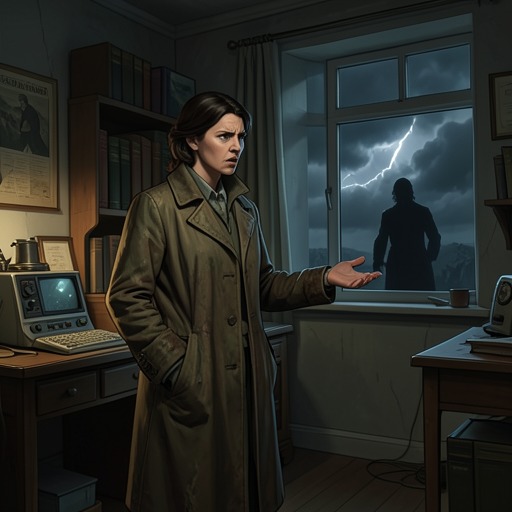
Tore appears on Elvy’s front steps in his best suit, though illness has altered its fit. In his final years he lost about twenty kilos, leaving the gabardine hanging loosely from his shoulders; his arms dangle, and his bare feet are white, with untrimmed toenails. Elvy notices those details before she can settle on what his appearance means. Her first response is not horror but surprise and exhaustion. Tore has been dead for three years, and his return does not restore the person she remembers so much as place an inert, altered body where that person once stood.
His eyes are open, but there is no gaze in them. Elvy has lived with that vacant look for three years, yet now it seems more frozen and lifeless than before. The familiar non-gaze therefore connects his returned state to the last years of his illness while also making the change unmistakable: the stillness she knew has become something more absolute. She thinks of him as a doll, a judgment shaped by his blankness and by the way his body seems present without the responsiveness that would make it a person to her.
Movement Through the House
Tore does not answer when Elvy asks what he is doing. He brushes past her and goes into the house, carrying a chilled hospital smell of disinfectant and starch, underlain by a sweeter, fruity odor. When she grabs his shoulder and whispers to him, he pays no attention. He moves jerkily, each step apparently effortful, toward the other bedroom—his room. Elvy realizes that she has not seen him walk for seven years. His stiff movement is both strange and familiar: it is a newly functioning body, but one that remains visibly unused to walking.
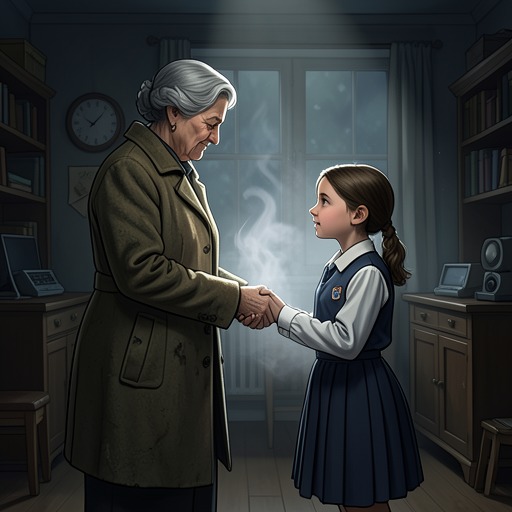
The room is not empty. Flora is asleep there, and Elvy tries to stop Tore from reaching her, taking hold of both his shoulders and warning him to leave the girl alone. Flora is still sitting on the floor afterward, and Elvy fears the shock may be too much for her sensitive granddaughter. Yet Flora’s question about what Tore is doing reassures Elvy that she has not entirely withdrawn from the moment. Elvy offers the interpretation she can manage: he is pretending to be alive. Flora gives a small nod, as if the answer fits what she has already understood.
Tore’s attention turns to the desk. His stiff white hands move over photocopied psalms sung at his funeral, blank stationery, and a copy of the day’s newspaper that Flora brought. He lifts a sheet and moves his head back and forth as though reading it. The paper bears the words “Only a day, one moment at a time.” He sets it down and picks up another copy bearing the same text, examining that one with equal care. The repeated gesture gives the scene a quiet, unnerving regularity: Tore handles writing but offers no speech, explanation, or sign that he understands the people around him.
Removal and Physical Deterioration
Tore is eventually brought back by paramedics, who show controlled revulsion as they approach. His shirt is damp across the front and spotted with yellowish fluid, and the smell of rotting organic matter surrounds him. Elvy understands the reaction: Tore has started to defrost. The returned body that first stood stiffly in the house is now visibly deteriorating, making his presence not simply a family crisis but a physical condition that others must confront and manage.
When Bernt begins to identify the figure, Elvy supplies the name Tore. That insistence holds a tension central to the episode. She can identify him, and she does not deny the shared history that makes the name matter; at the same time, his blankness and decay prevent recognition from becoming reunion. The paramedics take him away, but his return leaves material traces behind. The copied psalms have been spotted with his fluids, linking the words associated with his funeral to the body that has come back from it.
Marriage and Elvy’s Retrospective Judgment
Elvy’s later reflections distinguish her response from a more dramatic story of bereavement. After Flora’s late-night call, she cannot sleep and turns to a book by Grimberg about Gustav II Adolf and his widow, Maria Eleonora. She reads of the queen’s repeated attendance on the king’s corpse, her refusal to let go, and her caresses of a body that blackened and decayed. Elvy wonders whether she is heartless because she cannot imagine responding to Tore in the same way. The historical account gives her a comparison, but it also clarifies why the comparison does not fit.
Elvy decides that she and Tore had already shared a full life together. He was ten years older and had taken a hysterical woman in marriage; he cared for her and led her through life, although he never understood her. She holds little animosity toward him and believes he did the best he could, but by the time he died she had simply seen enough of him. Her lack of a desire to reclaim his returned body is therefore not presented as proof that the marriage meant nothing. It follows from her sense that its closeness, limitations, and obligations had already been lived through.
That conclusion steadies her briefly, but the returned body continues to intrude on ordinary life. After seeing a television report that angers her, Elvy paces through the house, takes the copied psalms from the guest room, crumples the pages stained by Tore’s fluids, and throws them away. She then calls Hagar, her close church friend and longtime partner in keeping their Saturday meetings supplied with coffee and cake. Elvy’s call turns the private disturbance into something she can share with a trusted companion. Tore’s return has reopened the fact of death in the household, but it does not reverse Elvy’s judgment of their marriage: she can name him, remember his care, and still know that she is done.