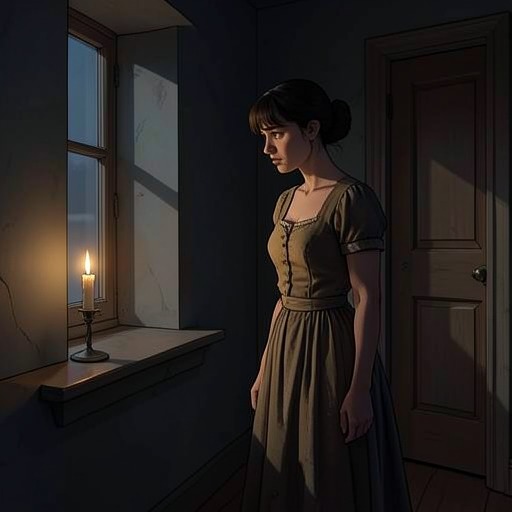
Virgin Mary
Handling the UndeadThe Virgin Mary’s apparition to Elvy Lundberg makes religious conviction in the novel both intimate and unsettling: a mother marked by grief appears on a television, recognizes Elvy, and gives her a task concerning the returned dead. The vision does not settle whether its message is divine, symbolic, or otherwise mediated. Instead, it joins the promise of salvation to suffering, bodily contact, and an image Elvy cannot fully explain.
Identity and Appearance
The Virgin Mary appears to Elvy not in a church or during a formal religious observance, but on a television that switches itself on while Elvy is dozing in a chair. The screen’s light first overwhelms her; as her eyes adjust, she sees a central woman surrounded by radiance, or apparently emitting it. Elvy recognizes the figure at once. The setting gives the encounter an ordinary threshold: a domestic room and a familiar appliance become the means through which the sacred becomes visible.
The woman wears a dark blue shawl over black hair. What defines her face is grief: Elvy reads in it the sorrow of a mother who has witnessed her child’s death. Her thoughts turn to the Virgin Mary at the foot of the cross, watching the nails being removed from her son’s hands. The vision is therefore not an image of comfort untouched by history. Its radiance surrounds a figure whose expression carries the violence of loss and the knowledge that such suffering belongs to the world.
The Encounter with Elvy Lundberg
Elvy whispers a recognition of the holy figure and understands the sight through the language of tribulation. The encounter’s force arrives first as a bodily and emotional response: trepidation rises in her chest, and she does not dare look directly at the screen. When the Virgin Mary opens her arms, Elvy begins to rise from her chair to kneel. The invitation to remain seated interrupts that gesture. The figure knows Elvy’s name and, as Elvy understands it, acknowledges a lifetime of running and working; she is allowed to rest for a while.
This recognition makes the apparition personal before it becomes public or doctrinal. The Virgin Mary does not first address Elvy as a representative of an institution, but as someone whose effort and fatigue are known. Yet the encounter does not remain a private consolation. The Virgin Mary tells Elvy that a task awaits her: the dead must come to her, their only salvation is to come to her, and Elvy must make them understand. The instruction gives Elvy’s faith an immediate practical direction, although it offers no easy method for carrying it out.
The Mission and Its Sign
Elvy’s first response is to consider the neighbors she would need to persuade: people she expects to meet with hard looks and rejected approaches. She asks how she can make anyone listen. The Virgin Mary answers by holding out her hand and presenting what she calls a sign. Something touches Elvy’s forehead; the television goes dark, and Elvy falls sideways from the chair. When she opens her eyes, the edge of a glass table is against her forehead. There is blood on its corner and drops on the rug.
The sequence makes the sign consequential without explaining it. Elvy has experienced a presence on the screen, a touch, a sudden blackout, a fall, and a physical wound; the narrative does not reduce these details to a confirmed supernatural cause. In the kitchen, she blots away the remaining blood but cannot throw the paper towel away. She seals it in a glass jar, preserving a material trace of an encounter whose meaning remains uncertain. She then calls Hagar and begins recounting what she regards as the greatest moment of her life.
The Hooks and the Limits of Certainty
After the call begins, Elvy recalls a detail she had not understood during the apparition. As the Virgin Mary reached toward her forehead, Elvy glimpsed tiny hooks protruding from the figure’s fingers. They were thin and no larger than ordinary fishing hooks. The image complicates the radiance and the gesture of welcome: the hand that appears to offer a sign also bears an unsettling, specific object.
Elvy believes the Virgin Mary may have been an image created for human eyes, a representation taking the form of the Holy Mother. That interpretation does not resolve the hooks; it sharpens the question of what they signify. The apparition thus gives Elvy certainty about having received a task while withholding certainty about the form in which its messenger appeared. The contrast between Elvy’s conviction and her unanswered question is central to the scene: revelation arrives, but it does not make every aspect of the revealed image legible.
Faith in Public
Elvy’s later words show her carrying the encounter into the crisis around the returned dead. She interprets their arrival as the release of the souls of the dead, and tells a man that she and Hagar have come to prepare people for the return of Jesus Christ. The mission she received from the Virgin Mary becomes a basis for action and public speech, even when the audience or circumstances do not promise a hearing.
Other religious responses in the story provide context without confirming Elvy’s vision. A hospital chaplain asks how Elvy and her companions are coping; Elvy says they are doing fine, while the chaplain describes the situation as extraordinary and disturbing. At a public gathering, two elderly women try to use a microphone to argue that the dead have awakened because their souls have returned, but security removes them before they can finish. These distinct moments show religious interpretations entering a crisis also addressed through public and institutional channels. The Virgin Mary’s importance lies in the particular authority she gives Elvy: not a general explanation alone, but a command to persuade the living that the dead must seek salvation through her.