White caterpillar
Handling the UndeadThe White caterpillar is a recurring, physically elusive creature whose appearances mark the boundary between a dead body and whatever may leave it. First seen burrowing into a marble grave without damaging the stone, it later enters Eva’s blanket unseen by David and appears in the intimate, frightening scenes of Elias’s departure. Its final transformation from caterpillar to butterfly gives its strange material presence a clear narrative connection to release, while leaving the nature of that passage mysterious.
Form and First Appearance
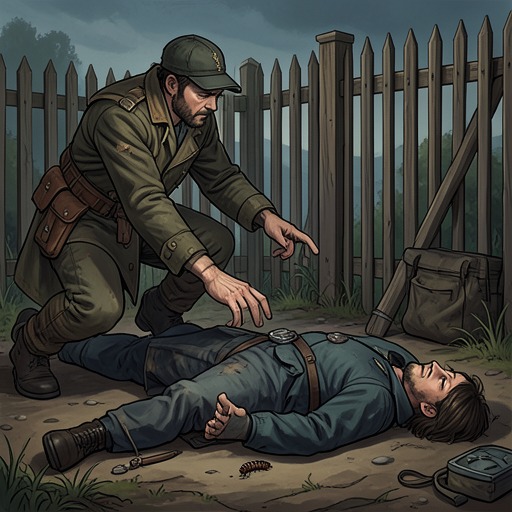
The White caterpillar first appears on the smooth black marble of a family grave. Henning notices a spotless white grub about the size of a cigarette filter, writhing on the stone. He takes its apparent distress seriously enough to try flicking it onto the grass, but it does not move. When he brings his face closer and uses a lighter to see, its body seems to shrink. The closer view corrects the impression: the creature is drilling down into the marble.
The scene makes the impossible precise. Henning knocks on the surface and confirms that it is solid, expensive stone; he sees no opening forming beneath the creature. The White caterpillar gradually disappears until only a small white knob remains, which seems to wave before sinking away. Henning searches the place with his finger, finding neither a hole nor loose fragments. He pats the marble and praises the creature’s work, then carries his wine toward the chapel steps. The ordinary gestures of inspection and approval sit beside an event that those gestures cannot explain. The narration adds that Henning was the only one who saw it, making the creature’s first appearance both material and radically private.
An Unseen Presence Around Eva
The White caterpillar appears again during the crisis surrounding Eva, but this time David does not see it. It comes through the ceiling and lands on the yellow institutional blanket covering her, then digs its way in. The creature’s route echoes its disappearance into the grave’s marble: in both scenes it passes into a surface without leaving visible damage. Here, however, the surface is not stone but the covering of a person David loves.
The moment follows David’s overwhelming pain and the sudden cessation of the alarms and lights. He has pressed Eva’s hand to his forehead and continues to hold it, longing for the pain to return now that it has stopped. He does not notice the White caterpillar entering the blanket. Then Eva’s hand jerks and squeezes his. The sequence places the creature beside a small but consequential movement from Eva, without giving David an explanation for it. Its presence is intimate, hidden, and distinct from the visible body he is trying to hold on to.
Other scenes surrounding Elias and Eva’s passage place such private contact against the force of the dead in bodily form. Elias’s voice reaches his mother inside her head while a drowned man pulls at the door, and the dead creature’s strength keeps her from reaching an axe beneath the kitchen counter. Later, Flora passes an amputated old man dragging himself down the stairs, repeating his desire to go home, before finding Eva in the hallway, her face bandaged. Neither scene shows the White caterpillar. Their contrasting forms nevertheless sharpen the creature’s function in the larger sequence: the dead can be terrifyingly physical, while the caterpillar is small, difficult to perceive, and associated with a passage that cannot be managed by ordinary force.
David and the Request to Let Go
After dreaming of Eva, David wakes in Magnus’s bed with his arms outstretched and the White caterpillar curled on his stomach. He hears a whining sound and senses Death nearby: a hand wearing colorful bracelets enters his field of vision, its fingers ending in hooks. David cannot turn to look directly at the apparition. When the hooks reach toward the creature, they stop short of his hand because he is alive. The boundary between living and dead is expressed as a limit on touch, not as an explanation of what the creature is.
David cups the White caterpillar in his hands. Through his skin and bones comes a plea from Eva to let her go. As he refuses, the creature swells beneath his palm; the hooks withdraw, and her voice grows weaker. When the plea returns as a whisper, David finally lifts his hands and tells her he loves her. The caterpillar is now swollen and pink, appearing sick and close to death. The scene turns David’s physical grasp into the visible form of his resistance: holding the creature means holding on to Eva, even as her voice asks him to release her.
The hooked hand returns and lifts the White caterpillar. At the point where the hook enters, a crack opens in its body. What David had taken for a caterpillar is revealed as a pupa: a tiny head emerges, and a butterfly works its way free. The dry shell falls away and dissolves. After resting briefly on the hook, the butterfly flies upward and disappears through the ceiling. The whining subsides, and the hooked hand is gone. David then hears Magnus call for his mother in his sleep. He leaves the room without waking him and cries alone on the kitchen floor. The transformation offers a concrete image of release, but it does not cancel David’s grief or make the loss easy.
Elias, Anna, and the Creature’s Meaning
The final scene of the White caterpillar’s appearances carries the same choice into Anna’s relationship with Elias. As she holds him within herself, she hears him ask whether they will see each other again soon and answers that they will. His speech is already weakening when the White caterpillar breaks free from his chest. A clump of darkness reaches toward it, ending in a hook. Anna cups the creature in her hand and holds it for a few seconds before letting it go.
The contrast with David’s encounter is decisive. David initially encloses the caterpillar and cannot bear to release it; Anna’s hand also closes around the creature, but she opens it. Neither gesture is abstract: each takes place through the body, as a loved one’s voice fades and the means of departure becomes almost touchable. The White caterpillar’s appearances thus gather around acts of attachment and relinquishment, without becoming a fully explained mechanism or a simple emblem of comfort.
Its changes of setting and form sustain that uncertainty. It can seem to drill into solid marble, enter a blanket without David noticing, lie against his skin, and split open into a butterfly under the hooked hand. The narrative makes each occurrence concrete—the lighter near the grave, the yellow blanket, the hooks, the dissolving shell—while withholding a complete account of the creature’s nature. Its strongest meaning comes from this combination of physical detail and unanswered mystery: the White caterpillar gives shape to a passage out of the dead, but the living must still decide whether to hold on.