Annie Bouman
Hans Brinker, or The Silver SkatesAnnie Bouman is a peasant girl whose loyalty to Hans Brinker and Gretel Brinker endures beyond the neighborhood’s judgment of their poverty and social standing. First shown as a faithful friend who makes time for others even while caring for a sick grandmother, she later helps Hans in a moment of family hardship. Her story concludes with her marriage to Hans and a life alongside the physician he becomes.
Identity and Social Position
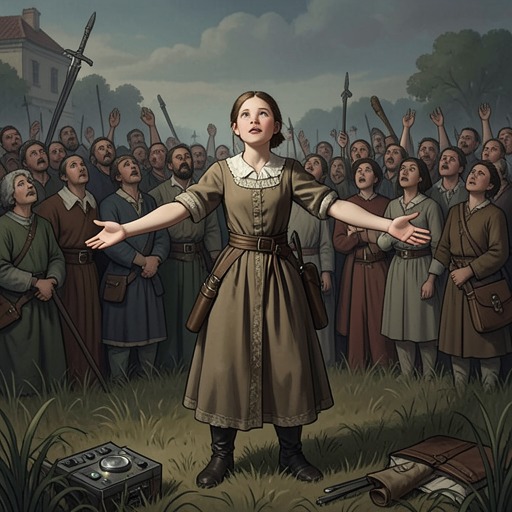
Annie belongs to the peasantry around Broek, and the narrator describes her in a graceful peasant costume. Her place in the neighborhood contrasts with the Brinkers’ precarious standing: Gretel Brinker is known as a goose girl, and the work and poverty attached to that label leave her with few companions. Annie alone openly claims friendship with both Gretel and Hans Brinker, in word as well as deed. The distinction matters because Annie’s loyalty is not merely private affection; she stands by them where other children make their poverty a reason for ridicule.
The children’s mockery does not make Annie withdraw. When Hans Brinker is ridiculed, she flushes; when Gretel Brinker is abused, she becomes angry and answers that Gretel is more fit to tend geese than the children who scorn her. She defends Gretel by naming the qualities that the insult overlooks: her brightness, patience, and gentleness toward the birds. Annie’s defense turns the work used to belittle Gretel into evidence of her care and character.
Annie’s understanding of Gretel’s home is incomplete. While skating toward Broek, she wonders where Gretel is and assumes she may be occupied with work. She imagines Gretel’s father, Raff Brinker, as strong and strange, and believes she would be afraid of him. Annie has not heard that he is ill. The gap between what she fears and what is actually happening underscores how little notice the neighbors take of Dame Brinker and her family, even though Annie herself is unusually concerned about Gretel.
Friendship, Work, and Care
Annie’s devotion to others is shown through the time she gives, not only through what she says. During a stay in Amsterdam, she nurses her sick grandmother day and night. When the grandmother grants her a short rest, Annie uses it to skate toward Broek and back, hoping to see either her mother on the canal or Gretel Brinker. She finds neither. She must hurry back without even catching sight of her mother’s cottage, knowing that her grandmother will need someone to turn her on her cot.
That unsuccessful trip makes her friendship vivid in its limits as well as its feeling. Annie longs to meet Gretel, but her grandmother’s dependence calls her back; she cannot remain in Broek or make the visit she hopes for. Her care for her grandmother and her attachment to Gretel occupy the same brief interval of freedom. The episode presents her as a young woman with obligations that shape her movements, while her effort to spend even a little of that time with a friend confirms how important Gretel is to her.
Annie’s kindness is not confined to Gretel. When she meets Hans Brinker skating homeward, she welcomes him warmly and listens as he tells her that his father has improved. Hans also confides the family’s immediate difficulty: they need money, and he has been unable to find work nearby. He does not present this as a complaint, but Annie’s attention gives him room to explain what is happening. Their exchange reveals a friendship in which he trusts her with distress, while she receives his news with genuine interest.
Help for Hans Brinker
Hans tells Annie that he is going to Amsterdam to sell his new skates so that his mother can have money at once. The decision costs him his chance to compete in the race only five days away. Annie is startled that he would sell his skates when he is the best skater around Broek, but Hans is resolute: he will return on his old wooden pair. His choice puts his family’s immediate needs ahead of his own competitive hopes.
When Hans reaches home, he has brought good news about Peter van Holp, and Dame Brinker reports that Raff Brinker continues to improve. Annie then tells Hans that his skates have been sold and gives him the money. He counts seven guilders, astonished that the amount is three times what he paid. Annie answers that she cannot help the buyer’s having paid more. The scene does not make the assistance a speech or a display of sentiment: she places the money in Hans’s hands when his family needs it, and his astonishment registers the scale of the help.
Her action belongs to a wider pattern of mutual aid in the story, but its immediate significance is particular. Hans had been willing to surrender the skates that could have carried him into the race; Annie ensures that the sale yields money for his family. The race remains important to him, yet the exchange makes clear that his first responsibility is at home. Annie’s support does not erase that sacrifice; it meets the necessity that prompted it.
From Annie Bouman to Annie Brinker
Annie is present at the skating race, where she stands among the girls alongside Gretel Brinker, Hilda van Gleck, and Rychie Korbes. Gretel now wears a red jacket, a new brown petticoat, and a new cap, a visible change from the poverty that had marked her earlier place in the neighborhood. Annie’s presence among the spectators reconnects the public celebration with the friendship she had maintained when Gretel was socially isolated.
The race also reveals that Hans has his skates again: he suspects that Hilda van Gleck, acting as the mysterious buyer, purchased them back for him. Annie’s earlier help should therefore be distinguished from Hilda’s later intervention. Annie gives Hans the seven guilders after the sale; the account of the race attributes the skates’ return to Hilda’s purchase. Both acts surround Hans with support, but they are separate gestures with different immediate effects.
In the narrator’s account of the years that follow, Annie becomes Annie Brinker, the wife of the famous Dr. Brinker. The narrator describes her as beautiful and frank-hearted and says that she remains much like the peasant girl she was, while becoming still lovelier and wiser. The conclusion gives her a future beyond the brief scenes of skating, nursing, and helping Hans: she is his wife, and the young friend who once listened to his troubles shares the life of the physician he becomes.
Narrative Role and Significance
Annie’s role is defined by constancy. The story repeatedly places her beside people whom the neighborhood has reason to overlook: Gretel, stigmatized for tending geese, and Hans, burdened by his family’s poverty. She responds not by denying their circumstances but by refusing to treat those circumstances as grounds for shame. Her defense of Gretel gives the girl’s patience and gentleness public recognition; her attention to Hans turns his private worry into something he can tell a trusted friend.
Her care also takes practical forms. She spends a short respite from nursing her grandmother trying to see Gretel, and she returns money to Hans after he gives up his new skates for his family. These episodes connect affection with time, attention, and material help. Annie’s kindness is not an abstract virtue appended to the plot: it changes what Hans has available to meet his family’s need, and it marks her as a dependable presence during hardship.
The ending extends that pattern into adult life. Annie’s transformation into Annie Brinker does not replace the loyal friend introduced earlier; the narrator presents her later beauty and wisdom as continuous with her frank-hearted character. Her marriage to Hans gives a lasting outcome to the closeness already shown in their easy confidence and mutual concern. Through Annie, the story joins its account of social exclusion and family need to a quieter measure of worth: the people who matter are those who continue to show up for one another.