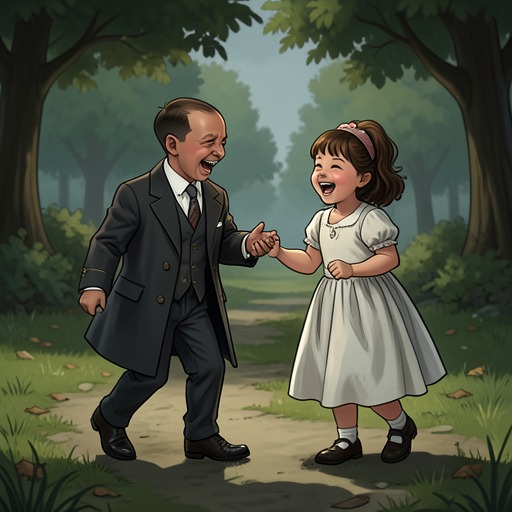
Annie Bouman and Gretel Brinker
Hans Brinker, or The Silver SkatesAnnie Bouman and Gretel Brinker’s friendship stands out because Annie refuses to treat Gretel’s poverty and work as a goose girl as reasons for shame. Where other children make Gretel’s social position a mark against her, Annie claims her openly, rebukes those who mock her, and appears beside her in the Brinker family’s private world. Their bond is shown less through declarations than through repeated choices: whom Annie stands with, whom she defends, and how naturally the two girls share one another’s company.
Friendship Across Social Stigma
Gretel’s work tending geese has consequences beyond the labor itself: the narrator observes that, had she not been known as a goose girl, she might have had more friends among the neighborhood peasantry. Annie is the exception. She is the only local companion who does not feel ashamed to avow her friendship with both Gretel and Hans Brinker, making her loyalty a public stance rather than a private kindness.
The children around them laugh at Annie for keeping such poor company. Her responses distinguish her care for the two Brinkers. When Hans is ridiculed, she flushes; when Gretel is abused, Annie’s anger is stirred. She answers the taunts by insisting that the other children are more suited to tending geese than Gretel is, and points to Gretel’s gentleness toward the birds as a virtue they lack. In naming Janzoon Kolp and Kate Wouters as examples, Annie turns the accusation back on the mockers: Gretel would not harm the geese as Janzoon might, or tread on them as Kate might.
Annie’s defense draws on a judgment she attributes to her father, who had been troubled the previous summer to see a bright-eyed, patient girl like Gretel doing such work. That recollection gives Annie’s argument a history beyond the immediate quarrel. She recognizes Gretel’s patience and character where the neighborhood reduces her to her occupation. After answering the gossips, Annie walks away loftily, refusing to let their judgment define either Gretel or the friendship.
Companionship at the Brinker Cottage
The friendship is also rendered through physical closeness and unforced presence. As evening falls, Annie and Gretel are waiting outside the Brinker cottage. They walk slowly up and down with their arms entwined, their heads nodding and shaking emphatically as they talk. The narration presents their closeness as familiar, not newly negotiated: Annie is there with Gretel, at the cottage, sharing the wait until Hans arrives with news that he has found work.
Their different clothing makes their circumstances visible in the same scene. Gretel wears a gray, well-patched jacket, a dull blue skirt and apron, a faded cap, and oversized shoes. Annie wears a bright red jacket and a bordered skirt, with a graceful cap, gold earrings, a neat apron, and fitted leather shoes. The contrast marks a material difference without disrupting their ease together. Their arms remain entwined; the difference in dress does not become a barrier between them.
Dame Brinker welcomes the sight of the three young people together, admiring the group and teasing that her own children are rough beside Annie, who looks like a fairy. Annie responds by turning the praise into a game: she asks Gretel and Hans to imagine that she is their godmother, visiting to grant each a wish. Gretel is included in this playful exchange alongside Hans, in a setting where Annie is received warmly by the family. The scene gives the friendship a domestic dimension: Annie is not only Gretel’s defender among neighborhood children but also an affectionate presence at the cottage.
Shared Play and Unequal Circumstances
Annie’s imagined role as a fairy godmother is playful, but her expression briefly becomes earnest as she looks at Hans; the narration suggests that she wishes she could truly exercise such power. The moment belongs to a group scene rather than a private exchange between the girls, yet Gretel is part of the imagined gift-giving and of the intimate circle gathered outside her home. Annie’s ability to make the moment into a game gives the children a temporary space of possibility, set against the material limits visible in Gretel’s patched clothes and the family’s rough circumstances.
That difference in circumstance is important to the friendship’s portrayal, but the evidence does not make Annie a rescuer or Gretel a passive recipient. Annie’s most clearly established action is to stand beside Gretel and defend her dignity; at the cottage, the two girls appear together, arms linked, as companions. The relationship therefore rests on recognition and solidarity more securely than on any act of charity. Annie does not simply feel pity for a girl who is mocked; she treats Gretel as someone whose character merits respect and whose company she openly chooses.
Narrative Significance and Limits
The relationship offers a counterexample to the neighborhood’s social sorting. Gretel’s low-status work narrows her prospects for friendship, but Annie’s public allegiance shows that such exclusion is not universal. Her response also changes the direction of the teasing: instead of accepting the label of goose girl as evidence against Gretel, she uses the other children’s own conduct toward the geese to expose their unkindness and clumsiness.
The book depicts the friendship through concrete gestures rather than a long account of its beginnings: Annie’s blush when Hans is mocked, her anger when Gretel is insulted, her proud departure from the gossiping group, and her entwined walk with Gretel outside the cottage. These moments establish a consistent pattern of loyalty and ease. They do not specify how the friendship began or describe a disagreement between the two girls; what they do establish is that Annie repeatedly chooses Gretel’s side and that Gretel shares with her a familiar closeness that reaches from the public world of neighborhood judgment into the Brinker home.