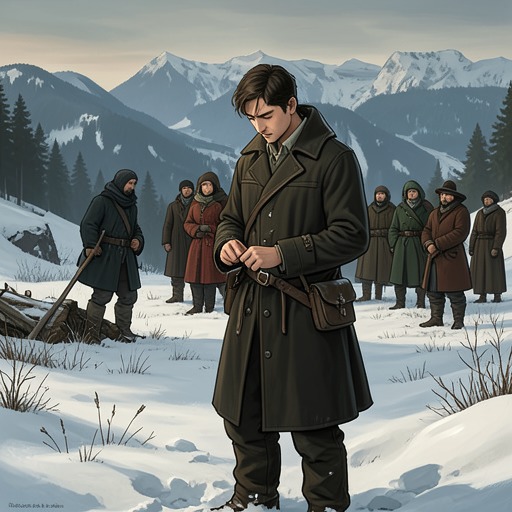
Carl Schummel—Hans Brinker
Hans Brinker, or The Silver SkatesCarl Schummel’s antagonism toward Hans Brinker is a recurring expression of class prejudice: he turns Hans’s worn clothes and poverty into grounds for ridicule, then tries to make that contempt a rule of who may belong on the ice. The contrast is clearest beside Peter van Holp, whose open friendliness to Hans exposes the exclusion in Carl’s conduct. In the cited encounters, Hans does not return Carl’s insults; the relationship is defined by Carl’s repeated attacks and Hans’s separate dealings with Peter.
Identity and Pattern
The conflict begins in public, among children gathered to skate, and is repeatedly staged on or beside the ice. Carl does not criticize Hans’s character or skating alone. He marks him by poverty, calling him a ragpicker and mocking the humble skates he and Gretel Brinker wear. When Carl jeers that their skates must have been a present from the king, Hilda van Gleck answers that Hans may have made his own and that learning on such equipment would require patience. Carl is briefly abashed, but the moment does not end his contempt. The exchange establishes a pattern: his ridicule treats visible poverty as a social distinction, while Hilda’s reply redirects attention to Hans’s effort and skill.
The distinction between the two children matters to Carl’s mockery. His first jibe groups Hans and Gretel together as ragpickers, but the later dispute over the race singles them out as competitors whom the others should supposedly refuse. Their poverty is no longer merely a target for a joke; Carl attempts to use it as a reason to deny them participation. Across these scenes, the ice becomes a shared public space in which the question of who counts as an equal skater is made visible.
Exclusion from the Race
When Hans shows Gretel how well his new skates work, Carl is already in a sour mood: Peter has beaten him in three of their four speed trials. Carl turns his attention to Hans and Gretel, urging the boys to stop the “young ragpickers” from joining the race. He invokes the others’ supposed views, claiming that Katrinka Flack and Rychie Korbes are furious at the thought of racing with Gretel, and presents his own opposition to Hans as a test of manhood. The attack therefore combines class insult with an attempt to recruit the group into exclusion.
Peter answers by deliberately interpreting Carl’s unfinished appeal in the opposite way. He says that no one with a spark of manhood would refuse two good skaters merely because they were poor. The intervention makes the issue explicit: the objection is not to the newcomers’ ability, but to their poverty. Carl wheeling around savagely and warning Peter not to put words in other people’s mouths reveals how quickly his proposed group consensus breaks down when Peter states its implication plainly. The exchange records a direct conflict between Carl’s effort to bar the Brinkers and Peter’s insistence that they be judged as skaters.
Encounters on the Road
Carl’s resentment resurfaces after the party leaves Haarlem. Before the skaters have gone twenty yards from the city gates, he spots Hans in patched leather breeches and wooden skates and complains that the boy is “everywhere.” The details he notices—the makeshift-looking skates and patched clothing—again make Hans’s poverty the focus of his response. Carl adds a sarcastic remark about the captain ordering the party to stop and shake Hans’s hand, treating even the possibility of welcoming him as ridiculous.
Peter first tells Carl that this is a false alarm, then sees Hans and greets him by name. Hans’s face, previously pale and tense, brightens at the greeting. He responds warmly to Peter and says that it is well they have met. The moment makes the difference between the two relationships concrete: Peter’s recognition comforts Hans, while Carl’s immediate reaction is to hiss about his “impertinence” and skate scornfully ahead. The others seem inclined to linger with Peter, so Carl’s departure also sets his scorn against the group’s willingness to pause for Hans.
Meaning and Limits of the Conflict
The scenes show a repeated, one-sided pattern rather than a developed exchange of insults between Carl and Hans. Carl initiates the ridicule, tries to turn it into exclusion from the race, and later interprets Hans’s presence and greeting as an offense. Hans is not shown retaliating in these encounters; his response to Peter is gratitude and relief, not a confrontation with Carl. The evidence therefore locates the conflict chiefly in Carl’s conduct and in the social boundary he tries to enforce.
Peter’s interventions offer a recurring counterpoint, but they do not erase the antagonism. On the canal he answers Carl’s exclusionary argument directly; near Haarlem he welcomes Hans without treating his poverty as a barrier. Hilda’s earlier defense of Hans’s patience provides another contrast to Carl’s mockery. Together, these responses prevent Carl’s contempt from appearing to represent everyone present. His hostility is persistent, but the scenes also show that the skating group’s social judgment is contested: Hans can be ridiculed for his circumstances and still be recognized by others as a capable skater and a welcome companion.