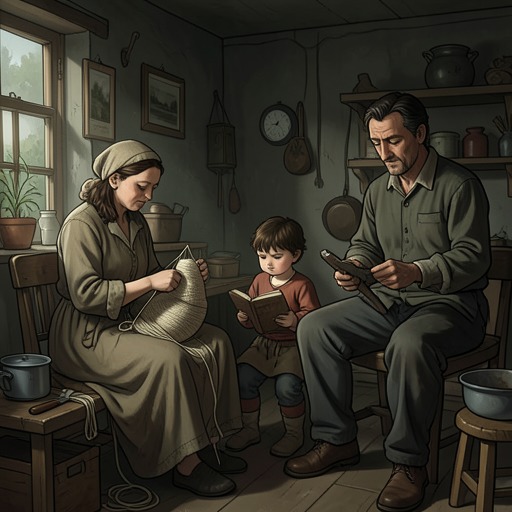
Dame Brinker
Hans Brinker, or The Silver SkatesDame Brinker holds the Brinker family together through poverty, exhausting work, and years of uncertainty about her husband’s condition. She is both its practical provider and the keeper of its memories: she cares for Raff Brinker as he is, while preserving the knowledge of the capable, cheerful man he once was. Her refusal to give up the watch he entrusted to her, even when hunger makes selling it tempting, also protects a secret that will eventually lead beyond the family’s cottage.
Identity and Household
Before the family’s long period of hardship, Dame Brinker had been known as Meitje Klenck, a pretty young woman whose holiday dress had accompanied her to dances and fairs. The children have only occasional glimpses of that dress from the old oak chest, but she brings it out on Saint Nicholas’s Eve to brighten the household. Its linen collar, blue homespun bodice, reddish-brown skirt, knitted mitts, and cap make the occasion distinct from the family’s ordinary life. Gretel Brinker regards her mother’s appearance with delight, while Hans Brinker grows quiet and well behaved as he looks on. Dame Brinker has dressed not simply for herself but in the hope of making the festival brighter for her children, and their response confirms that small act of care.
The household has been shaped by Raff Brinker’s long-lasting mental incapacity. Gretel Brinker cannot remember him otherwise than as a silent man whose eyes follow her without understanding. Hans Brinker, who was older when the change occurred, remembers a different father: strong, cheerful, affectionate, and given to singing as he carried his son on his shoulders. Dame Brinker shares that earlier memory. She recalls Raff as intelligent and dependable, a man whose judgment even the burgomaster sought. The contrast between the father she describes and the man who now sits unable to recognize his wife and children gives her care its particular grief: she tends not only to his needs, but also to the family’s knowledge of who he had been.
Work and Care
Dame Brinker supports the family by raising vegetables, spinning, and knitting. In earlier years she also worked aboard canal barges and, on occasion, joined other women hauling a pakschuyt between Broek and Amsterdam. When Hans Brinker grew strong enough, he insisted on taking over this arduous work. That change relieved his mother of some physical labor, but it did not remove the burden of the household: Raff Brinker had become so helpless that he needed her constant attention. Although his understanding was greatly diminished, he remained physically strong, and Dame Brinker sometimes struggled to control him.
Her care is made up of immediate, repetitive tasks. She watches that Raff does not hurt himself with a knitting needle, tries to keep his shoes on because his feet are often cold, and returns to her spinning when the household allows. The children’s willingness to help does not erase her responsibility; it makes their cottage a shared place of care, where Hans takes on labor and Gretel Brinker knits nearby. The festival dress and the daily work belong to the same pattern. Dame Brinker uses what little she has—an old garment, food, her labor, her attention—to sustain her family’s spirits as well as its material needs.
The Watch and the Missing Savings
The watch is the lasting object around which Dame Brinker’s memories of Raff’s accident and the family’s unanswered questions gather. On the night he first came home with it, he asked her to keep it until he requested it again. Before he could explain further, Broom Klatterboost arrived with news that the dike was in danger. Raff went out with his tools during the flood threat of Pinxter-week and returned by midnight in a grave condition. His fever eventually passed, but his mental dullness remained and worsened. Dame Brinker never learned where the watch had come from or what Raff had intended to tell her.
The unresolved watch matters alongside the family’s missing savings. During a winter when Hans Brinker and Gretel Brinker were ill, the bread was nearly gone, and Dame Brinker could earn nothing while tending them, she tried to question Raff about the money. He could not give her an intelligible answer. Even in moments of severe need, she had sometimes taken the watch from its hiding place and considered selling it, but she did not. She treats keeping it safe as a promise to her husband, and tells Hans Brinker that the family must be nearer to starvation before she will break faith with Raff. Hans responds by urging his mother to put the money from her mind, promising that he and Gretel will work and that their well-being matters more to him than silver.
Raff’s Return and the Unfinished Story
After Raff Brinker recovers enough to return to his family, the watch briefly becomes a source of distress between the couple. When Dame Brinker sees him crying, she goes to him, clasps his hands, and apologizes for pressing him about it so soon after his return. She offers to put the watch away rather than let it disturb their reunion. Raff then explains that the matter feels like speaking of the dead, and begins to recall a young man who entrusted him with the watch while fleeing his country. The man had asked Raff to deliver it to his father and send word that he might return if his father wished it. But Raff cannot remember the father’s name or the destination for the message; when he tries to recover those details, his thoughts fail him.
Dame Brinker listens, asks what she needs to know, and offers to take the watch to its owner’s father when Gretel Brinker returns. Her promise shows that she does not regard the watch merely as a family possession or a possible source of money. It carries an obligation to someone outside the household, and she is ready to act on it even though Raff’s memories remain incomplete. Later, when Peter van Holp identifies the initials as Thomas Higgs, the family’s recognition is immediate. Dame Brinker rushes about with an unlighted candle, finds Hans Brinker’s hat, and urges him to go to Amsterdam. Her response links the old mystery to a new lead without suggesting that she herself knows more than the recovered clue has established.
Later Life and Narrative Significance
In later years, Raff Brinker and Dame Brinker live comfortably in Amsterdam. Their good fortune changes their circumstances but not the qualities the narrative associates with them: they remain faithful to one another and straightforward in their prosperity, as they had been patient and trusting during hardship. They often return with their children and grandchildren to a summer house near the old cottage, where they spend pleasant afternoons by the pond. The return visits preserve a connection to the place where the family endured its difficult years, without making those years the whole measure of their later life.
Dame Brinker’s significance lies in the way domestic care carries the story’s larger changes. She sustains her children through scarcity, preserves Raff Brinker’s earlier identity when his own memory cannot, and guards the watch until its story can move forward. These are not separate acts of passive endurance: each involves a decision about what to protect, whether a child’s spirits, a husband’s dignity, or a promise whose meaning is still unknown. Her later comfort completes that arc without erasing its hardships. The woman who once measured need against the temptation to sell the watch eventually shares a secure home and family life with Raff, while the old cottage remains part of the family’s remembered landscape.