Dutch Dike Hero Legend
Hans Brinker, or The Silver SkatesThe Dutch Dike Hero Legend makes a tiny gesture carry the weight of a nation’s survival: when a boy finds water escaping through a dike, he plugs the opening with his finger and stays there through the night. The tale is presented both as a schoolroom reading and as a story passed down in Holland. Its power lies not only in the child’s courage, but in the infrastructure and communal vigilance that make his action intelligible.
The Dike and the Danger
The school lesson first explains the boy’s world. His father is a sluicer, responsible for opening and closing the large wooden gates set across canal entrances. The gates regulate how much water enters the canals; if they are mishandled, water can overflow into the surrounding country. Because much of Holland lies below sea level, dikes and sluices are not incidental constructions but essential defenses, and even a moment’s neglect can bring ruin and death.
That practical knowledge shapes the boy’s response. While walking home from a lonely ravine, he realizes that sunset has come and that he is still some distance away. He has been gathering flowers, but the darkening landscape and his recollection of frightening stories make him hurry. Then he hears water trickling. A small hole has opened in the dike, and he immediately understands that the stream could enlarge the breach and lead to a disastrous inundation. The danger is initially almost invisible; what he recognizes is the consequence that may follow if it is left unattended.
The larger setting gives this small leak national force. Holland’s dikes face both pressure from the sea and inland floods, especially during spring thaws, when ice can obstruct rivers and make them overflow. Engineers and workmen keep watch in threatened places, and inhabitants hurry to help when danger signals are raised. Against that recurring need for maintenance, the boy’s solitary vigil becomes a miniature of a society compelled to guard its boundary against water.
The Boy’s Vigil
The boy throws away his flowers, climbs the dike, and thrusts his finger into the opening. The flow stops. His first response is delight at the prospect of keeping Haarlem safe, but night quickly changes the character of the deed. He is alone, the air grows cold, and his shouts for help receive no answer. His mother has already locked the doors, intending to scold him the next day for spending the night away without permission. The ordinary domestic expectation of a child’s return home cannot reach him where he is.
As the cold intensifies, numbness and pain spread from his finger through his arm and body. He tries to whistle, but his chattering teeth prevent it. He calls on God, and the answer comes in the form of a resolve to remain until morning. The tale does not make that resolve effortless: the boy thinks of his warm bed and family, fears the night, and is unsure that he will survive it. Yet he also understands that withdrawing his finger might allow the water to rush through and sweep over the town. His endurance comes from holding those consequences in view while his body weakens.
The midnight moon illuminates his small, solitary figure seated partway up the dike. He is not asleep; one hand repeatedly rubs his aching arm, while his tearful face turns at sounds that may be real or imagined. The account dwells on the uncertain length of the watch and the boy’s physical suffering rather than presenting courage as an absence of fear. His promise to stay is tested by cold, pain, and the thought of home, and the test continues until daylight.
Discovery and Retelling
At daybreak, a clergyman returning from the bedside of a sick parishioner hears groans as he walks along the top of the dike. Looking down, he sees a child in pain on its slope and asks what he is doing. The boy answers that he is keeping the water from running out and asks the clergyman to send people quickly. The lesson says that help arrives, but the passage breaks off before giving further details of the boy’s recovery or the town’s response. Its emphasis remains on the moment when an isolated act becomes visible to another person.
The legend also crosses between settings in the novel. While children read it aloud in an English classroom, Ben is skating in Holland with Lambert van Mounen. Ben recognizes the account but has not known that the Dutch characters regard the incident as true. Lambert says he learned it from his mother and that children throughout Holland know the story. In this exchange, the legend moves from a printed lesson to an inherited national memory: it is at once a tale encountered abroad and a story embedded in Dutch childhood.
A Figure for Collective Responsibility
Lambert interprets the boy as representing the spirit of Holland. His point is that no breach—in public safety, honor, or political life—will be left without people ready to oppose it. The legend’s movement from one small finger to the readiness of a million is therefore more than a celebration of individual bravery. The child’s action offers an image for collective vigilance: a threatened boundary calls for someone to notice, someone to act, and others to come when summoned.
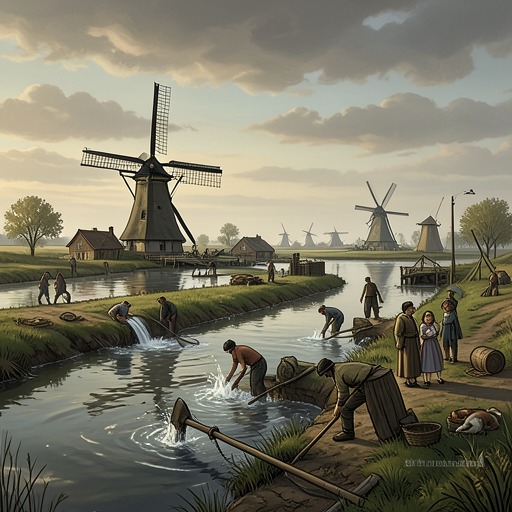
The comparison has particular force in a country where water control depends on networks of labor and machinery. Holland’s windmills pump water from lowlands into canals and help guard against inland freshets; sluices regulate flow, while dikes hold back the sea. These works demand continuing attention, not a single decisive victory over nature. The boy’s finger cannot replace that system, but the tale makes its underlying principle memorable: a small opening matters because it belongs to a larger, shared defense. In the skating scene, Ben reacts to the scale of Lambert’s claim, while Lambert quietly insists on its truth. The contrast between the child’s modest act and the country’s expansive self-understanding is the legend’s central turn.