Gretel Brinker
Hans Brinker, or The Silver SkatesGretel Brinker is the younger child of Dame Brinker and Raff Brinker, and the sister whose skating victory becomes one of the Brinker family’s clearest reversals of fortune. At twelve, she is quick and lithe, but her life is shaped less by youthful opportunity than by poverty and her father’s long incapacity. She helps sustain her household, gives her brother’s ambitions precedence over her own, and ultimately wins the Silver Skates through her own ability. In adulthood, the child once treated as a poor goose girl is remembered as a beloved member of her family and community.
Identity and Early Life
Gretel first appears with Hans Brinker on a frozen canal in Holland, where the two thinly clad children are skating on a bright December morning. When their mother calls them home, they obey despite the growing number of skaters and the pleasure of remaining on the ice. Gretel is twelve, three years younger than Hans. He is described as solid and broad-shouldered; she is smaller, lithe, and quick. The contrast introduces a brother and sister who share a childhood but will have different opportunities to pursue their ambitions.
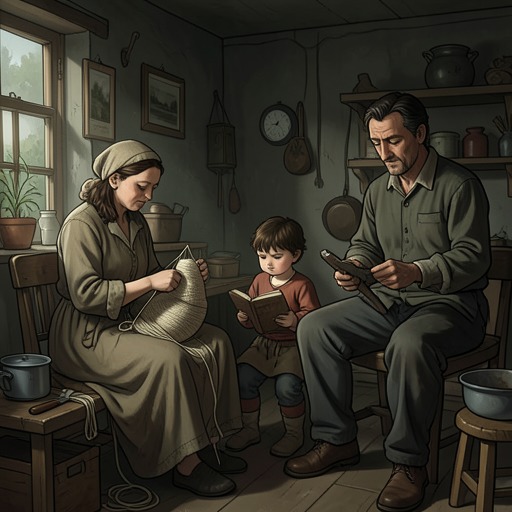
Their home is a cottage, and the family’s circumstances are precarious. Dame Brinker earns a scant living by raising vegetables, spinning, and knitting, while Hans has taken over difficult work once performed by his mother. Raff Brinker, formerly a capable and cheerful father, has become so helpless that he needs constant care. Gretel cannot remember him as he was before his injury: to her, he has always been the silent man whose eyes follow her without recognition. The loss is thus part of her ordinary life, not merely a later shock.
Family Care and Self-Denial
When Hans brings home money intended to help him obtain skates, Gretel presses him to accept the gift for himself. She argues that she does not need the money and that the skates might serve her when she is older. Hans has long wanted a good pair and believes he could compete well, but he notices that Gretel’s natural ability could make her an especially strong skater with proper equipment. He decides she should have the money for skates instead. Gretel protests that the young woman gave it to Hans, not to her; his resolve holds. The exchange establishes both her reluctance to claim a scarce resource and Hans’s willingness to recognize her ability even when doing so costs him his own chance.
That generosity takes on greater weight when Raff suffers a grave crisis. While Hans has gone to seek Dr. Boekman, Gretel does what she can at home: she cleans the rough brick floor, brings peat for the fire, melts ice for her mother, and tries to persuade Dame Brinker to rest. Her attention is practical and directed toward her exhausted mother, who remains beside her husband. The children’s care for their parents is not presented as a single brave gesture but as work demanded by the family’s circumstances.
Four days later, Raff remains unresponsive while Dr. Boekman prepares to operate. Gretel watches him take sharp instruments from a leather case and fears that he may be about to harm her father. The scene registers how little she can know or control: she sees the instruments, but not the doctor’s purpose. At this point, she is worn down by worry and fatigue. Hilda van Gleck finds her lying outside in the cold and firmly gets her up, preventing her from remaining there. The intervention gives Gretel a moment of safety while the crisis in the cottage continues.
Her Father’s Awakening
After the operation, Gretel returns quietly to her mother’s side. The room is still, Dame Brinker watches the bed anxiously, and Dr. Boekman waits as Raff begins to move. When Raff recovers his awareness, the passage of ten years becomes visible to him in the changed ages and appearances of his wife and children. Gretel is no longer the small child he remembers. Her response is immediate: she throws her arms around his neck and reassures him that the family is there. Raff answers with a blessing and recognizes that he had forgotten them.
For Gretel, this reunion answers a hope that has structured her life. She has spent her childhood beside a father who could not know her, and the family’s care for him has not guaranteed that he would return to himself. His awakening therefore changes the household’s emotional reality as well as its practical future. The story associates her joy not with a speech or explanation but with her embrace and the recognition restored between them.
The Race and the Silver Skates
Gretel’s skating opportunity develops from the earlier choice to give her Hans’s money. At the competition, twenty girls are lined up for the first run. Gretel appears among them in a red jacket, a new brown petticoat, and a new cap; Hilda van Gleck speaks pleasantly with her. The narrator contrasts her appearance at the event with the poor child others had known. Her place on the starting line makes her ability public, while the presence of Rychie Korbes, Katrinka Flack, and Hilda sets her among established competitors.
In the one-mile race, Gretel skates past the spectators’ pavilions and waves toward no privileged viewing place. She hears her father’s encouragement, and the narrative makes that family connection her focus as she advances. Katrinka briefly takes the lead, but Gretel passes the competitors and wins. In the later decisive race, she is no longer merely playing: an inward determination has made her continue until she crosses the goal. The announcement that she has won the Silver Skates confirms the result, while the crowd’s response marks a change in how she is regarded. The child dismissed as a goose girl is acknowledged as the queen of the skaters.
The prize scene extends beyond individual triumph. Gretel and Peter van Holp stand together at the center before Madame van Gleck’s pavilion; Gretel trembles as Madame van Gleck rises, then cries out when a dazzling award is placed in her hand. Peter also holds an award, and the silver skates catch the light before their happy faces. Gretel’s victory belongs to her, but the public ceremony places it within a wider circle of recognition and shared celebration.
Adulthood and Narrative Significance
The book’s closing view of Gretel measures her life beyond the race. Dr. Boekman regards her as Amsterdam’s finest singer and loveliest woman; Hans Brinker and Annie Bouman regard her as a devoted sister; her husband sees her as a cherished wife. Dame Brinker and Raff Brinker look on with joyful tears, and the poor are said to bless her. The account presents these adult identities as the long unfolding of the child’s character, rather than as a substitute for the achievement that first made her publicly known.
The Van Glecks, too, continue to remember the small, trembling child who won the Silver Skates. That memory preserves the disparity between Gretel’s former poverty and her later recognition without reducing her to either condition. Her arc links domestic care, a brother’s sacrifice, recovery within the family, and athletic accomplishment. She begins as a child whose needs are easily overlooked; she ends as a figure valued by her family, celebrated on the ice, and remembered for both her victory and the person she became.