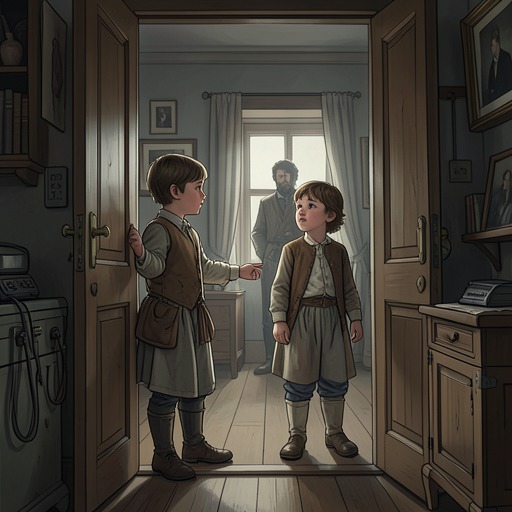
Gretel Brinker—Raff Brinker
Hans Brinker, or The Silver SkatesGretel Brinker—Raff Brinker is a bond under strain, not a simple story of filial devotion. As Raff lies sick and moaning, Gretel tries to understand how she can fear her father and still love him. Her distress grows from the memory of his violence toward Dame Brinker, but it does not cancel her tenderness. Instead, his illness forces her to recognize that both feelings are real.
Fear and attachment
Gretel’s first reckoning is private: she wonders whether it is wicked to care more for one parent than the other. She is certain that she dreads Raff, while her love for Dame Brinker feels almost like idolatry. This contrast reflects the different kinds of closeness the scene gives her. She clings to the mother who patiently keeps watch, yet cannot regard her father’s suffering with indifference.
The comparison with Hans Brinker sharpens Gretel’s uncertainty. She knows that Hans loves their father strongly and does not fear him as she does. Gretel cannot match that confidence, but she remembers crying when Raff’s hand bled after he snatched a knife the previous month. Now, hearing him moan, she feels pain throughout herself. She reasons that perhaps she does love him after all—almost as Hans does, though not quite. Her affection is not presented as proof that her fear was mistaken; the two emotions remain side by side.
The sickroom and the remembered violence
Raff’s illness gives this conflicted relationship its immediate stakes. Gretel fears that the sickness may continue and that the family may lose the chance to skate in the race. More gravely, she does not want her father to die and become blue and cold, as Annie Bouman’s little sister had. She prays that he will live. The thought that he might open his eyes and tell them where Dame Brinker’s missing guilders went also enters her distress, but Gretel recognizes that his life matters to her beyond the answer she might receive.
Her memory of violence makes that attachment harder to admit. Gretel tells her mother that Raff tried to burn her and that she saw him laughing. The account links her fear to a specific act, rather than to an unexplained dislike. A hole in Dame Brinker’s holiday gown, burned during the incident, remains visible as Gretel plucks at its jagged edge. The damaged wool garment gives the remembered danger a material presence in the sickroom, even while Raff lies too unresponsive to take in what is said around him.
A love she struggles to name
Gretel calls herself wicked before she explains why: she believes her fear and her unequal attachment make her a bad daughter. Her mother answers with reassurance, describing her as patient and good, but Gretel insists there is something her mother does not know. The confession exposes the difference between how others see her and how she judges herself. Her distress is not simply sorrow at Raff’s illness; it includes shame about the feelings his conduct has produced in her.
The scene does not resolve that shame by erasing the injury. Gretel’s mother sharply hushes her when she speaks of the attempted burning, and Raff twitches slightly, although he is otherwise insensible to what is happening around him. Gretel then falls silent and returns to the burned edge of the gown. The gesture leaves her accusation present without turning it into a confrontation: the father she fears cannot answer, and the daughter who loves him cannot make herself forget what he did.
The relationship’s emotional significance
Gretel’s bond with Raff is distinguished from Hans’s by fear, but not emptied of affection. Her memory of the bleeding hand, her bodily ache at his moaning, and her prayer against his death all give that affection concrete form. At the same time, the burned gown and her recollection of Raff laughing prevent the scene from offering an uncomplicated reconciliation. Love emerges as something Gretel discovers within herself, not as a judgment that her father’s violence was harmless.
That tension makes the sickroom an important moment in Gretel’s understanding of her family. She can love Raff without loving him as Hans does; she can fear him and still grieve at the thought of losing him. Her relationship to her father therefore becomes a struggle to hold compassion and hurt together, while her closeness to Dame Brinker remains the refuge from which she tries to make sense of both.