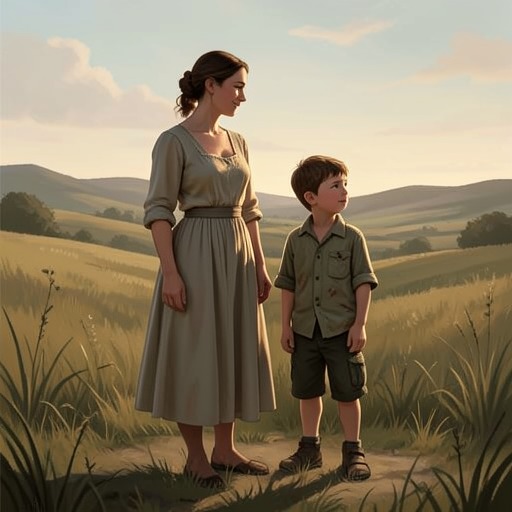
Hans Brinker and Annie Bouman’s marriage
Hans Brinker, or The Silver SkatesHans Brinker and Annie Bouman’s marriage is revealed in the novel’s closing glimpse of their adult lives: Hans has become a famous physician, and Annie, once a frank-hearted peasant girl, is now his wife. The brief account gives their union its force through the distance it spans—from the hardships of Hans’s youth to the secure family life he has made—without supplying a courtship narrative.
Identity and Background
The closing passage identifies Annie Bouman as the beautiful, frank-hearted peasant girl of Hans’s earlier life and names her as Annie Brinker, the wife of the celebrated Dr. Brinker. It presents continuity rather than a transformation of character: the narrator says that as Hans’s wife she remains very like the young woman he knew, while describing her as still lovelier and wiser. The comparison preserves her earlier identity even as marriage places her within Hans’s later household.
Hans’s adult standing is part of the relation’s meaning. By the time the narrator looks in on the couple, he is a famous doctor who travels in a grand coach to visit patients. That public success contrasts with the family’s earlier poverty: his mother had spoken of the stolen money that had not been seen since the day before his father’s injury, and of searching the cottage without finding it. The ending therefore locates the marriage in a life changed by years of effort, not in the ease of an uncomplicated beginning.
From Youth to Shared Adulthood
The novel does not recount how Hans and Annie became a couple or specify when they married. Instead, it moves directly from Hans’s years of determined work to the settled image of him and Annie as husband and wife. Hans’s path is described as rugged but sustained: he meets obstacles without abandoning his purpose, and his enduring conviction that surgery is a noble calling gives his professional life a moral dimension. Annie’s place beside him belongs to the future that this persistence has made possible, although the passage does not claim that the marriage caused or enabled his career.
The portrait also looks beyond the couple to their family. Hans may be seen skating with his own boys and girls on a frozen canal, an image that places the doctor’s household back within the winter world that shaped his youth. The coach and the skates hold different parts of his adult life together: professional responsibility in the city and family companionship on the ice. Annie is not separately described in that skating scene, but the preceding identification of her as his wife establishes her as part of the family life surrounding him.
The Marriage in the Ending
The marriage appears not as a dramatic resolution to a romantic conflict but as one element in the narrator’s final accounting of what time has brought. The account pairs Hans and Annie with Peter van Holp and Hilda van Gleck, whose marriage the narrator likewise presents as the continuation of their earlier companionship on the ice. In contrast, the narrator recalls having nearly suggested that Katrinka Flack and Carl Schummel would marry, then clarifies that Katrinka remains single. These brief outcomes distinguish an actual shared future from a possibility the story never fulfills.
The narrator’s retrospective tone makes Hans and Annie’s marriage a sign of continuity amid change. Annie is recognizable across the divide between her youth and married life; Hans’s vocation and household, meanwhile, register the distance he has traveled from a boy facing hardship. Their union is affirmed through the simple fact of their shared adult life, rather than through an account of how love began.